Original topic illustration: ChainView BTC866 original topic diagram · ChainView BTC866 Editorial · CC BY 4.0
Inputs are not account debits
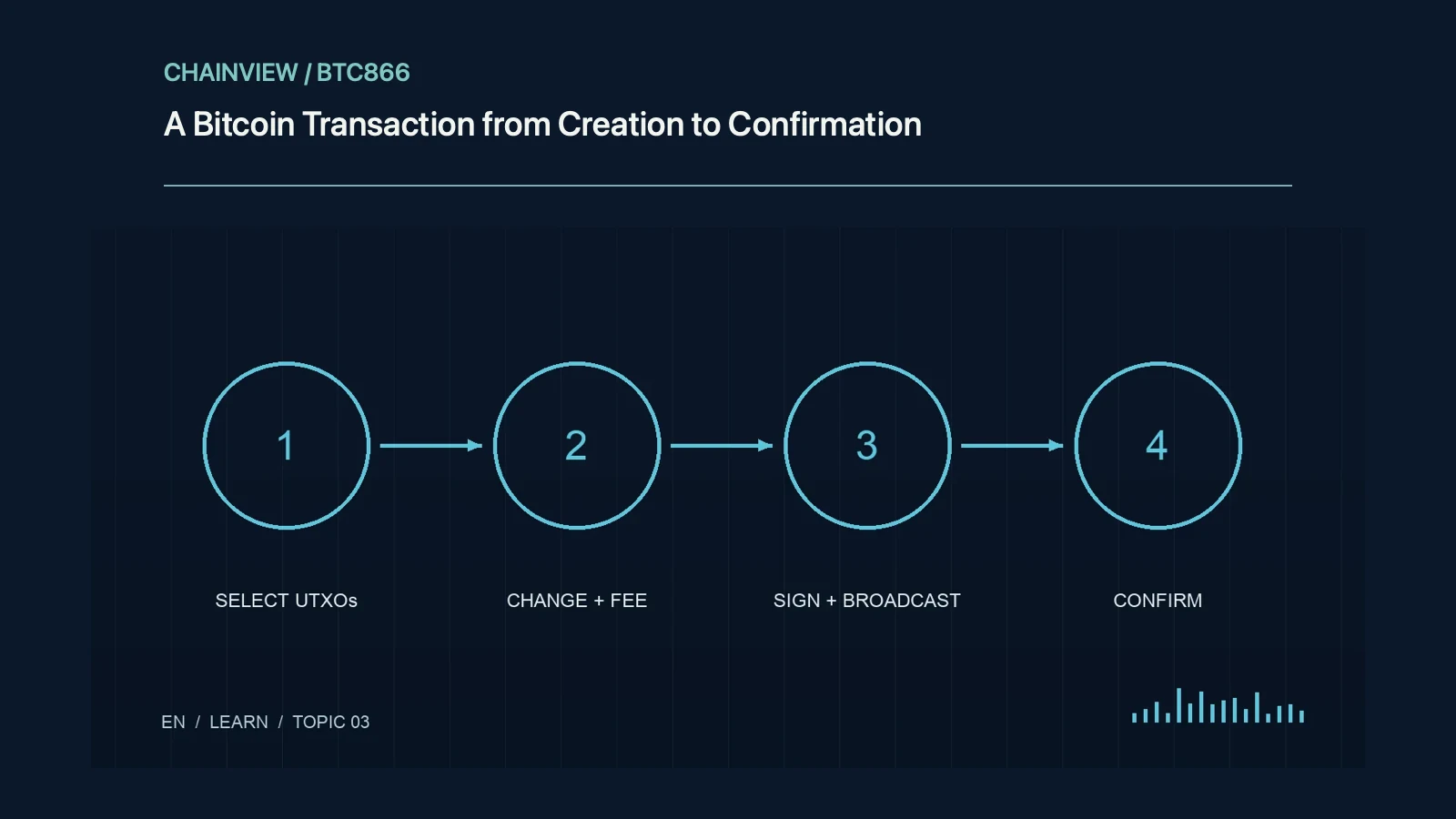
Bitcoin transactions consume earlier unspent outputs and create new ones. A wallet balance aggregates spendable outputs rather than updating a bank-style account field. Inspect a simple public transaction and record references, output indexes, and values. Learn why an input is spent whole and why change is typically created as a separate output.
Change and fee accounting
For ordinary transactions, input value minus output value is the fee. Some outputs may be change, and explorer heuristics can misidentify them. Calculate in integer satoshis and distinguish absolute fees from fee rates. Costs depend largely on transaction size and block-space demand, not simply a percentage of the transferred amount.
Signatures satisfy spending conditions
Signatures authorize spending under the output conditions, which nodes verify alongside other rules. Multisig and timelocks require more than a simple address model. Authorization does not make a recipient trustworthy. Before broadcast, compare network, full destination, amount, and total fees, including an independent hardware display where available.
Broadcast and mempools
Mempools differ across nodes; there is no perfectly uniform global waiting queue. Fees, conflicts, and policy can affect acceptance or eviction. Use the transaction hash to distinguish unbroadcast requests from unconfirmed transactions. An interface spinner is not sufficient evidence that payment failed or that another payment should be sent.
Observe inclusion and confirmations
Miners propose blocks and nodes validate them. Record inclusion height and hash, then observe subsequent confirmations. Reorganizations can change inclusion, so recipients set acceptance policies. An exchange can credit later for its own review reasons. Keep blockchain inclusion and platform-credit timestamps separately to locate the actual source of delay.
Practice on historical data
Use a public example unrelated to your private activity to tabulate inputs, outputs, change assumptions, fee, size, and timing. Separate facts from ownership guesses. No purchase or recovery-phrase entry is needed. Once you can reconcile the example, consult your wallet documentation about fee adjustments and conflicting transactions rather than assuming universal support.
Worked review example
Inputs of 70,000 and 50,000 satoshis and outputs of 80,000 and 39,000 imply a 1,000-satoshi fee. Ownership and change attribution remain separate questions. Divide by virtual size to obtain the fee rate and compare with the wallet display. These teaching numbers require no real transfer and do not identify a live transaction or recipient.