Original topic illustration: ChainView BTC866 original topic diagram · ChainView BTC866 Editorial · CC BY 4.0
What the two clients validate
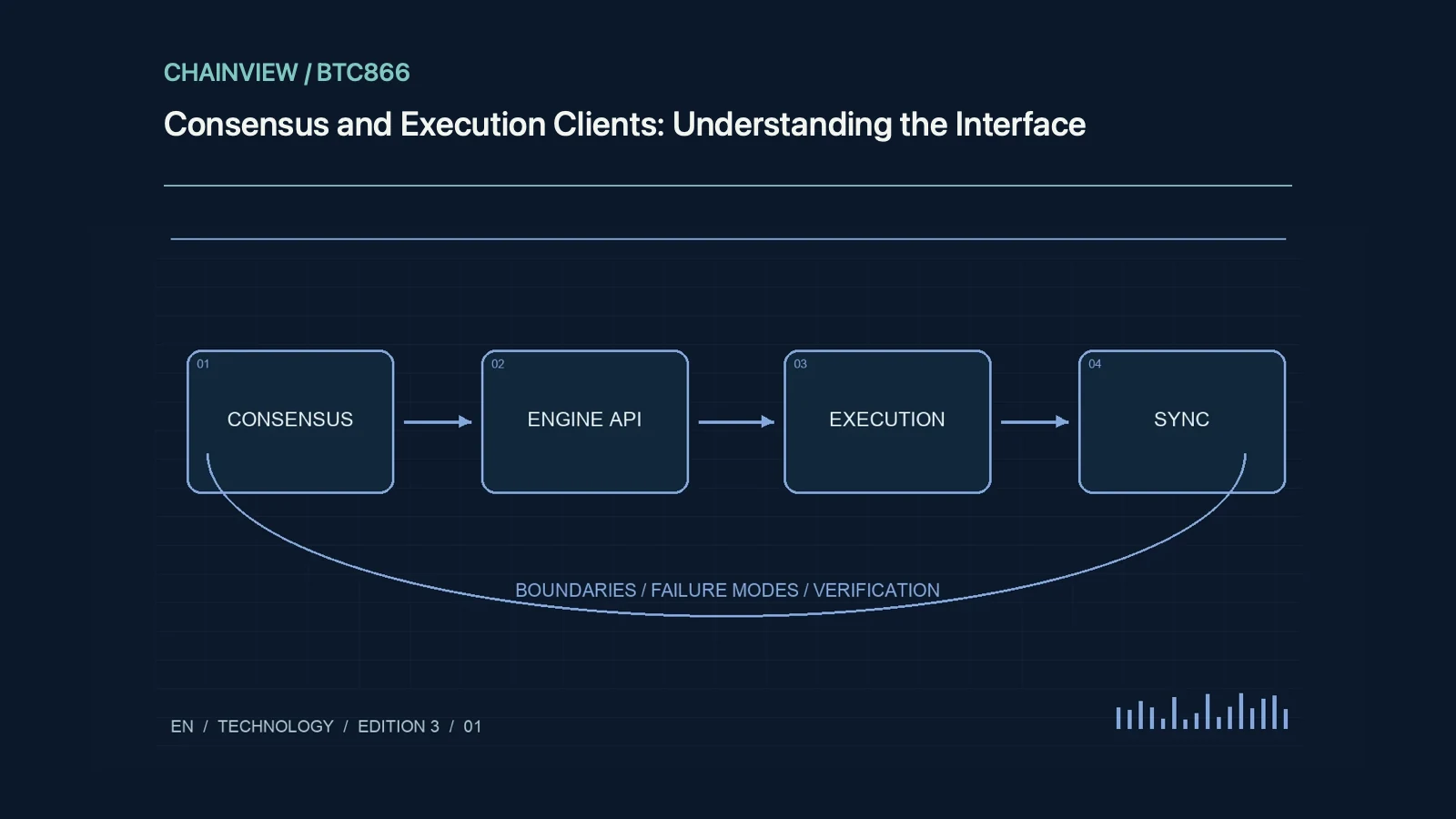
Ethereum's execution client processes transactions and validates state transitions; its consensus client handles consensus messages, chain choice, and finality. Validator signing has separate keys and operational duties. Map these components instead of calling every process simply a node. A running execution process does not prove consensus synchronisation. A wallet response containing an old balance also does not establish that the queried node is serving the current canonical state.
Engine API and trust boundaries
The Engine API exchanges payload and chain-head information between clients. Authentication does not make it safe to expose publicly; restrict bind addresses and network access. User JSON-RPC, consensus APIs, and the Engine API have different roles and privileges. Keep proxy rules distinct. Preserve error codes and timestamps while redacting secrets. A successful API request is evidence about that request, not proof of whole-network health.
Compatibility and synchronisation checks
Review supported client pairs, network parameters, migrations, and known issues before upgrading. Monitor execution height, consensus slots, peers, finality delay, and resources against an independent reference. Clock drift, full disks, and firewall errors can resemble protocol failures. Validator operators also need duty monitoring and duplicate-signing protection. Restoring the same signing key onto simultaneously active machines can create slashing exposure rather than improve resilience.
Diagnose with layered evidence
If transaction RPC works but finality stalls, inspect consensus sync, inter-client connectivity, and network-wide conditions separately. Record both versions, relevant configuration, heads, and times before intervening. Repeated broadcasts or blind database rebuilds may worsen recovery and destroy evidence. A useful handover identifies which layer passed which check and what remains unknown, allowing another operator to reproduce the diagnosis rather than merely repeat a restart.