Original topic illustration: ChainView BTC866 original topic diagram · ChainView BTC866 Editorial · CC BY 4.0
Start with unspent outputs
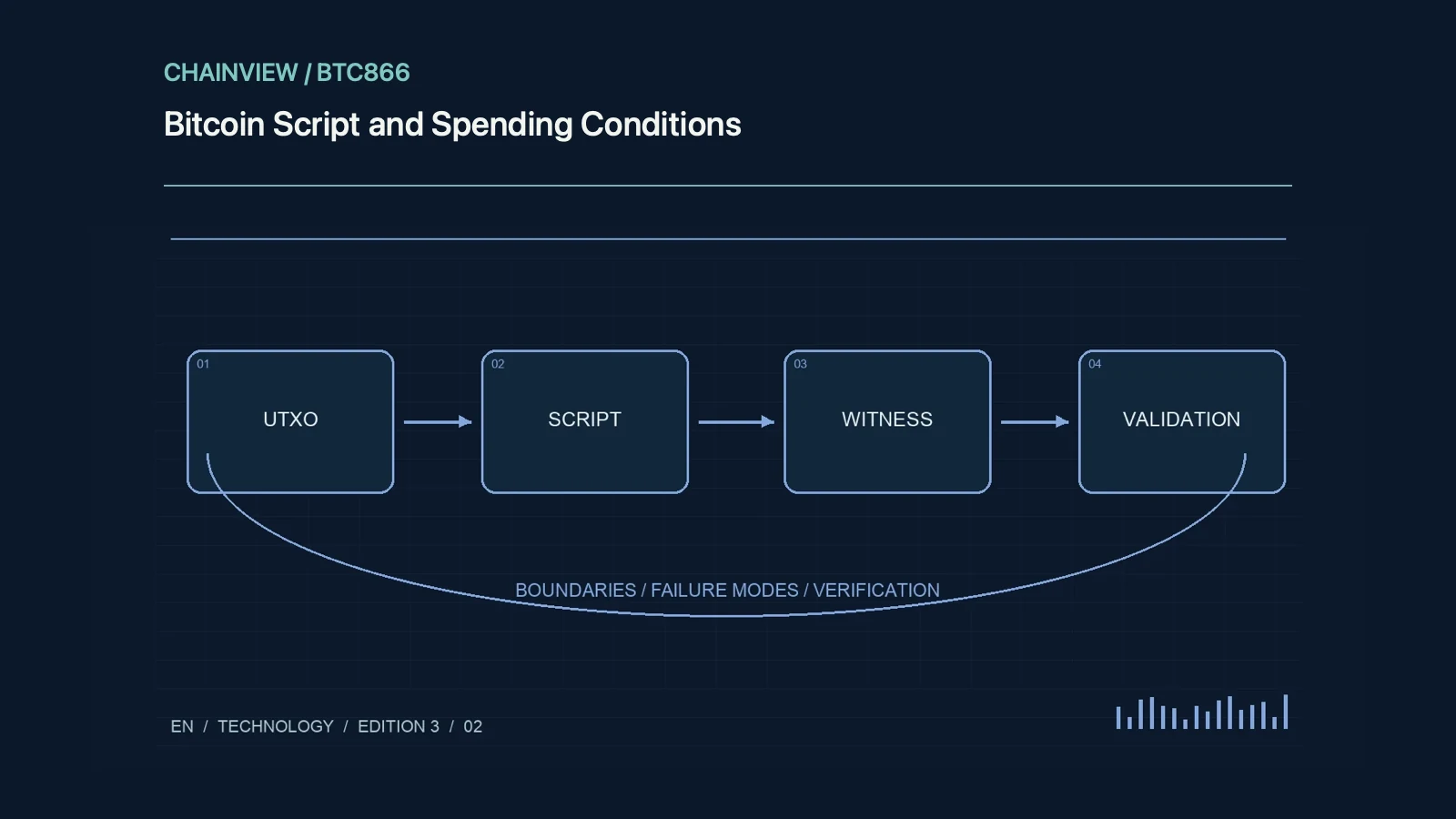
Bitcoin consumes existing UTXOs and creates new outputs with values and spending conditions. An address encodes a supported receiving construction; the network does not maintain a conventional account balance for it. Spending requires the relevant conditions and material under consensus rules. Public historical transactions are enough for practice. Address labels and common change heuristics do not conclusively establish ownership, and should remain separate from script-level validation.
Scripts and witness material
Output types use different script and witness arrangements for signatures, keys, and other satisfaction data. Bitcoin Script is constrained, and one signature does not necessarily authorise every input. Signature algorithms and hash flags affect commitments. A multisig label is not proof of its threshold or key ownership. Inspect verifiable scripts and revealed data, recognising that an unspent output may expose only a commitment rather than its complete future spending path.
Timelocks are not scheduled payments
A timelock restricts validity; it generally does not construct or broadcast an automatic payment. Absolute and relative locks use different references, including height or time under specific rules. After a threshold, signing, broadcast, fees, and inclusion may still be needed. Distinguish eligible to spend, broadcast, included, and sufficiently confirmed. Calling a timelock a guaranteed delivery time hides congestion and competing-spend considerations.
Back up the recovery conditions
An address alone may not recover keys, descriptors, derivation paths, or cooperative policy. Multisig and complex scripts need documented thresholds, participating public keys, and tested recovery steps. Keep private material out of public examples. Having some signing keys but losing the complete policy can still impede recovery. Script education should clarify control and backup boundaries, rather than encourage large deposits into unfamiliar hand-built constructions.