Original topic illustration: ChainView BTC866 original topic diagram · ChainView BTC866 Editorial · CC BY 4.0
Mechanism and observed state
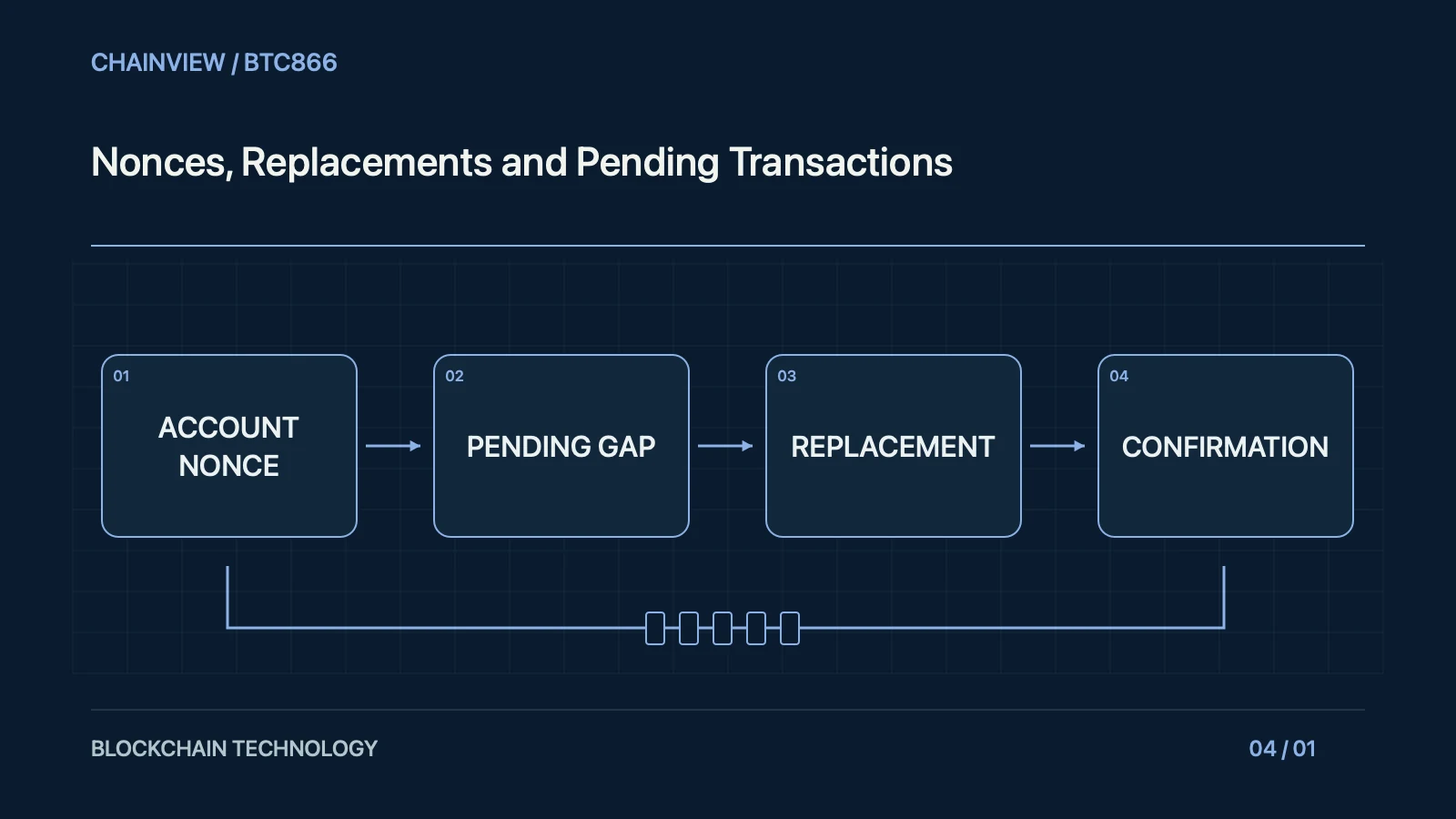
An Ethereum account nonce orders its outgoing transactions; it is not a count of successful business actions. A higher-nonce transaction can wait behind a lower one, creating a visible gap. Queries using latest and pending can disagree because nodes observe different transaction pools. Record the account, chain, confirmed nonce, candidate nonce, and every hash. A wallet's waiting list is one local presentation rather than a universally agreed queue.
For example, if the confirmed sequence ends before a missing candidate, inspect that lower position before accelerating a later one. Compare observations from named endpoints at recorded times. A pending count can include transactions visible to one node but absent from another, so the count is an observation with provenance rather than a universal queue length.
Validation workflow
A replacement normally competes for the same nonce and must satisfy the receiving node's fee-bump policy and transaction-type rules. A higher maximum fee is not the same as paying that amount, nor does it ensure immediate inclusion. Acceleration generally creates another signed candidate instead of editing an already broadcast transaction. Keep the original and replacement hashes, fee fields, submission times, and node responses so that the eventual winner can be identified.
Place the original and replacement fields side by side before signing. Confirm that the intended fee change did not alter value, recipient, or call data. If the wallet or node does not support replacement for that transaction type, follow its documented route. Experience with another network is not evidence of identical acceptance or pricing policies here.
Authority and execution limits
Cancellation is also commonly a competing same-nonce transaction. The original can be included before the cancellation, so a button cannot undo a confirmed transfer. Deleting a wallet entry changes the interface rather than chain history. Review recipient, value, data, chain, and fee fields of the proposed cancellation. A transaction named cancel still needs ordinary scrutiny, particularly if a third-party site offers to prepare or sign it.
After a cancellation appears successful, identify which hash actually consumed the nonce and whether the intended business action occurred through any other transaction. A wallet marking an entry cancelled does not cancel a separate exchange order or application obligation. Reconcile chain state and off-chain business records independently before declaring the entire workflow closed or repeating its original action.
Diagnosis and testing
After a timeout, query a reliable endpoint for the confirmed nonce, receipt, and relevant state changes before doing anything else. Resending the same payment with a new nonce can result in two valid transfers. A node not finding a hash is not conclusive evidence that the transaction never propagated. Synchronisation delays, differing pool visibility, replacement policies, and reorganisations can all affect observations. Distinguish unknown, pending, replaced, and confirmed states explicitly.
Multiple devices or automated senders using one account can create nonce collisions. Record each sender and coordinate a pause in new submissions during diagnosis. Otherwise a manual fix can replace an automated candidate or be superseded immediately. Increasing fees repeatedly without controlling concurrent senders can obscure the cause and create unnecessary expense without resolving the sequence problem.
Outcome and evidence
A useful incident record includes wallet version, RPC source, fee parameters, nonce, submission time, all candidate hashes, and the final receipt. Start with read-only checks and map each nonce gap individually. For a contract call, changed state may make the original action invalid even if its fee is increased. Fee replacement addresses candidate competition; it does not repair insufficient balances, incorrect permissions, expired conditions, or a contract's own business logic.
The final incident summary should distinguish confirmed, replaced, not observed, and still pending candidates, with query times. Do not erase failed candidates merely to make the interface tidy: they can explain fees, retries, and support questions. Archive them while keeping the final state easy to read, preserving a complete trail from original intent to the transaction that actually executed.