Original topic illustration: ChainView BTC866 original topic diagram · ChainView BTC866 Editorial · CC BY 4.0
Mechanism and observed state
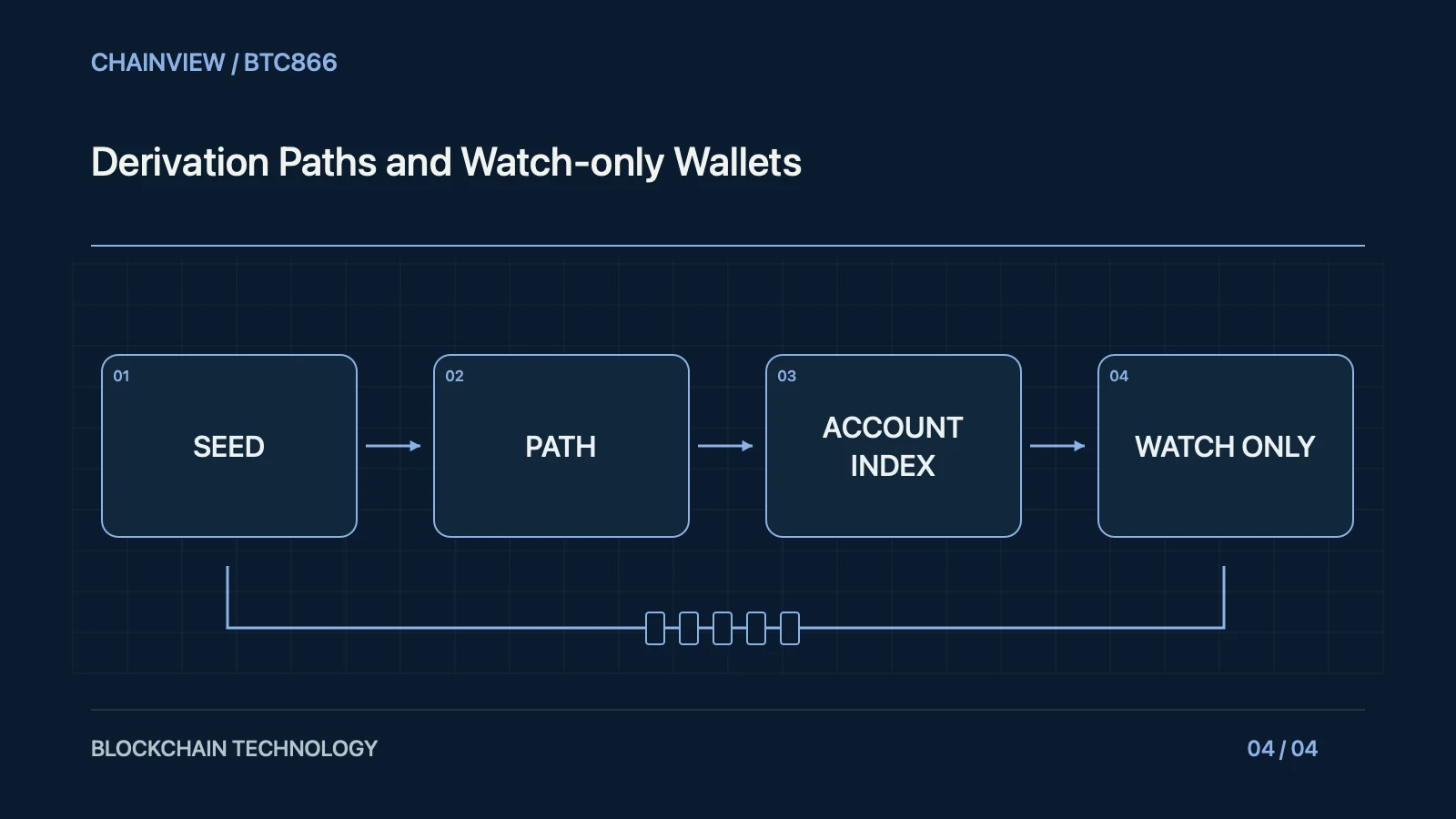
A recovery phrase can derive many accounts and address types. Restoring the intended wallet can also require the correct network, derivation path, account index, and script or address format. An empty display may mean that the wrong branch was opened rather than that assets disappeared. Retain the old wallet's name, version, known public addresses, and networks used. Consult official compatibility notes before entering secrets anywhere, especially a website advertised as a recovery utility.
A known public address is a useful anchor for testing whether a candidate configuration matches the original wallet without revealing secrets first. Record its address type and the account label that produced it. Receiving addresses, change addresses, and addresses from another network should not be mixed casually. This public comparison narrows troubleshooting while preserving the separation between observation and spending authority.
Validation workflow
BIP32 describes hierarchical deterministic keys, while conventions such as BIP44 organise path levels. Wallet implementations and historical versions can still differ. Record the literal path and distinguish a user-interface account number from its underlying zero-based or one-based index. Compare behaviour with a harmless test account first. Importing a production seed into several unfamiliar tools to discover the right path multiplies exposure and is not a sound troubleshooting method.
A note saying account one is ambiguous because interfaces can number accounts differently. Preserve the standard path text, software version, and address type in a location separate from secret recovery material. Configuration metadata still has privacy value and should be shared selectively. Good documentation makes recovery reproducible without collecting every sensitive element into one easily copied package or public support post.
Authority and execution limits
An extended public key can derive public addresses for a defined branch and generally cannot spend funds by itself. It nevertheless reveals address linkage and financial history. Before giving an xpub or similar key to a tracker, review its scope, retention policy, and access controls. Copied public information cannot reliably be recalled later. Prefixes and address-script conventions can also affect interpretation, so an arbitrary extended public key is not a universal address list that every wallet will interpret identically.
An extended public key exposed together with certain non-hardened child private keys can create additional risks depending on the derivation structure. Avoid calling an xpub absolutely harmless under every combination of leaked material. Apply minimal disclosure and do not give an unnecessary service a complete branch. The inability to spend from an isolated public key does not erase the consequences of combining it with other compromised information.
Diagnosis and testing
An optional passphrase participates in derivation together with the recovery words. A mistyped passphrase can open another structurally valid wallet rather than producing a clear error. It is not necessarily the same thing as an application's login password. Protect it according to a deliberate backup plan and never reveal it through support chat, screen sharing, or a recovery form. Necessary configuration metadata is useful, but storing every secret and address relationship together in one cloud document creates a concentrated failure point.
Passphrase case, spaces, input methods, and character handling can matter, subject to wallet specifications. Do not test alternatives in online forms advertised as recovery helpers. Backup verification should use trusted devices and harmless rehearsal procedures. If a valid-looking empty wallet appears, preserve the configuration and compare known addresses rather than assuming that a support agent needs the phrase to diagnose the issue.
Outcome and evidence
A watch-only investigation starts by comparing known public addresses with candidate configurations using trusted compatible tools. Check historical receipts and the network before concluding that a path is wrong. If an address-gap limit affects scanning, understand why the tool stopped rather than increasing ranges blindly. Preserve the configuration and public evidence that reproduce the result. When seeking qualified assistance, describe symptoms and public metadata first; do not begin by surrendering the seed, optional passphrase, or remote control of the device.
Finding the expected address does not require immediately moving all assets to prove recovery. Begin with read-only historical checks, and plan a controlled migration separately if needed. Public addresses and error descriptions can support assistance without disclosing material that combines into full recovery authority. A successful result should document the compatible configuration and its public evidence while keeping the secret elements outside the troubleshooting record.