Original topic illustration: ChainView BTC866 original topic diagram · ChainView BTC866 Editorial · CC BY 4.0
Mechanism and observed state
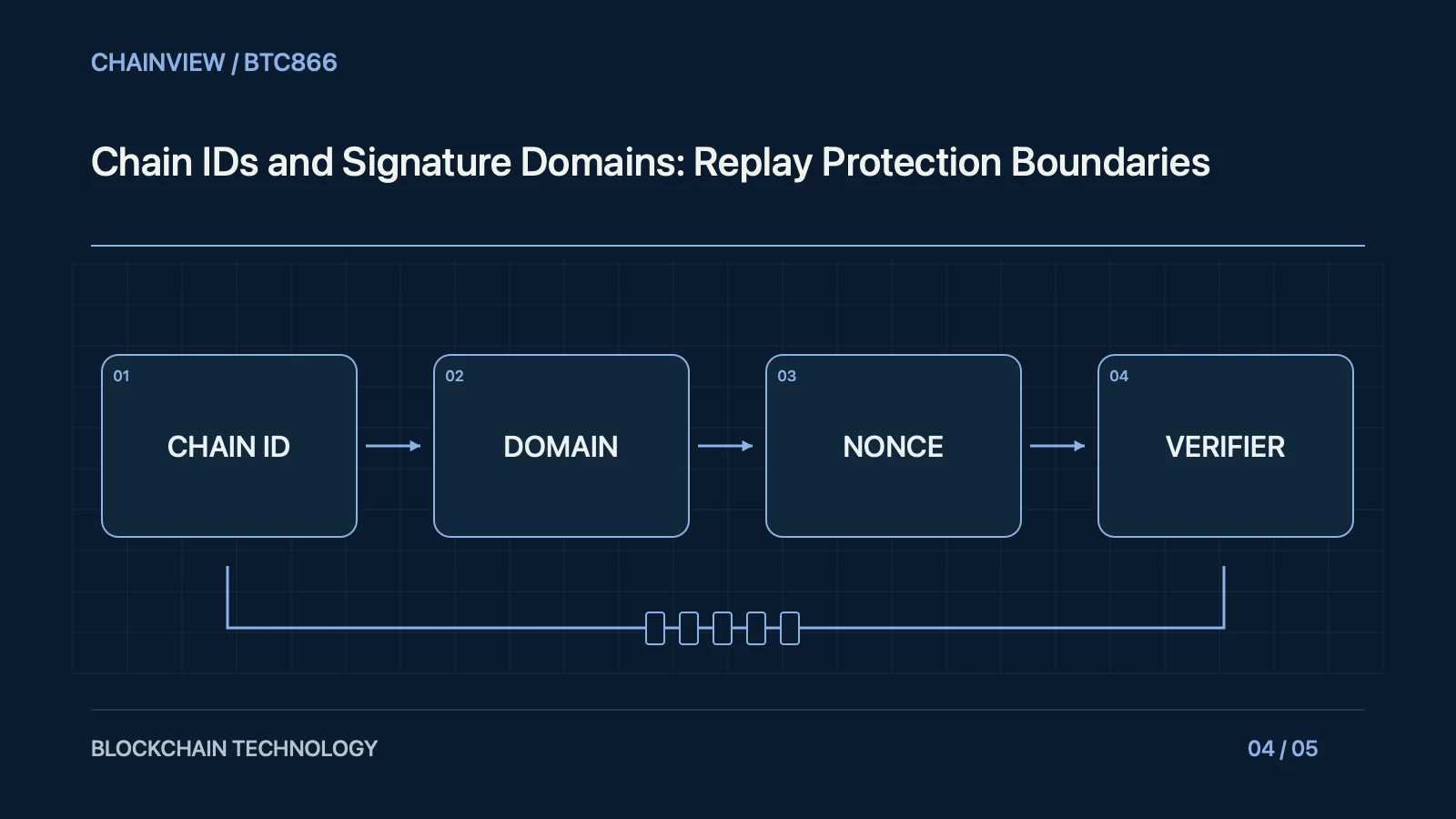
A chain ID is an identifier, not a quality certificate or proof that an RPC endpoint is officially operated. EIP-155 binds certain transaction signatures to a chain identifier to reduce cross-chain replay, but transaction types, implementation, and chain configuration still matter. When adding a network, verify the RPC, chain ID, and native asset against trusted documentation. A wallet accepting a set of parameters does not establish that the network or endpoint is trustworthy.
Compare chain ID with chain name, RPC provenance, and explorer documentation, and pause network addition if they conflict. A numeric identifier can be reused through misconfiguration. Its presence does not imply global governance certification or that an endpoint cannot observe requests. Distinguish replay-related fields from privacy and node-trust questions when explaining the network setup to a reader.
Validation workflow
EIP-712 structured-data signing uses a domain mechanism distinct from transaction replay protection. A domain can include an application name, version, chainId, and verifyingContract, but the application and contract must actually check the intended fields. A familiar application name can be copied. Review the requesting origin and complete domain rather than treating a readable title as authentication. The existence of a standard does not prove that every deployment follows it correctly.
Implementations can select different domain fields, so distinguish what the standard permits from what the deployed application actually uses and validates. Explain missing fields through evidence rather than filling them in from an attractive wallet layout. An application name is also not the same as authenticated web-domain ownership. Both the requesting origin and the signed domain need their own checks.
Authority and execution limits
The action itself also needs review: recipient, asset, amount, spender, expiry, and nonce can determine its effect. A readable message may authorise a valuable transfer, and a signature requiring no immediate gas payment can still have financial consequences. For permit-style permissions, establish who may use the authority, its amount, and its lifetime. Wallet rendering may omit or fail to explain fields fully. An unclear request is a reason to pause, not a reason to approve because the button appears familiar.
The economic effect depends on the receiving contract rather than only a displayed zero value. Batches, unlimited amounts, and messages submitable by another party require an understanding of their conditions of use. An unclear field can justify refusal and a request for official explanation. The absence of a gas charge at signing time says little about what a later submitted authorisation can permit.
Diagnosis and testing
A harmless demonstration compares test messages that differ only in chain ID, verifying contract, or nonce and observes their resulting digests. That exercise explains a mechanism without proving the safety of a live application. Duplicate chain configuration, omitted validation, or acceptance by another contract can undermine an expected boundary. A failed simulation is not permanent protection against later state or implementation changes. Document what the test establishes and what requires code review or deployment-specific evidence.
A test report should list changed inputs, expected results, encoding-tool versions, and observed outputs without publishing production-valid authorisations. Standard test vectors can help assess encoding consistency, but they do not review business permissions or prove a deployment's correctness. Keep the demonstration's scope narrow so that a successful digest comparison is not promoted into a complete security assessment of an application.
Outcome and evidence
Preserve the requesting origin, domain, action parameters, and application version while avoiding publication of a still-valid authorisation signature. Whether a signed message can be revoked depends on the contract's rules; deleting browser history does not invalidate it. After an unintended signature, inspect relevant allowances, nonce state, and revocation options through trusted tools and official support. Explain the standard's intended function separately from implementation responsibility, so readers understand replay protection as a conditional control rather than a universal safety guarantee.
Where revocation or nonce invalidation is supported, confirm that the relevant state change completed and covers the intended authority. Logging out does not normally invalidate an already signed message, and expiry needs the actual contract's time rules. Describe the evidenced state rather than declaring all signatures cleared. Preserve the incident timeline while keeping any still-usable signatures away from public reports or unrestricted support attachments.