Original topic illustration: ChainView BTC866 original topic diagram · ChainView BTC866 Editorial · CC BY 4.0
Identify the source of risk
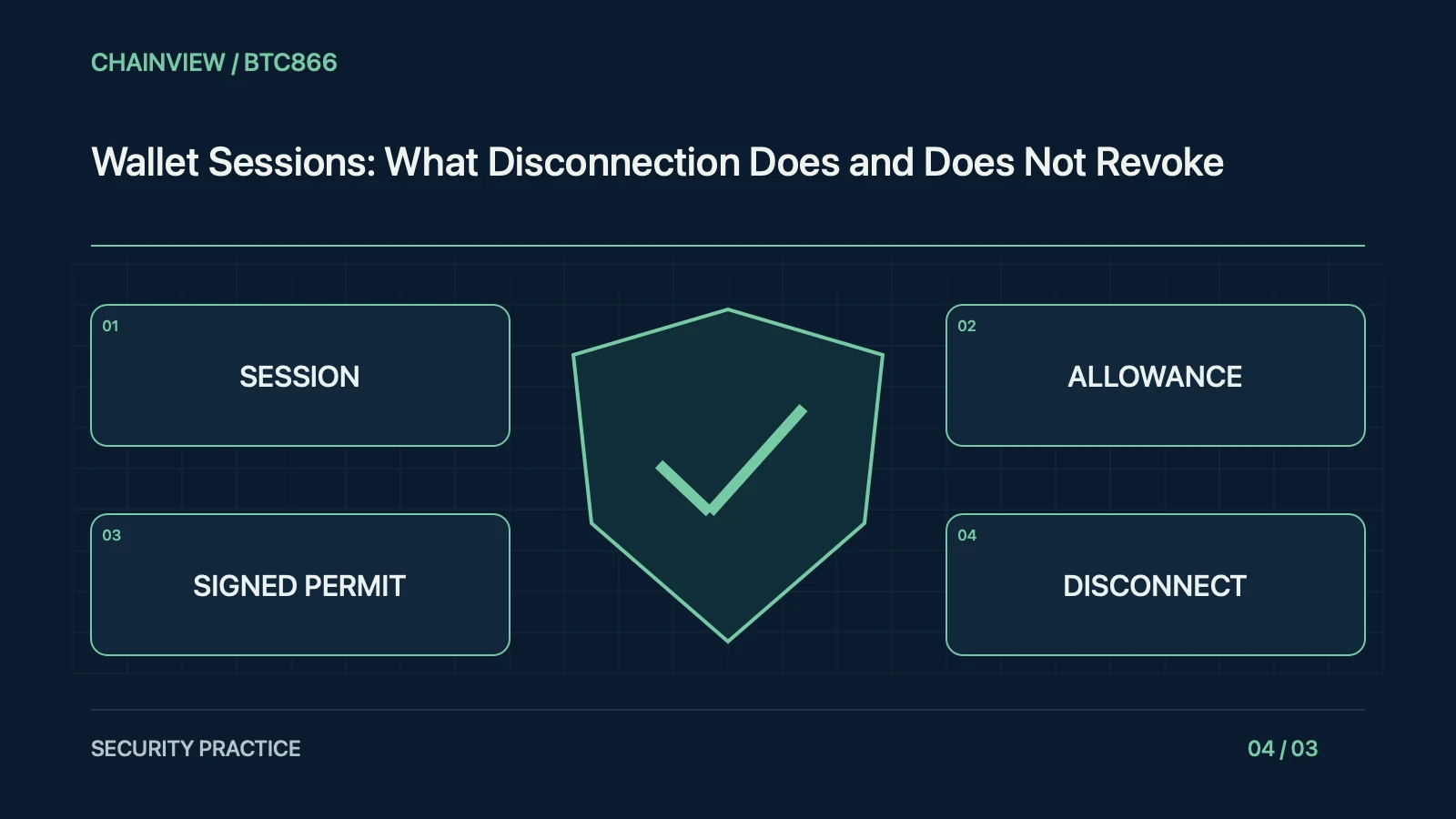
A wallet connection generally creates a request channel between a site and an account and exposes information such as address and network. It is different from a token allowance, operator permission, or previously signed authorisation. Connecting need not spend assets, and disconnecting need not remove every authority. List connected domains, chains, methods, expiry, and active requests before inspecting separate signatures and on-chain permission transactions.
A connection list is a starting point, but some signed messages are not visible on-chain. An explorer alone cannot prove that no authorisation exists. Preserve personal signing records while recognising that a still-valid signature can itself be sensitive. Redact appropriately or seek trusted assistance before posting it publicly. Evidence collection should not accidentally distribute the very authority whose consequences are being assessed.
Inspect each relevant field
Disconnecting can stop a session from making further requests, yet an existing contract allowance, permit, or other valid authorisation can remain usable. Browser caches and information already stored by the site also do not disappear automatically. One toggle cannot describe all security states. Every permission needs an object, scope, grant time, and expiry or revocation mechanism. A wallet displaying no connected sites is not evidence that no valuable authority remains elsewhere.
On-chain permissions commonly differ by network, asset, and spender. Revoking an allowance on one chain does not automatically change another. Verify complete destinations even when the prepared action is described as protective cleanup. A malicious revoke transaction can request a new authority instead. Security intent does not excuse skipping the same recipient, method, and contract checks used for an ordinary financial action.
Understand the limits
Mobile deep links, QR codes, and cross-device sessions can obscure the requesting origin. Review the domain, chain list, methods, and lifetime. An informational site should not receive transfer or signing capabilities merely because it displays familiar content. Persistent sessions and session keys require scrutiny of limits, callable contracts, and revocation control. When the details are unclear, pause rather than relying on a recognised icon or an application name that another party can imitate.
Session expiry and asset-permission expiry can differ, and changing a mobile device may leave old sessions active. Review management screens on both wallet and application sides. Establish which action stops a local connection and which terminates server-side access. Uninstalling an application is not necessarily either. A clear state table prevents several distinct operations from being compressed into the ambiguous instruction to disconnect everything.
Respond safely
Use trusted wallet tools and explorers to examine allowances, NFT operators, permit nonce states, and session connections separately. Revoking an on-chain permission can cost fees and normally affects a specified asset and contract. An all-in-one revoke website can itself be malicious. Authenticate the tool through official entry points, read every prepared transaction, and avoid granting broader unknown authority merely to inspect existing permissions. A successful revocation should be checked through its receipt and relevant contract state.
Before using an allowance inspector, read its official documentation and contract references and begin with read-only inspection. A tool asking for asset deposits or seed words before revocation is a reason to stop. Querying public allowance state normally does not require recovery authority. Keep inspection and signing separate so the user can understand the existing permission before approving any transaction intended to alter it.
Maintain controls
During an incident, retain domains, times, signature contents, hashes, and current permissions. Disconnect suspicious sessions, then address each remaining layer through its own mechanism. Already disclosed data cannot be recalled through an on-chain revoke, and completed transfers do not return automatically after an allowance is removed. Mark authorities terminated, still valid, unknown, or awaiting confirmation. This layered record supports concrete decisions and avoids a misleading promise that one disconnect or cleanup button has erased every consequence of past interactions.
Final review should compare the revocation receipt with current permission state and identify signatures that remain unverified. If private-key exposure is suspected, ending one session cannot address the root problem. Evaluate further action through a trusted incident process rather than repeatedly signing cleanup transactions on the same questionable device. A truthful result can include unresolved risks instead of promising total removal of every past authorisation.