Original topic illustration: ChainView BTC866 original topic diagram · ChainView BTC866 Editorial · CC BY 4.0
Establish the concept
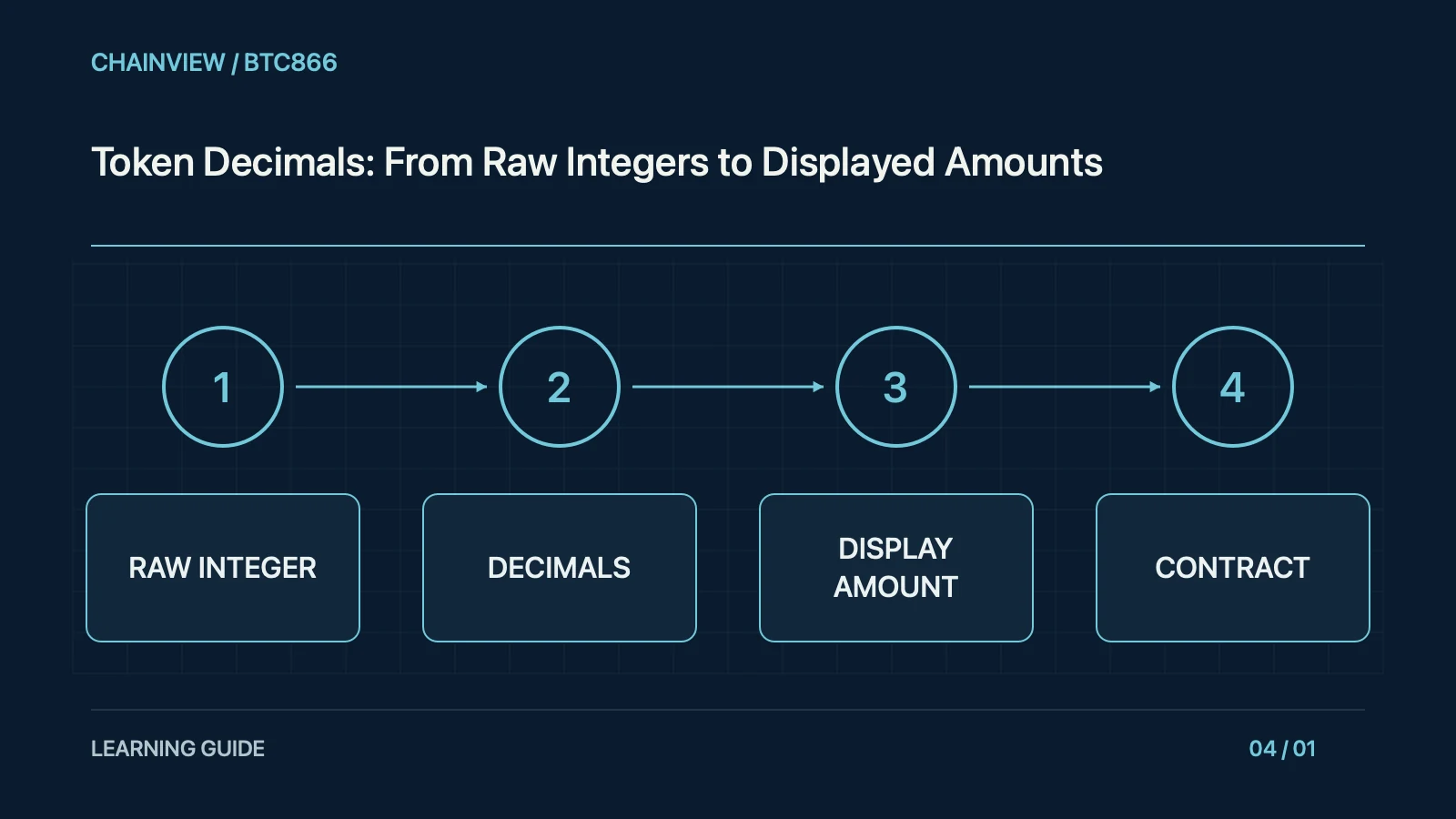
Token balances are commonly stored as integers, while an interface applies a decimal scale for display. At six decimals, a raw value of 1234500 represents 1.2345 units rather than 1234500 tokens. Names and symbols are not globally unique identifiers. Record the network and contract address as well as the label, because a lookalike token or different scale can completely change an interpretation.
Exchange and wallet fields can display scaled quantities while imposing separate step sizes and minimums on input. Check the complete contract and venue rule before sending. A rounded balance page does not prove that the same displayed amount is transferable, and a UI accepting a decimal string does not establish that the contract will interpret it as intended.
Choose reliable evidence
The ERC-20 decimals field is optional metadata, so a nonstandard contract may not return an expected value. Do not silently assume eighteen decimals whenever retrieval fails. Compare the actual contract, trusted explorer, and issuer documentation, including proxy implementations and revisions. If metadata remains unresolved, retain the raw integer and an unknown scale. Guessing a familiar display value does not establish the asset's identity or balance.
A proxy upgrade can change where metadata is read, so preserve the query block and tool source. If explorers disagree, first establish that they use the same network and address. Then investigate whether decimals are mutable, implementation-dependent, or simply cached. A display conflict is an evidence problem to resolve, not a reason to choose the more convenient number or send a test transaction.
Check concrete fields
Use integer or decimal fixed-point arithmetic for financial records. Binary floating-point can introduce errors during addition, rounding, or handling large values. Preserve raw integer, scale, and display unit as separate fields and format only at input or output boundaries. Spreadsheet software can convert long integers into scientific notation or truncate them. Import as text where necessary and verify with a known sample instead of accepting values that merely look close.
Split and combine large values through round-trip tests and guard against integer overflow. Avoid converting a raw integer to binary floating point before scaling in code or a spreadsheet. Record the rounding direction required by the business rule. Default formatting can hide a one-unit difference that matters at a token's smallest scale, especially when fees or minimums are near the boundary.
Handle boundary cases
Transfer-event amounts and balances need the same unit conventions. The fee asset can differ from the transferred asset. Display rounding does not prove that an on-chain remainder is zero, and small residual quantities should not be erased silently. Exchange minimums, withdrawal limits, and order precision are also separate from token decimals. A six-decimal token does not imply that every trading venue accepts orders with six decimal places.
Label the currency whenever fees and balances appear together. A multilingual display may change separators and digit grouping, but the underlying scale must not change through translation. Preserve the formula, raw value, and unit in each language. A comma that denotes a decimal in one locale can be interpreted as a thousands separator in another, creating a different amount without any change on-chain.
Keep results and versions
Practise with harmless data by converting 1234500 at six decimals and then reversing the calculation exactly. A change in reported metadata should trigger review rather than a quiet revaluation. Show the raw value, formula, unit, and evidence in the article. Decimal scale explains representation; it does not create economic value or additional rights merely because an interface displays more zeroes or a larger-looking integer.
When a same-name token or unusual scale appears, pause and verify the contract and transfer events through a trusted explorer. Do not grant an unfamiliar site permission to read or move assets merely to fix a display. Presentation and asset state are separate questions. Resolve the representation first, then decide whether any actual transaction is necessary under the verified token and venue rules.