Original topic illustration: ChainView BTC866 original topic diagram · ChainView BTC866 Editorial · CC BY 4.0
Separate a paper from a deployed service
A blockchain paper is an argument within a defined model. A preprint, an accepted paper and a production release describe different stages. Peer review can improve scrutiny without certifying that an implementation is free of vulnerabilities. Identify whether the contribution is an algorithm, an engineering optimisation or an observation before turning it into a product headline.
For example, a paper may report a tenfold improvement inside a verification routine. Identify whether it optimises arithmetic, database access or complete consensus. The headline must name the improved step. An isolated computation result cannot establish tenfold faster consumer settlement or an unreported security improvement.
A research paper or preprint presents claims under stated assumptions; peer review is not proof that a production deployment is secure or equally fast.
Read the benchmark boundary
A throughput figure needs its hardware, node count, geographic spread and workload. Signature checks in one process are not the same measurement as decentralised settlement. Ask when the clock starts and stops, and whether failures count. A fast first acknowledgement is not equivalent to finality, while a batch of simple transfers is not interchangeable with complex contract execution.
Make a parameter table for transaction mix, node configuration, network delay and completion standard. Different compiler flags or warm-cache conditions can invalidate a baseline comparison. Peak and sustained performance also differ: memory growth, rejected work and failures during a longer run can change the user experience substantially.
For transactions-per-second or latency claims, record hardware, network topology, workload, transaction complexity, failure conditions and finality definition.
Ask what another team can repeat
A reproducible experiment needs a code version, parameters, inputs and environment instructions. Public code can still depend on unavailable equipment or private data. If another team obtains a different result, compare those conditions before judging the original claim. Label a number as author-reported when independent repetition has not been established, and preserve the exact artifact used.
When code is available, check its licence, commit identifier and experiment scripts against the paper version. A later repository update should not silently replace the original artifact. Failed repetition can reflect unavailable dependencies or platform differences, so record a specific limitation instead of making an unsupported accusation of fabrication.
Compare the same system boundaries: a local execution benchmark is not an end-to-end decentralised settlement measurement.
Use a controlled comparison
Imagine one test measures validation within a data centre while another includes consensus between continents. Their transaction counts cannot establish which production network settles faster. A useful demonstration fixes machines, inputs and network assumptions, then records successful throughput and latency percentiles. Hypothetical figures explain the method; they should never be presented as a new live industry record.
Use successfully completed requests as the throughput numerator and report submitted, rejected and failed counts separately. Otherwise a load generator's sending rate can masquerade as achieved processing. Show median and higher-percentile latency as well: a low average can conceal a smaller group waiting much longer than the headline suggests.
Look for public code, datasets, parameter settings and independent reproductions; describe missing evidence without inventing a new performance record.
Write an evidence-based research note
A research story should separate the claimed improvement, experimental limits, independent reproduction and real deployment. An interesting proposal can matter before adoption, but its future benefit remains conditional. Keep the original paper and benchmark version attached to the analysis. When the methodology changes, update the comparison rather than leaving an attractive chart with an incompatible denominator.
Finally, separate research significance from an investment conclusion. Compatibility, resource budgets and operational procedures may remain unresolved before adoption. Explain which bottleneck the method addresses and which assumptions remain untested. Neither an accepted paper nor an impressive experiment establishes that an associated token must appreciate or that users should fund a project.
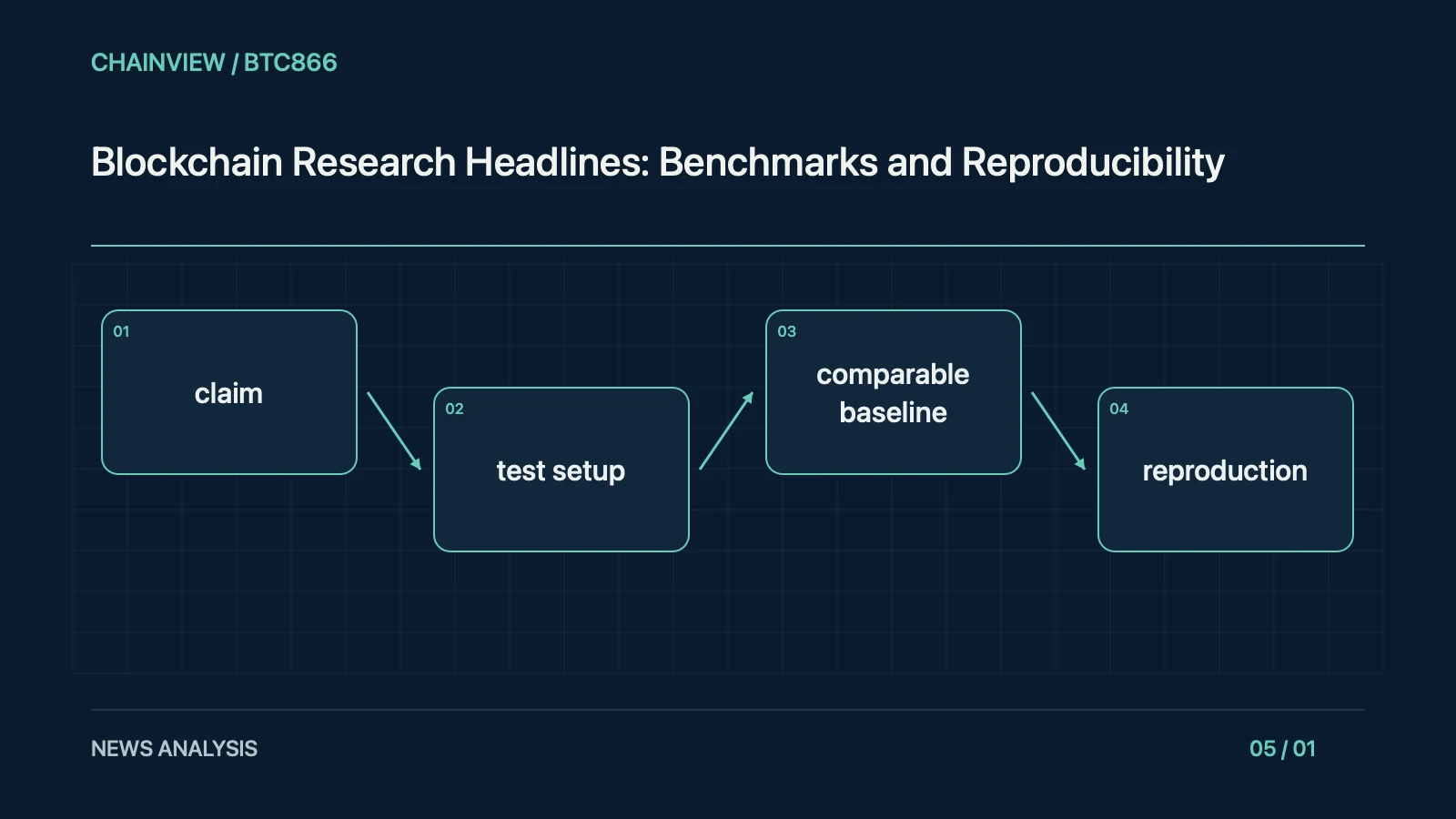
For this story, create four evidence columns headed claim, test setup, comparable baseline and reproduction. In each, retain the original passage, publisher, date and unresolved question. Separate completed events from interpretation and future conditions; the headline should rely only on supported findings. Preserve the original retrieval when a source changes and explain which conclusion was revised. Repetition across popular accounts is not independent confirmation when they all trace to one announcement. A reader should be able to follow the article back to the underlying document without trusting a screenshot, a familiar logo or an unexplained numerical comparison.