Original topic illustration: ChainView BTC866 original topic diagram · ChainView BTC866 Editorial · CC BY 4.0
Understand what the chain reveals
Bitcoin blocks reveal successful proofs of work and difficulty, but they do not disclose every unsuccessful hash attempt across the network. Hashrate is therefore estimated from observed block production and difficulty over a chosen interval. A record headline describes a particular estimate, not a reading from a universal counter of running machines.
The news card should show how many blocks or days enter the estimate and whether smoothing is applied. A provider without a method cannot support a precise independent ranking. Attribute its record claim while explaining that the comparison conditions remain insufficiently documented; this communicates the evidence level without inventing certainty.
Bitcoin blocks expose proof-of-work results and difficulty, but the total number of unsuccessful hash attempts is not directly visible on-chain.
Choose the comparison window
Block discovery is random, so a busy short interval can occur without a sudden installation of equipment. Longer windows smooth noise but react more slowly. Record starting and ending blocks, elapsed time and difficulty changes. A one-hour estimate and a month-long average should not be compared as if both described the same observation.
Near a difficulty adjustment, mixing old and new difficulty assumptions can affect estimates. Even a correct formula requires a clear treatment of observed time and block timestamps. Do not join incompatible windows into one apparently continuous series merely to publish quickly. Keep a note explaining any methodological break.
Estimated network hashrate combines observed block production and difficulty over a chosen window; short windows can be noisy because discovery is random.
Interpret pool attribution carefully
A pool label groups attributed blocks; it does not establish ownership of every connected mining device. Miners can redirect participation, and some blocks remain unattributed. State whether concentration is measured by block count or an estimated share, alongside label coverage. A few fortunate discoveries do not prove that control of the network has permanently changed.
A pool share calculated from the last hundred blocks can fluctuate considerably. A longer sample may support a different conclusion. Display unattributed blocks rather than assigning them arbitrarily to the largest pool. Pool destinations also cannot be treated as a verified list of the real-world identities of all participating miners.
Compare matching windows, difficulty epochs and data revisions, and distinguish a pool's attributed share from ownership of all participating equipment.
Avoid unsupported energy and profit claims
Hashrate does not directly measure electricity consumption because equipment efficiencies differ. Profitability also depends on coin prices, energy costs, transaction fees and capital expenses. Two hypothetical machine fleets can use the same power while producing different numbers of hashes. That distinction explains measurement limits without inventing current regional energy shares or future price effects.
Profit analysis needs hardware efficiency, electricity, rewards and operating assumptions. Price and hashrate may rise together without proving a single causal direction. Present plausible mechanisms conditionally instead of claiming that a hashrate record must lift bitcoin prices. That distinction remains useful after the immediate news cycle ends.
Hashrate alone does not measure electricity use, profitability, decentralisation or future price; report estimates with dates and methodological limits.
Publish a methodological note
Attach the source, estimation window, units and comparison range to the chart. If a provider revises history, investigate whether labels, timing or formulas changed before describing equipment migration. Public block records can help test the estimator, but they cannot supply a precise inventory of every miner. Clear uncertainty makes the report more useful than an unexplained record number.
For updates, retain raw values, retrieval times, unit conversions and revision reasons. Exahashes and petahashes differ by orders of magnitude, so omitted units can create exaggerated comparisons. If a dataset covers only selected pools, state that sample boundary instead of presenting the result as a precise census of the entire network.
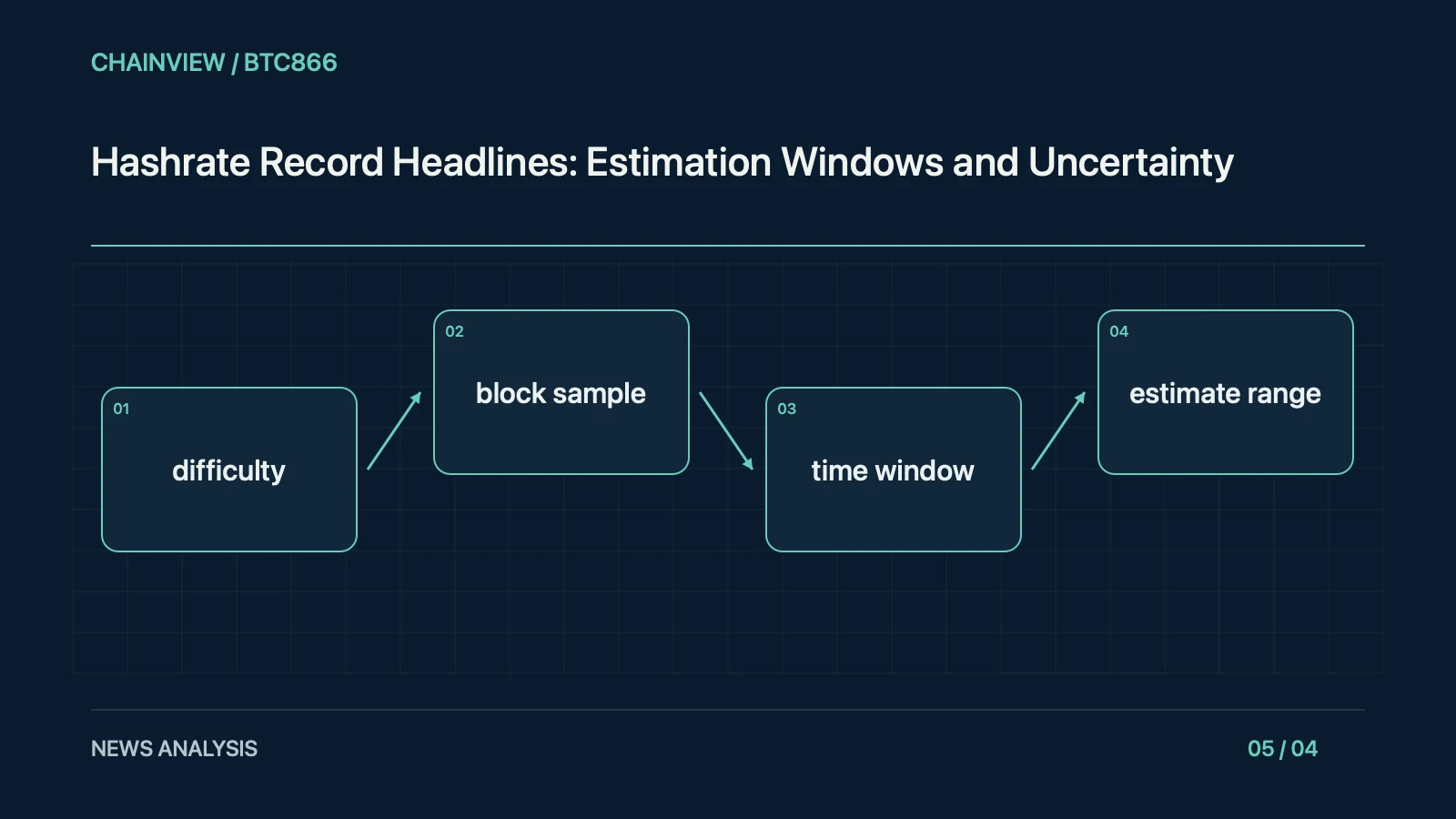
For this story, create four evidence columns headed difficulty, block sample, time window and estimate range. In each, retain the original passage, publisher, date and unresolved question. Separate completed events from interpretation and future conditions; the headline should rely only on supported findings. Preserve the original retrieval when a source changes and explain which conclusion was revised. Repetition across popular accounts is not independent confirmation when they all trace to one announcement. A reader should be able to follow the article back to the underlying document without trusting a screenshot, a familiar logo or an unexplained numerical comparison.