Original topic illustration: ChainView BTC866 original topic diagram · ChainView BTC866 Editorial · CC BY 4.0
Identify the burn mechanism
A token burn can mean a transfer to a supposed burn address or a contract operation that reduces totalSupply. Those actions can affect balances and supply reporting differently. Verify the asset and network, then read the implementation. An unusual-looking address or a marketing graphic does not independently establish permanent unspendability.
A before-and-after totalSupply check needs fixed blocks, not today's value compared with a month-old screenshot while ignoring intervening issuance. Determine whether the project mixes wrapped units, burn balances and locked balances. Locking and burning can have entirely different reversibility and ownership consequences even when both reduce a dashboard's available figure.
A transfer to an address described as a burn address and a contract burn that reduces totalSupply can have different accounting effects.
Inspect the transaction result
Use the announced transaction hash to check execution status, call details, events and before-and-after accounting. An event named Burn is not sufficient proof because contracts define their own logs. Avoid counting a transfer to a burn destination and a later burn call as two removals of the same units. Preserve decimals when interpreting raw amounts.
Preserve successful execution status and log position, checking whether the caller reached the token, a router, proxy or batch module. If events and balance changes disagree, investigate documentation and query limits rather than substituting a label for analysis. Do not invite readers to interact with an unknown contract as an experiment.
Check the network, contract, transaction receipt, event logs and resulting balances; an announcement or screenshot is not independent on-chain confirmation.
Review supply definitions and authority
Total supply, circulating supply and tradable float answer different questions. Removing treasury units may not reduce currently traded float by the same amount. Check minting, upgrades and any recovery powers, including related issuance on another chain. A snapshot cannot explain every future issuance rule, so record the relevant administrator or governance constraints.
Administrators may retain issuance limits, role powers or upgrades. A visible burn quantity says little about whether future supply policy is fixed. Locking a native asset in a bridge and issuing its representation should not be described as creating equivalent new wealth at both ends; avoid double counting in the supply table.
Inspect minting, upgrade or recovery powers and distinguish treasury-held tokens, circulating supply and permanently removed units.
Use a quantity bridge
Suppose a hypothetical contract starts with 1,000 units and a real burn reduces its reported supply to 900. A transfer of 100 units to a special address might instead leave that interface unchanged. Report the appropriate distinction. Neither example predicts price: a smaller unit count does not automatically create demand, liquidity or a proportional investment gain.
A further fictional example can add 50 newly issued units on the same day as a burn of 100. Net supply change then differs from gross burning. Report issuance, burning and ending quantity separately. There is no universal linear price formula, even when promotional language describes the mechanism as deflationary.
Destroying units does not guarantee stronger demand or price appreciation; disclose which supply measure changed and avoid counting the same burn twice.
Preserve a repeatable check
Keep the network, contract, block, transaction and chosen supply definition. Review migrations or methodological changes before comparing periods. If an address's inability to spend cannot be established, attribute the burn-address description to its source. Useful reporting explains the verified quantity change and remaining powers rather than turning a scarcity narrative into a promise of appreciation.
If an announcement combines completed burns with a future plan, give each a separate status and condition. Plans may depend on governance, revenue or market purchases and cannot enter historical totals early. Preserve the previous method when correcting a figure so stale summaries do not keep spreading an incompatible supply conclusion.
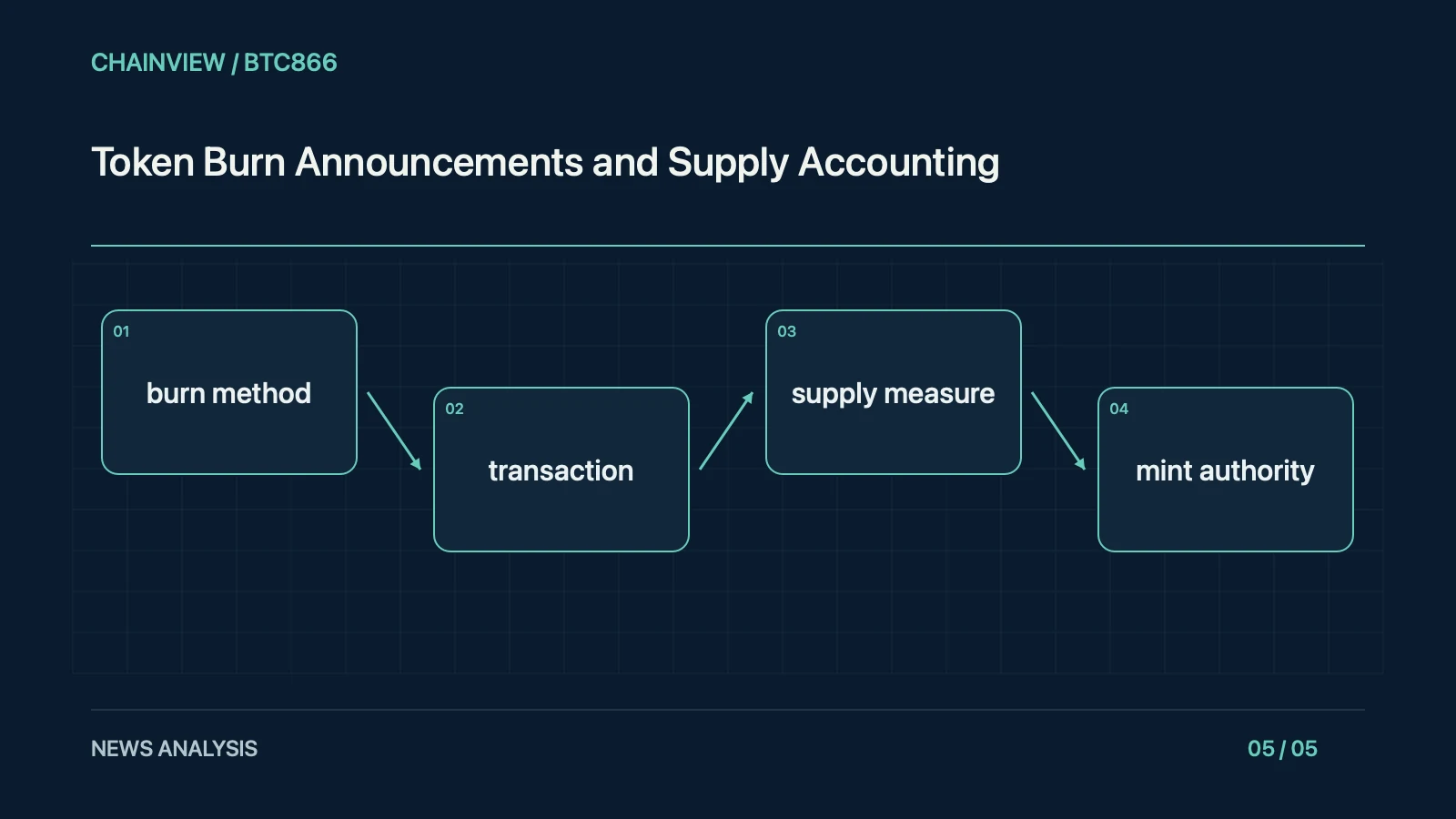
For this story, create four evidence columns headed burn method, transaction, supply measure and mint authority. In each, retain the original passage, publisher, date and unresolved question. Separate completed events from interpretation and future conditions; the headline should rely only on supported findings. Preserve the original retrieval when a source changes and explain which conclusion was revised. Repetition across popular accounts is not independent confirmation when they all trace to one announcement. A reader should be able to follow the article back to the underlying document without trusting a screenshot, a familiar logo or an unexplained numerical comparison.