Original topic illustration: ChainView BTC866 original topic diagram · ChainView BTC866 Editorial · CC BY 4.0
Identify the separate data channel
Blob-carrying transactions provide rollups with a channel distinct from ordinary calldata. Commitments connect the data to transactions, but the full content is not simply ordinary EVM contract storage.
A commitment checks whether retrieved content corresponds to the transaction, but its presence does not ensure that content can always be found. Availability, integrity and long-term preservation are different questions. Name the responsible party and time horizon for each instead of extending a cryptographic guarantee into an indefinite storage promise.
Blob-carrying transactions provide a separate data channel designed for rollups, with commitments linking blob data to a transaction.
Read the execution interface
The EVM can access versioned blob hashes rather than read complete blob contents as calldata. An application must explain where data is obtained and how it is checked instead of assuming cheaper publication gives an identical interface.
An application using versioned hashes needs a separate content-retrieval and decoding process. An ordinary contract call cannot arbitrarily load the body. For nontechnical readers, a receipt identifier and the package contents provide a useful analogy: possessing the identifier does not reconstruct contents that no source will serve.
EVM execution can access blob versioned hashes but not read full blob contents as ordinary calldata; calldata and blob data serve different interfaces.
Plan beyond the retention horizon
Protocol data availability has a retention horizon rather than an unlimited archive promise. Long-term replay and research require additional storage arrangements. Verify those arrangements before historical data becomes unavailable from ordinary serving nodes.
An archive plan should address independent copies, exportability and recovery tests. A single service URL is not evidence of permanent retention. Include storage expense and service-closure scenarios. Researchers relying on historical content should preserve legitimately available copies within the serving horizon and check that those copies remain intact.
Blob data availability has a protocol-defined retention horizon rather than an unlimited archive guarantee; long-term retrieval needs separate storage arrangements.
Separate the fee layers
Blob fees do not eliminate execution gas or application charges. A cheap data publication event cannot establish a rollup's overall security. Ordering, proving, upgrades and exit conditions remain separate questions.
Costs can be separated into publication, execution, proving and application additions, but implementations do not necessarily bill users for each separately. State what a quote includes. One cheap transaction does not establish a fixed future rate, because congestion and parameters can change after the observation used in the article.
A separate blob fee market does not eliminate execution gas or application charges, and a cheap publication event does not prove a rollup's complete security.
Document retrieval dependencies
Keep the transaction, commitment, retrieval date and archive location separately. Test which analyses stop if blob content cannot be retrieved. Missing historical content and an invalid cryptographic proof describe different failures and should not be conflated.
A public historical transaction can illustrate the link between commitment and externally obtained body, with a retrieval timestamp. A failed download establishes only that this attempt failed, not that every copy has vanished. Do not invent live blob fees, capacities or retention values when no current authoritative source supports them.
An archive rehearsal should attempt retrieval from a preserved copy, not merely check that an index entry exists. Keep the expected commitment and verify the recovered content against it. A searchable identifier without the underlying body is an incomplete backup for any workload needing that body. Record who maintains copies and what happens if funding stops, because operational continuity is a separate requirement from cryptographic consistency at publication time.
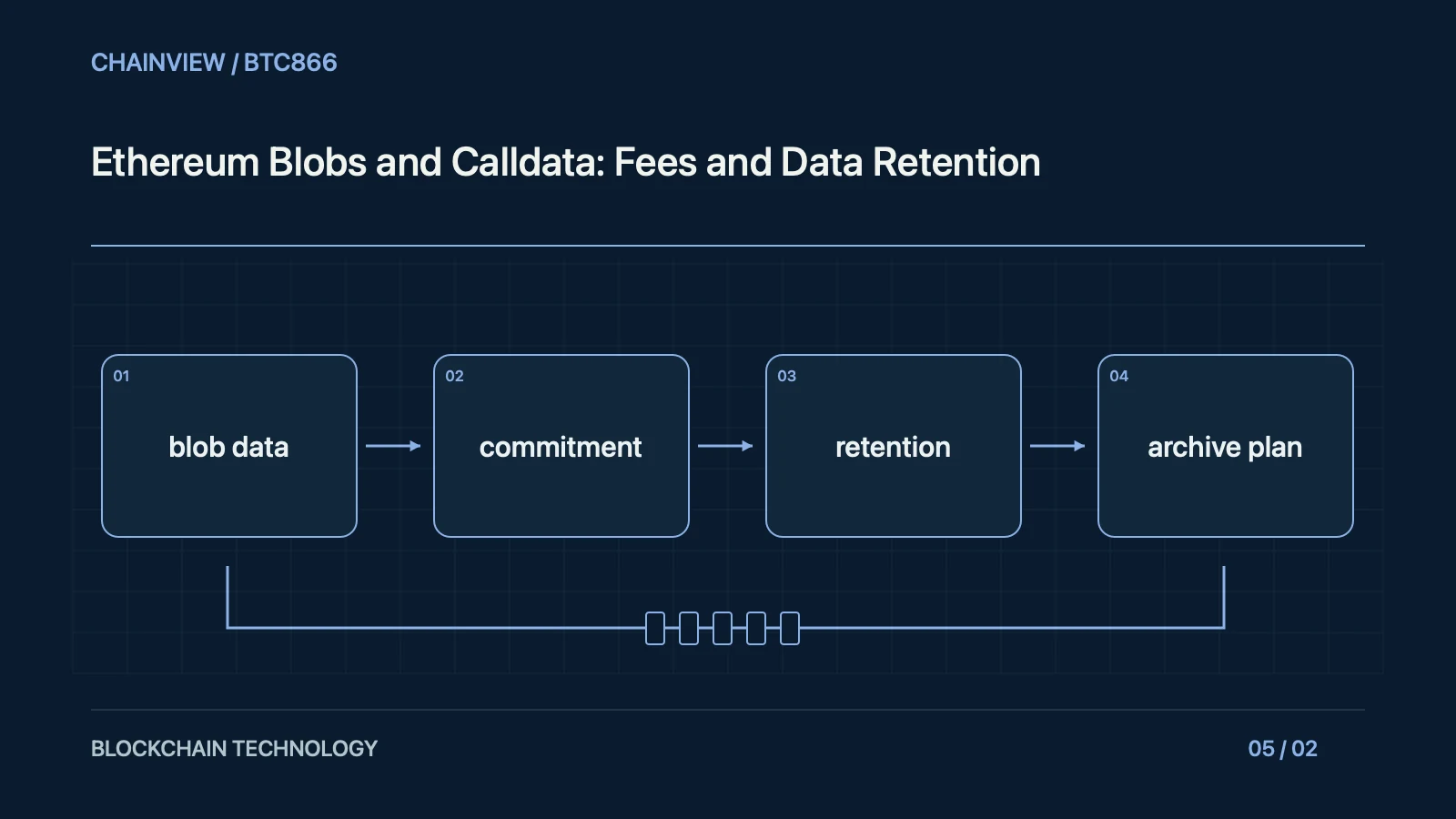
The implementation checklist for this mechanism should separate blob data, commitment, retention and archive plan. For each item, distinguish the specification, software behaviour and the observation actually obtained. Start with a narrow read-only example that has no valuable assets at risk, preserving versions and block references. Missing evidence limits the conclusion instead of proving the entire protocol failed. When clients disagree, compare configuration and data coverage before choosing a result. Explain enough of the boundary that a reader can identify what remains trusted. Technical terminology, open code and a successful small demonstration are useful evidence, but none independently certifies a production system.