Original topic illustration: ChainView BTC866 original topic diagram · ChainView BTC866 Editorial · CC BY 4.0
Calculate before deployment
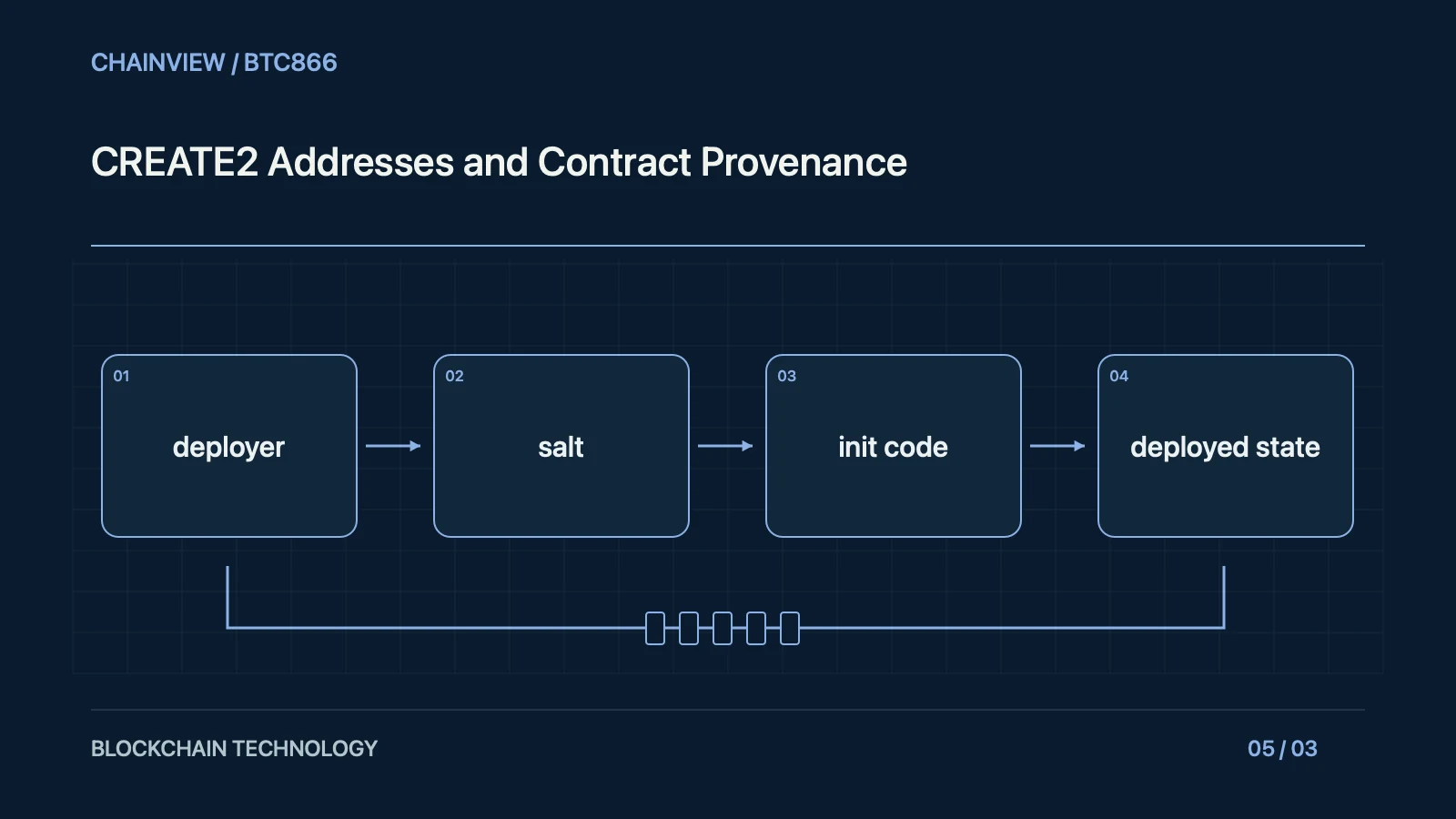
CREATE2 derives an address from the deployer, salt and initialisation-code hash. Predictability helps engineering workflows but does not authenticate a project or certify safe control of the resulting destination.
The deployer in the formula is the address executing creation, not the author of a promotional page. A factory deployment requires identifying that factory and call relationship. A readable salt has no extra authenticity, and a brand-like string should never lower the verification standard for the resulting destination.
CREATE2 derives a contract address from the deployer, a salt and the hash of initialisation code, enabling a destination to be computed before deployment.
Separate construction from behaviour
The formula concerns initialisation inputs. Runtime behaviour also depends on construction, configuration and dependencies. Administrative or proxy-upgrade powers can remain relevant after deployment, so inspect the actual state.
Initialisation code may include constructor arguments, while dependencies and state can affect resulting behaviour. Matching source still requires checking build and deployment inputs. Proxy business logic and administration need separate review. A checklist can improve understanding but cannot promise that an ordinary reader will identify every implementation risk alone.
The formula commits to initialisation code inputs, while actual runtime behaviour also depends on construction, configuration, linked components and later upgrade mechanisms.
Do not audit an empty destination
An undeployed address has no runtime code to inspect. A familiar appearance or previous announcement does not prove control. Identical-looking addresses on different chains still require independent network verification.
An undeployed predicted address may show a balance without runtime code. Absence of a contract page does not establish that an ordinary private-key account controls it. Distinguish empty code, deployed code and upgradeable logic, especially when assessing whether a transferred asset could later be recovered through the intended design.
An undeployed address has no runtime contract to inspect; a familiar-looking or previously announced address is not an audit or a guarantee about control.
Check before funding
Review the deployer, bytecode, initial parameters and administrator arrangements against maintained documentation. A computed address alone is insufficient grounds for transferring valuable assets, and source verification is not a complete security audit.
When documentation publishes an address in advance, retain its date and exact network, then compare actual bytecode and initial parameters after deployment. Seek an official explanation for differences rather than accepting a chat-room replacement. This comparison is read-only and does not require signing a message to prove the observer's identity.
Verify the chain, deployer, deployed bytecode, initial state and administrative powers before funding a deterministic address; keep examples conceptual rather than providing attack instructions.
Preserve a deployment trail
A harmless example can compare a prediction with its deployment transaction and resulting state. Explain which inputs were checked, without providing exploitation instructions. Revisit the conclusion when configuration or governing protocol rules change.
A deployment evidence table can include creation transaction, runtime-code hash, administrators and later upgrades. Matching hashes prove only that the compared bytes match, not that the business logic is safe. Do not turn predictability into a yield promise or incorrectly imply that a predictable destination is controlled by anyone who computes it.
A useful diagram draws separate boxes for the predicted destination, deployment transaction and subsequently callable contract. This prevents a frequent conceptual shortcut in which all three are treated as the same completed event. Note which box the evidence actually supports. A published formula establishes a prediction under its inputs, while a deployment receipt and runtime inspection provide additional observations. None alone determines all legal ownership rights associated with assets later transferred there.
The implementation checklist for this mechanism should separate deployer, salt, init code and deployed state. For each item, distinguish the specification, software behaviour and the observation actually obtained. Start with a narrow read-only example that has no valuable assets at risk, preserving versions and block references. Missing evidence limits the conclusion instead of proving the entire protocol failed. When clients disagree, compare configuration and data coverage before choosing a result. Explain enough of the boundary that a reader can identify what remains trusted. Technical terminology, open code and a successful small demonstration are useful evidence, but none independently certifies a production system.