Original topic illustration: ChainView BTC866 original topic diagram · ChainView BTC866 Editorial · CC BY 4.0
Differentiate state and history
Current state supports new execution, while bodies and receipts describe past blocks. Historical account storage is another data type. Finding an old transaction does not prove an endpoint can read every variable at that old height.
Balance queries and complex historical calls can require different data paths at the same height. Specify method and range in a coverage table. One successful latest-balance request does not establish that a multi-year research workload will run; public samples from several periods reveal retention boundaries more effectively.
Current state records the accounts and storage needed to execute new blocks, while block bodies and receipts describe historical activity.
Validation and archival access differ
A fully validating node need not retain the same historical-state coverage as an archive service. Client and version choices affect retention. Labels alone cannot establish all supported queries or their historical range.
A validating node may execute history to establish current state and later prune selected content. Retention is a resource and service choice. Not being archival does not imply failure to validate, and the archive label does not guarantee unlimited support for every log index or query shape. Read the client implementation.
An archive service preserves access to historical state at many block heights; an ordinary fully validating node need not expose the same historical query coverage.
Classify pruning effects
A block hash does not ensure that every related data type remains available locally. Treat a timeout, an unsupported method and a genuine zero balance separately. Replacing every error with zero creates false research conclusions.
Record error codes and messages, separating nonexistent heights, unavailable state, rate limits and timeouts. Retry policies suit temporary faults, not permanently out-of-range requests. Preserve an unknown balance as unknown instead of producing a zero-asset notification. Otherwise a technical coverage gap can become a materially false financial statement.
Pruning policies and client versions affect what can be served locally, and a block hash alone does not guarantee an RPC provider retains every associated data type.
Fix the query reference
Record height, hash, requested type and retrieval time, with a policy for reorganisations. Applications needing years of historical calls should verify provider retention and export arrangements before depending on the service.
A fixed block hash reduces confusion between branches at the same height, subject to the endpoint's query support. Exports need a confirmation policy and retrieval date. If a historical sample changes after a reorganisation, preserve the reason rather than describing the difference as an unexplained disappearance or creation of account assets.
Specify block number, data type, retention and reorganisation policy when designing research queries, and distinguish missing history from an actual zero balance.
Make missing data explainable
Read-only tests at selected public historical heights can classify successful, out-of-range and temporarily failed requests. Preserve client and API versions, then investigate service coverage changes before interpreting changed results as changed assets.
An operating note can define primary coverage, fallback sources and stop-output conditions. When essential data is absent, report that calculation is unavailable. Transparent historical coverage is more reliable than promising all chain data forever, and makes it possible to replace a provider without silently changing the statistical definition of the product.
Test coverage at a quiet recent height and an older height with the same request shape, recording both responses. If only the old one fails, investigate retention before debugging the application calculation. If both fail, configuration or endpoint compatibility may be the issue. This paired comparison is a diagnostic aid rather than a guarantee about every height, and should use public data without credentials or secret wallet material in the report.
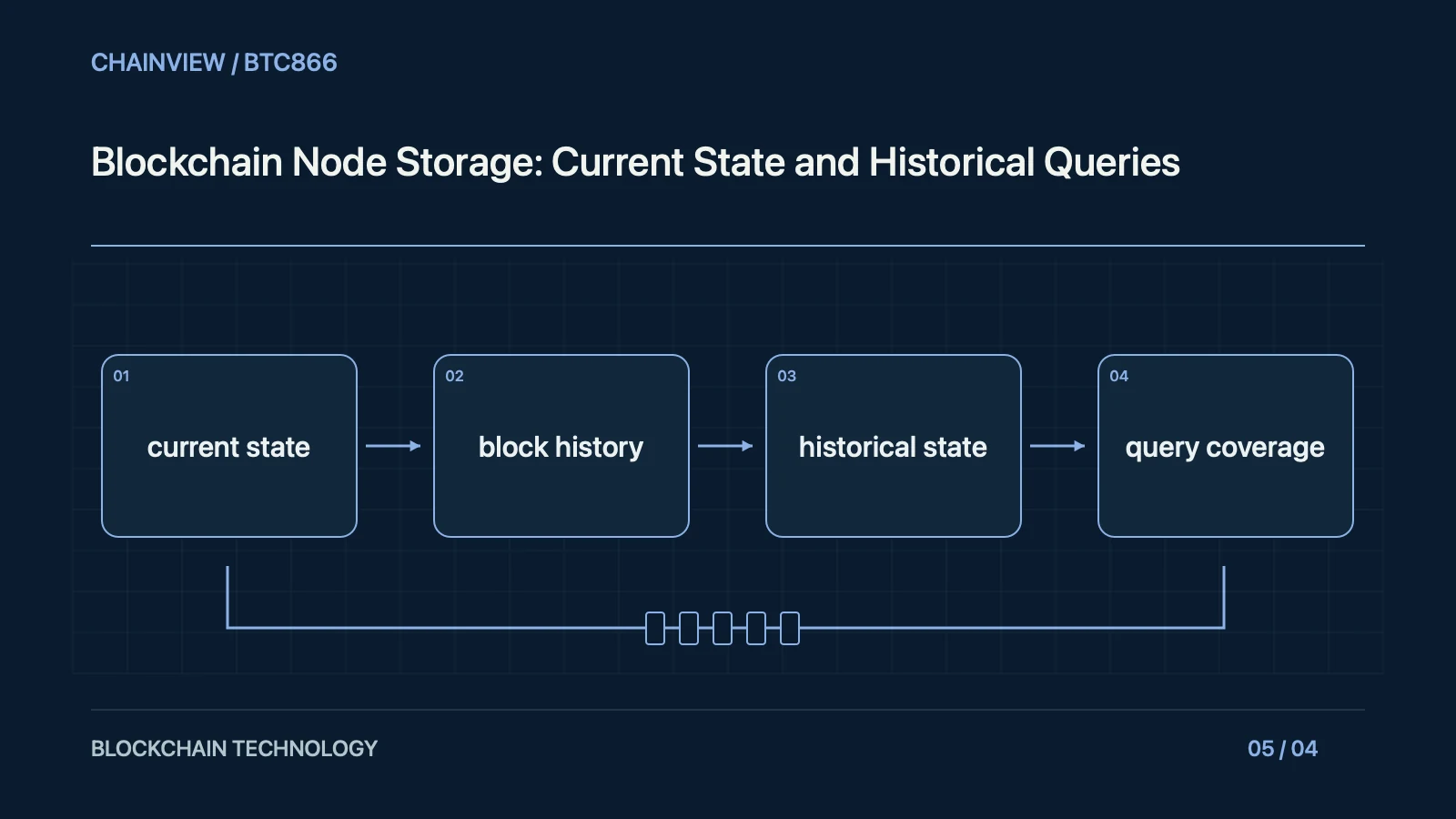
The implementation checklist for this mechanism should separate current state, block history, historical state and query coverage. For each item, distinguish the specification, software behaviour and the observation actually obtained. Start with a narrow read-only example that has no valuable assets at risk, preserving versions and block references. Missing evidence limits the conclusion instead of proving the entire protocol failed. When clients disagree, compare configuration and data coverage before choosing a result. Explain enough of the boundary that a reader can identify what remains trusted. Technical terminology, open code and a successful small demonstration are useful evidence, but none independently certifies a production system.