Original topic illustration: ChainView BTC866 original topic diagram · ChainView BTC866 Editorial · CC BY 4.0
Identify the suspended function
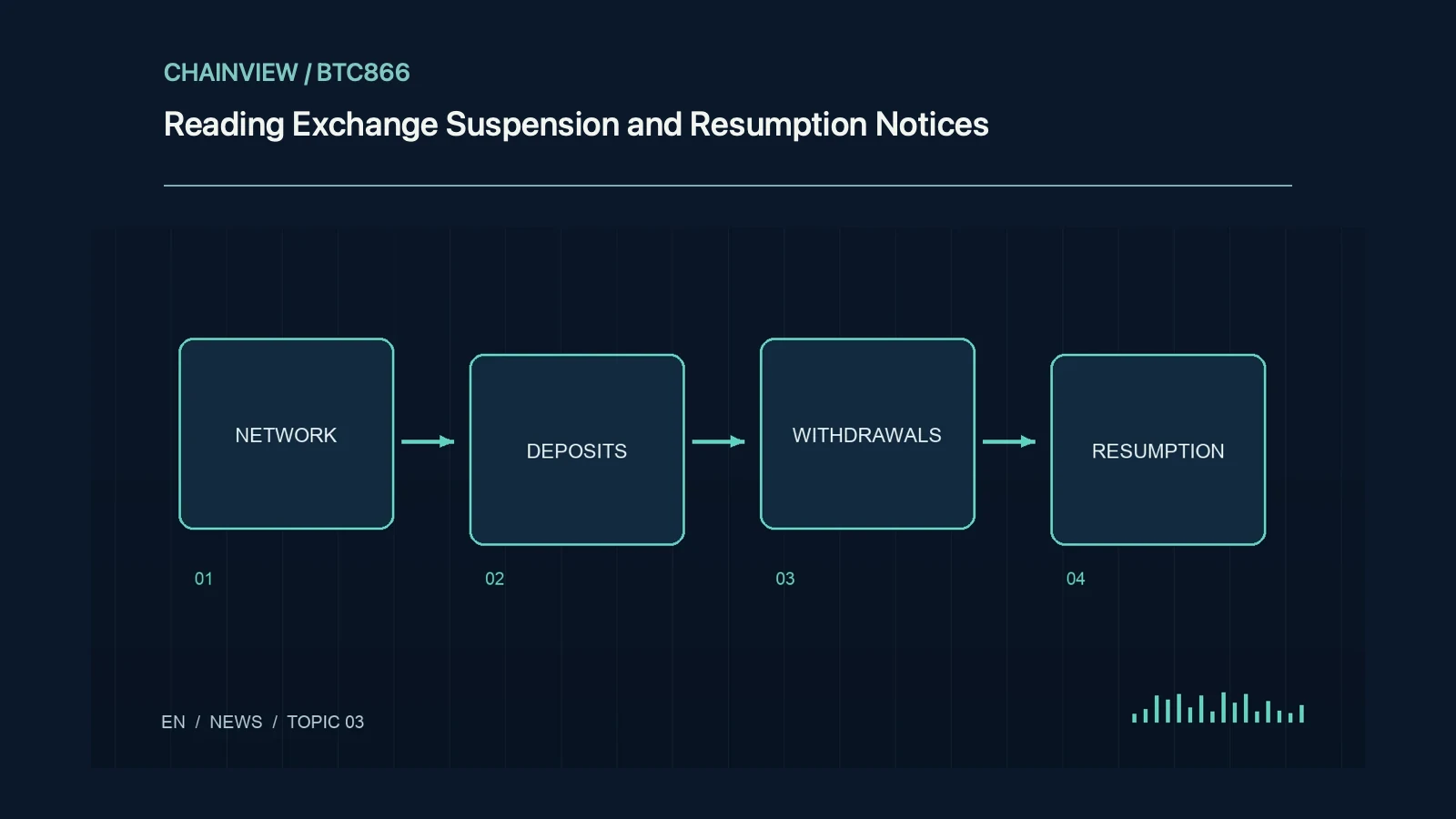
Trading, deposits, withdrawals, internal transfers, and bank settlement are separate functions. Record the asset, network, account type, and region. A withdrawal halt on one chain does not prove every network or spot market is closed. A disabled button may reflect account-specific controls, regional eligibility, or platform maintenance; check which explanation applies.
Reasons and evidence
Maintenance may involve nodes or signing systems; congestion can change confirmation requirements; risk controls may involve internal review. If the cause is undisclosed, mark it unknown. Preserve status pages, transaction records, and support references. Normal block production does not establish healthy internal exchange accounting, while a pause alone does not prove insolvency.
Track pending transfers
A pending withdrawal may be unbroadcast or simply waiting for an interface update. With a transaction hash, check inclusion, recipient, and amount on the correct network. An internal reference is not a blockchain hash. Confirmed deposits can still await required confirmations, minimum thresholds, supported-asset checks, or a necessary memo/tag.
Restart times and conditions
An estimated restart depends on upstream nodes, service providers, or review procedures. Record update cadence and restart conditions rather than treating social-media countdowns as commitments. After reopening, check limits, fees, supported networks, and whether access is phased. Confirm treatment of old addresses and transfers sent during the interruption.
Avoid compounding the problem
Repeated withdrawal requests can all succeed; a cancellation control may not reverse a broadcast transaction. Reconcile each request by time, amount, status, and reference before acting. Avoid private offers to unlock funds for a fee. Use a saved official support entry and never provide recovery phrases or remote device control to supposed support agents.
Reconcile after resolution
After resolution, reconcile account balances, venue statements, and chain transfers. Check duplicate requests, fee changes, and returned transactions, and retain the final notice and support outcome. Prolonged uncertainty should inform concentration and liquidity planning. A previous successful reopening does not guarantee that a later interruption will end on schedule.
Worked review example
Suppose withdrawals pause at 10:00 and a request remains pending at 10:15. Preserve its platform reference and check whether a chain hash exists. Without a hash, do not invent a confirmation count. With an included transaction, verify destination and later account updates rather than paying again. A reopening notice does not prove that every earlier request has cleared, so reconcile the backlog individually. These times are illustrative, not a live incident report. Separating feature availability from completion of old requests prevents a general status update from being mistaken for evidence about one customer transfer.