Original topic illustration: ChainView BTC866 original topic diagram · ChainView BTC866 Editorial · CC BY 4.0
Composition before totals
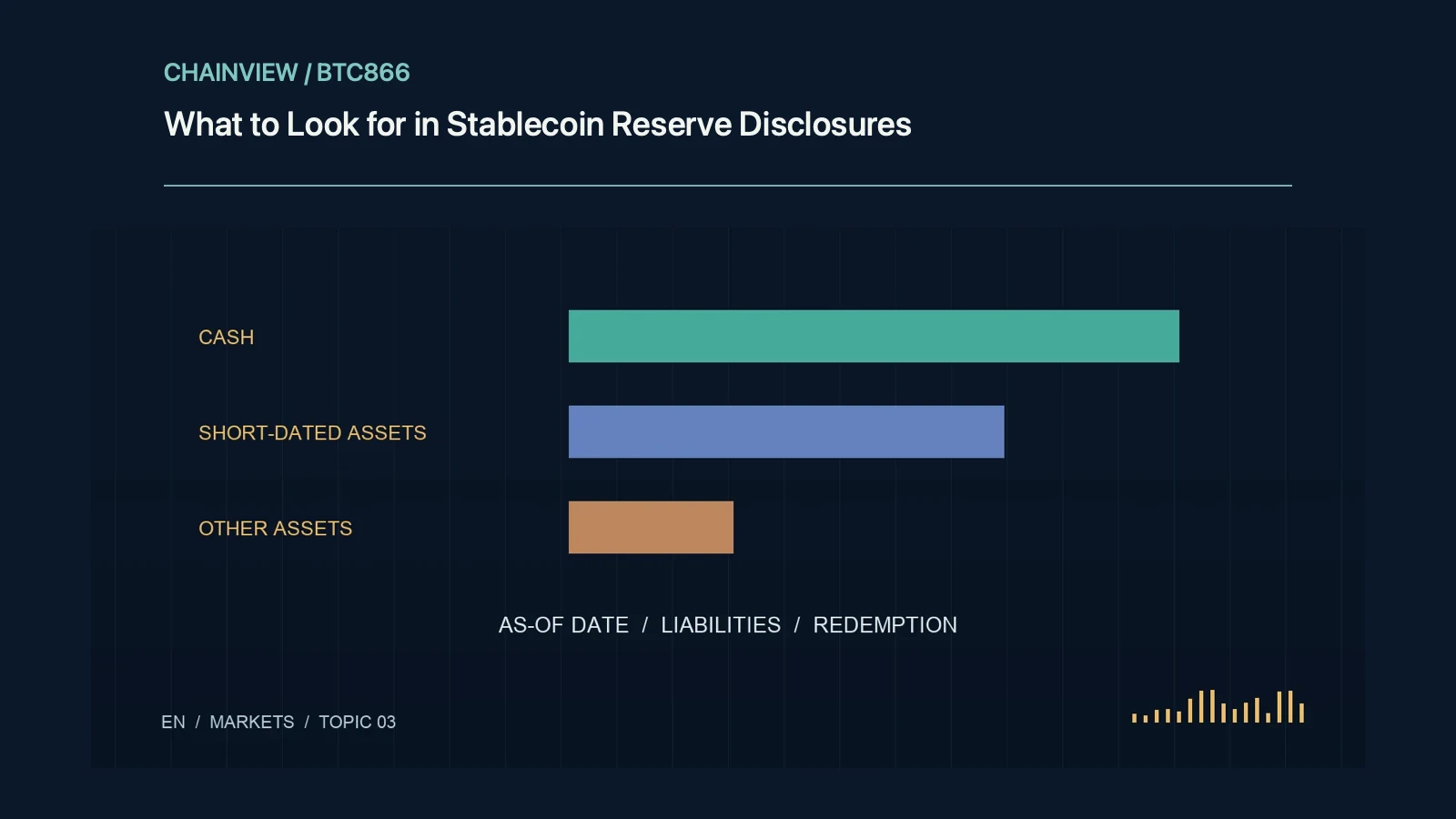
Inspect asset types, maturities, currencies, concentration, and restrictions. Deposits, government bills, repos, and other securities have different liquidity and credit risks. Match asset and liability dates. A snapshot showing reserves above token liabilities does not establish continuous redemption capacity or unrestricted access to every reported asset.
Scope of attestations
An attestation and a financial-statement audit are different engagements. Read the criteria, measurement time, materiality, qualifications, and coverage of liabilities and ownership. Point-in-time balances do not prove year-round control effectiveness. The assurance provider name is less informative than the actual scope and limitations of the report.
Who can redeem directly
Direct redemption may be limited to verified customers above minimum sizes. Check fees, processing times, banks, working days, and rejection conditions. One-to-one backing does not mean every holder can redeem instantly without cost. Read whether token ownership creates a direct legal claim against the issuer under the applicable terms.
Market price and redemption friction
A market discount can reflect illiquidity, banking closure, credit concerns, or capital restrictions. Arbitrage requires functioning redemption, capital, and time. Observe depth, spread, and network transfer conditions. Issuer redemption terms and exchange execution prices are distinct references; a discount is not automatically a risk-free opportunity.
Custody and legal segregation
Review custodians, account ownership, segregation, beneficiaries, insolvency treatment, and rehypothecation rights. Several banks can share correlated regulatory or liquidity risks. On-chain reserve addresses cannot establish the state of bank assets or all off-balance-sheet obligations. Mark missing legal information as unresolved rather than filling gaps with marketing claims.
Maintain a reserve tracker
Track reporting dates, composition, liabilities, redemption changes, and unexplained differences month by month. Normalize currencies and valuation methods. During a depeg, preserve issuer notices and payment-channel status. Evaluate issuer, custody, banking, network, and venue risks separately: a stable unit of account does not eliminate credit or operational exposure.
Worked review example
Suppose reserves are 102 million against 100 million of token liabilities, but some assets are accessible only on working days and direct redemption has a high minimum. The surplus alone does not prove a small holder can obtain cash immediately on a weekend. Review reporting time, asset availability, redemption eligibility, and market depth separately. These hypothetical balances distinguish solvency snapshots, legal claims, and immediate liquidity. Even a correctly calculated coverage ratio cannot answer every question about banking access, redemption delays, custody segregation, or the price available to someone who must sell through a secondary market.