Original topic illustration: ChainView BTC866 original topic diagram · ChainView BTC866 Editorial · CC BY 4.0
Token ownership and work rights
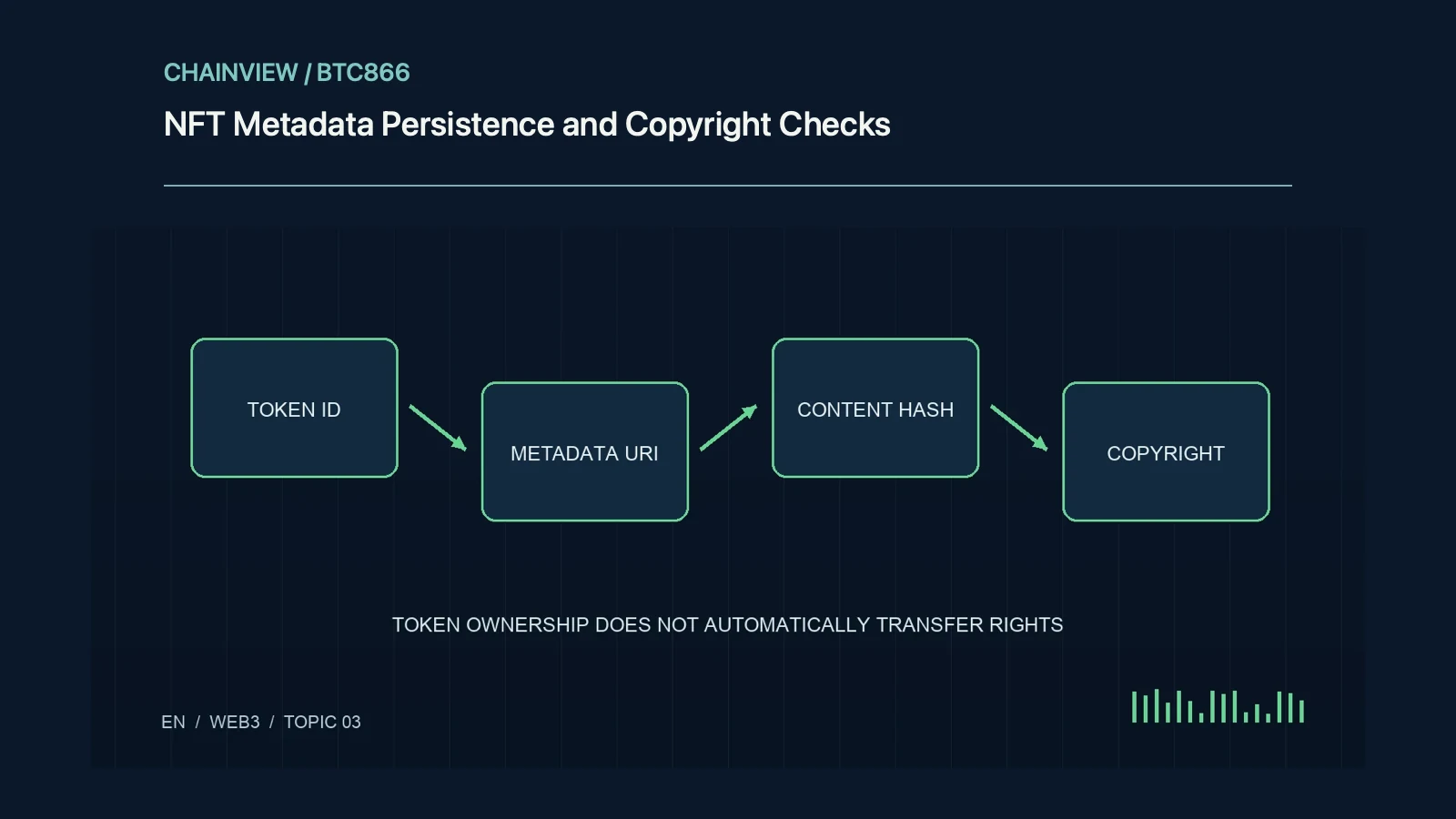
Controlling an NFT does not automatically transfer copyright. Downloading, displaying, commercial use, adaptation, and sublicensing are different rights. Identify the issuer, creator, and license, saving the version applicable to purchase. Marketing language about ownership may describe control of a token rather than legal ownership of the associated work.
Where metadata points
A token URI may return metadata that points elsewhere for media. Identify server hosting, content-addressed storage, or on-chain data, including redirects and mutable fields. Content addressing checks identity, not indefinite availability. A picture loading today does not establish persistence of every associated file or the high-resolution original.
Fixed content and mutable traits
Check who can update URIs, reveal traits, or freeze metadata, and which layer is frozen. Unchanged media does not fix external game rules; fixed on-chain traits do not guarantee ongoing application support. Separate enforced constraints, contractual promises, and creative plans. A roadmap is not the same as a service already delivered.
Preserve and verify content
Keep a manifest of metadata, media locations, hashes, formats, and retrieval dates. Where permitted, store copies and verify hashes, understanding ongoing pinning or hosting requirements. Do not execute downloaded scripts or connect wallets to unknown viewers. Preserving evidence of displayed content does not create usage rights absent from the license.
Creator identity and authorization
Copied media can be minted in an unrelated contract. Verify provenance through the creator channels, authorization documents, and official issuance addresses. Partnerships may confer only limited rights. Trademarks, likenesses, and third-party materials can create separate restrictions. Marketplace popularity is not evidence of a complete chain of intellectual-property authorization.
Exit and failure conditions
Review delisting, refunds, termination, dispute resolution, and whether licenses transfer on resale. A marketplace outage need not destroy the token but can impair access and trading. Evaluate token control, work availability, legal rights, and liquidity separately. Strength in one dimension does not compensate automatically for failure in another.
Worked review example
Suppose metadata includes a content hash but media remains on an issuer server. The image can disappear if hosting stops. Inventory metadata and media separately and check commercial-use and resale license terms. Token existence, file availability, and legal usage rights are independent facts; establishing one does not automatically establish the others.