Original topic illustration: ChainView BTC866 original topic diagram · ChainView BTC866 Editorial · CC BY 4.0
A vote is not delivery
Grant approval records a governance decision, not completed work. Separate the decision, actual disbursement and acceptance of results. Identify the recipient, purpose and deadline before treating a repeated announcement as fresh progress.
A proposal may authorise negotiation rather than immediate payment. Execution transactions establish what was disbursed. Keep approved budget and actual spending in separate columns: unused authorisation is not consumed cost, and money leaving a treasury does not establish successful development.
A passed grant proposal authorises a decision under governance rules; it does not establish that the funded work has been delivered.
Make milestones observable
Define deliverables, evidence, budget units and acceptance responsibility. Commit counts and release frequency do not establish usefulness. Evaluate whether the agreed product works and can be maintained instead of using token-price performance as a development metric.
Agree acceptance criteria before funding, such as a working release, documentation and maintenance period. A demonstration video alone is weak evidence. For a public tool, inspect whether access exists while distinguishing availability from adoption; one successful visit cannot establish a large active user population.
Define concrete milestones, acceptance evidence, budget units, recipient identity and responsibility for reviewing completion before each disbursement.
Explain the payment structure
Upfront funding, escrow, instalments and reimbursement distribute risk differently. Read pause, refund and recovery provisions, distinguishing a policy promise from an enforceable right. Do not assume identical remedies in every jurisdiction.
Staged payments reduce some upfront exposure, but vague milestones can still be difficult to enforce. Escrow needs a release authority, dispute process and exit condition. A contract constraining transfers does not necessarily resolve off-chain quality disagreements or cross-border recovery from an uncooperative recipient.
Upfront funding, escrow, staged payments and reimbursement allocate risk differently; explain refund or clawback provisions without assuming they are enforceable everywhere.
Disclose conflicts without excess exposure
Connections between reviewers, delegates and recipients can affect decisions and deserve relevant disclosure. Spending transparency does not require publishing identity documents or home addresses. Accountability and personal-data minimisation can be designed together.
Reviewers who share control, receive compensation or have other interests should disclose relevant relationships under governance rules. Transparency does not require unrelated personal data. Allegations need evidence and an opportunity to respond; disagreement or a changing vote count is not automatically proof of corruption.
Publish spending and conflict-of-interest disclosures while limiting personal data, and compare delivered outcomes with the original scope rather than token-price performance.
Compare outcomes with the scope
A hypothetical three-stage table can match budget, payments and unfinished items. Identify who approved a change rather than rewriting the original goal afterwards. Acceptance records help the community understand remaining obligations and actual results.
Acceptance records should identify scope changes, delivery dates, defects and continuing obligations. Report missed goals honestly rather than inventing users or commercial outcomes to complete a dashboard. A failed grant can still teach useful lessons, and preserving the reason is more valuable than silently deleting its earlier commitments.
A grant dashboard should distinguish a delivered artifact from an independent reviewer accepting it. Both dates matter when payment is conditional on acceptance. If an update extends scope, record the additional budget and approval instead of obscuring cost growth inside the original figure. Community members can then compare what was promised, produced and accepted without inferring fraud from every delay or assuming every disbursement proves satisfactory work. Clear stages support fair accountability for both sides.
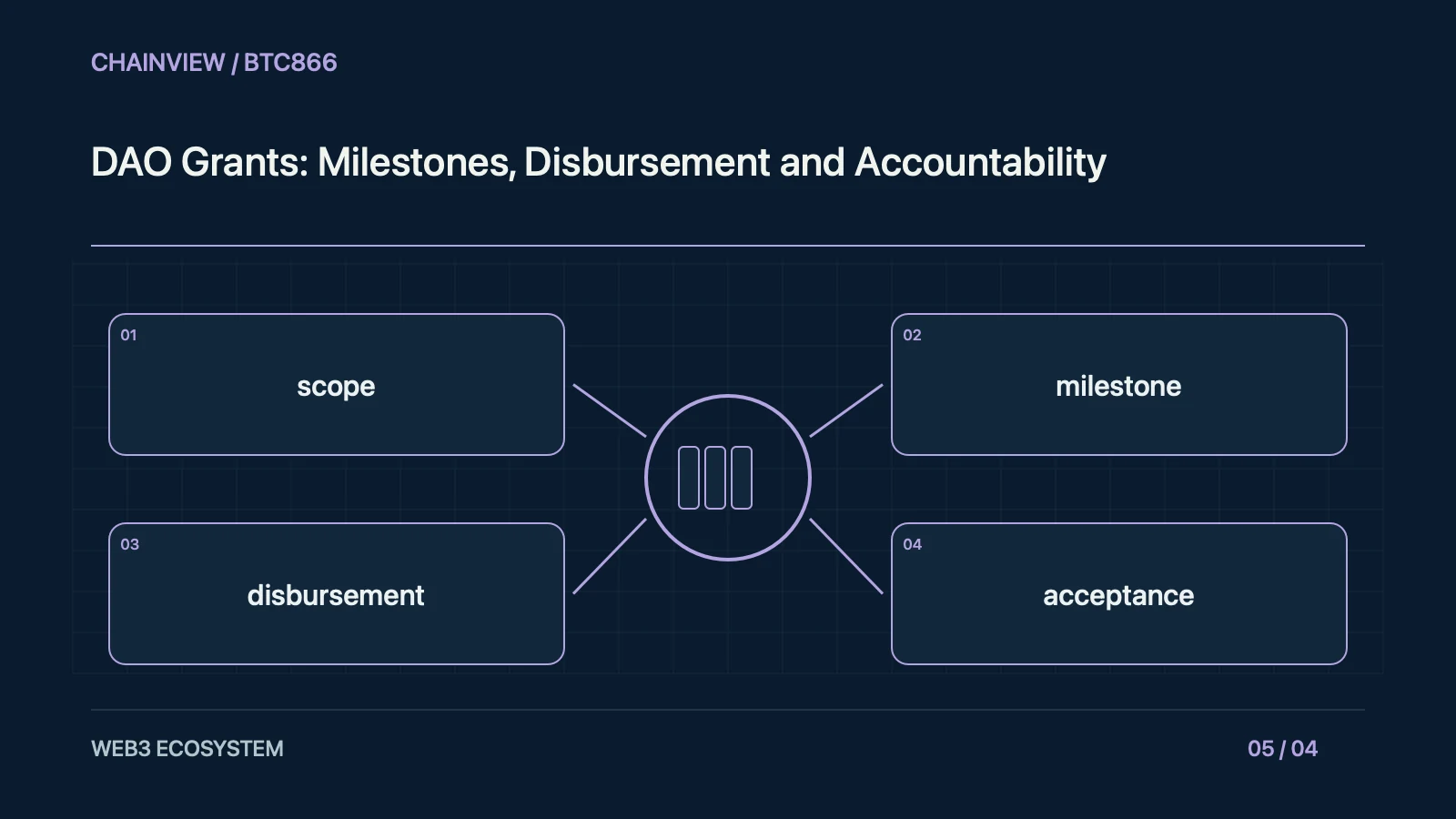
Build a rights-and-execution table around scope, milestone, disbursement and acceptance. Record who can act, which condition must be satisfied, when funds become available and what happens if the step fails. Separate interface display, signed commitment and completed transaction; the same claim shown in two places must not become two assets in a ledger. Keep the rule version and exit conditions, explicitly marking unknown powers. This exercise supports an assessment of real obligations and control. A headline return, community vote or popular application can be relevant context, but does not replace the specific contractual and technical facts of the operation.