Original topic illustration: ChainView BTC866 original topic diagram · ChainView BTC866 Editorial · CC BY 4.0
List requested permissions
Inventory wallet, browser, account, and contract permissions. Address reading, login signatures, email, location, notifications, and spending authority have different consequences. Check whether each permission is necessary. Privacy review must include analytics, scripts, and stored account information rather than focusing exclusively on visible blockchain transactions.
Public-chain linkage
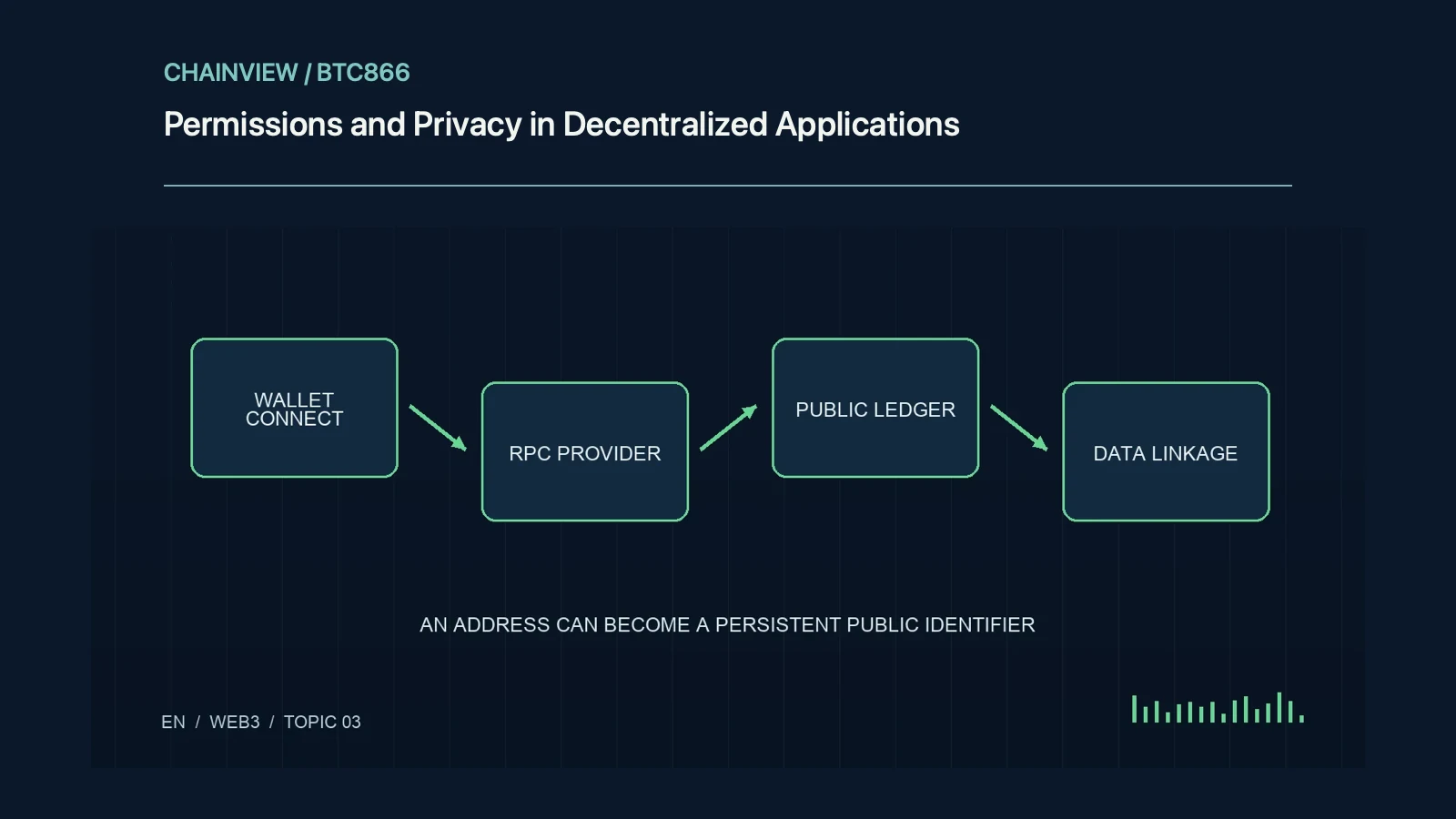
Addresses, timing, amounts, and contract interactions can be public and linked to exchange identities or social profiles. New addresses do not necessarily sever history, especially when transfers reveal relationships. Publishing a receiving address may expose long-lived activity. Pseudonymity should not be described as a guarantee of anonymity.
Session risks in signed login
A signed login proves control but should bind domain, purpose, chain, nonce, and expiry. Session cookies or tokens can persist after the initial signature. Review active sessions and avoid leaving access on shared devices. No-gas wording does not establish safety, and an unintelligible message should not be approved merely because it resembles a login prompt.
Retention and third parties
Read data categories, purposes, retention, sharing, and deletion procedures. On-chain records generally cannot be erased by the application, while server-held contacts and analytics identifiers may follow different rules. Verify support upload channels before sharing identity documents. A decentralized architecture claim does not establish that no identifying information is collected.
Reduce unnecessary exposure
Separate experimentation from reserves, restrict extension permissions, and review sessions and devices. Separation is not guaranteed anonymity because funding paths and behavior can link accounts. Minimize information disclosure and avoid combining addresses, balances, and real identity publicly. Privacy practices must preserve recovery; discarding essential backups can create a different, irreversible risk.
Review after leaving an application
On departure, inspect allowances, sessions, browser permissions, subscriptions, and deletion options. Disconnecting does not undo approvals or public records. Preserve necessary accounting evidence before deleting eligible data. Reinstalling a wallet does not remove on-chain authority, so investigate the scope of suspicious signatures or permissions before assuming exposure has ended.
Worked review example
An app combining address, email, and analytics identifiers may link activity without a name field. Inventory purposes, retention, and sharing. Account deletion does not erase public-chain records, and disconnection does not revoke allowances. Treat deletion, session termination, and on-chain revocation as separate tasks rather than assuming a single exit button clears every form of access.