Original topic illustration: ChainView BTC866 original topic diagram · ChainView BTC866 Editorial · CC BY 4.0
Record facts before conclusions
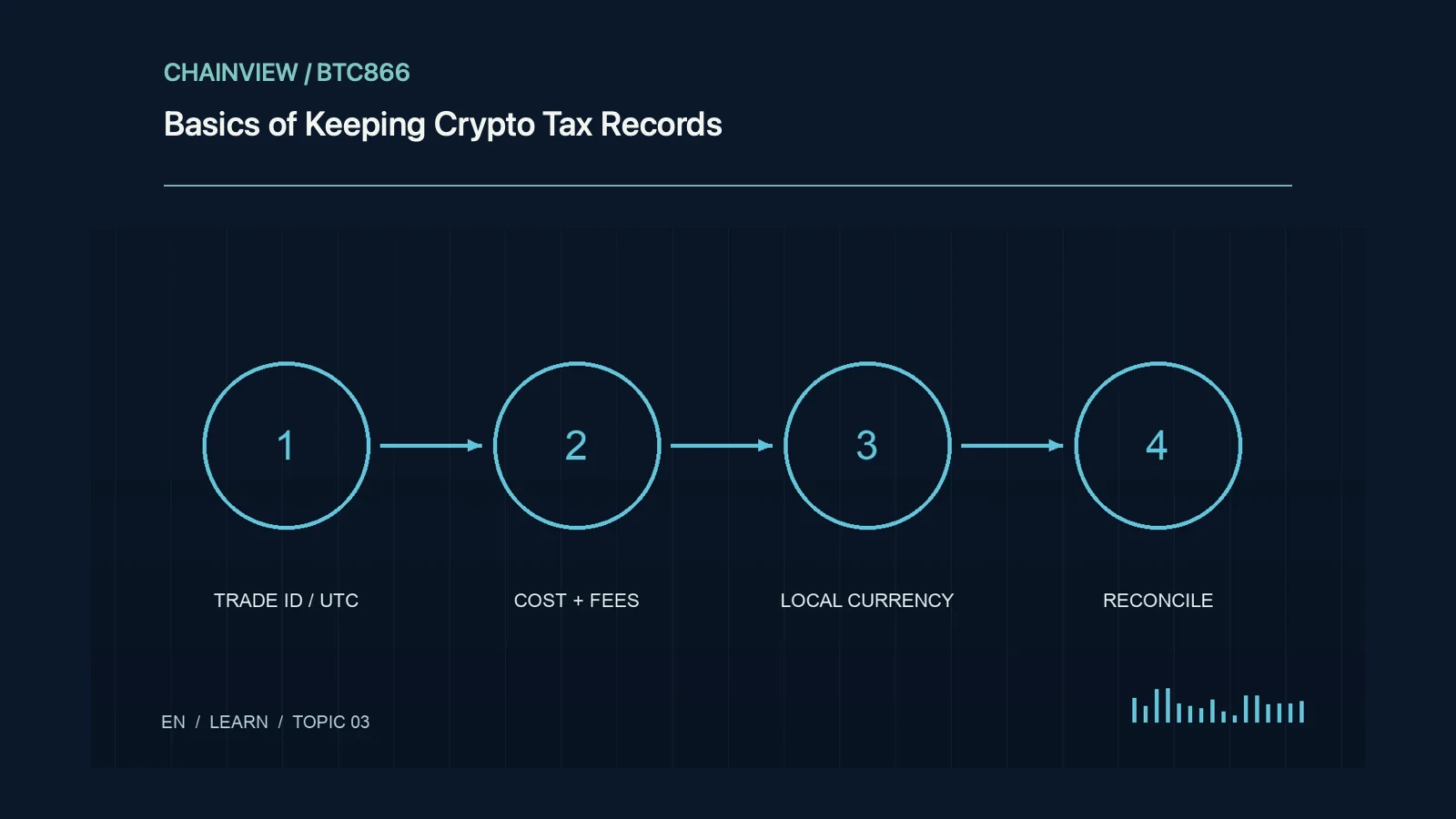
Tax treatment depends on jurisdiction, status, purpose, and date. Preserve facts before classifying every inflow as income or every outflow as disposal. Record time, asset, quantity, counterparty, and purpose, separating own-account transfers, trades, rewards, and lending. Use local official guidance and qualified advice for reporting decisions.
Evidence of basis and fees
Retain fills, payment evidence, and hashes, separating price, venue fees, network fees, and received quantity. Platform profit reports may use a different basis method from local requirements. Preserve both sides of token swaps and contemporaneous fiat references. Missing basis should be investigated rather than replaced arbitrarily with zero or today price.
Pair transfers between own accounts
Link withdrawals, chain hashes, receiving addresses, and deposit records to avoid double-counting internal transfers. Fees, bridges, and wrapped assets can create quantity differences. Verify ownership rather than matching solely by amount. Keep control evidence without providing accountants or software providers with private keys or recovery phrases.
Consistent valuation sources and time
Record reference venue, price type, FX source, and timestamp. Closing, executed, and midpoint prices differ, and their suitability depends on rules and facts. For illiquid assets, document a reasonable method and limitations instead of selecting a favorable screenshot. Preserve original timestamps alongside normalized times, especially around tax-year boundaries.
Exports, duplicates, and gaps
Export regularly before access disappears. When merging APIs and CSVs, check duplicates, missing pages, and symbol collisions. Preserve originals and maintain a separate cleaned dataset with an edit log. Reconstruct gaps from bank, chain, and email evidence, making remaining uncertainty explicit to the professional preparing the filing.
Retention and secure sharing
Check local retention, filing, and correction requirements. Protect identity and portfolio records. Give tax tools read-only access where possible and understand retention and revocation. Reconcile yearly balances and unresolved items. Good records support factual explanations; they do not automatically determine tax treatment or remove reporting obligations.
Worked review example
One unit withdrawn and 0.999 received may represent an internal transfer with a fee. Link both records before classifying the deposit, then retain fee and valuation evidence. Normalize time zones while preserving originals, especially across year-end. Local rules determine tax treatment; reconciliation avoids double-counting without pretending every internal movement has identical consequences.