Original topic illustration: ChainView BTC866 original topic diagram · ChainView BTC866 Editorial · CC BY 4.0
Entropy is not visual randomness
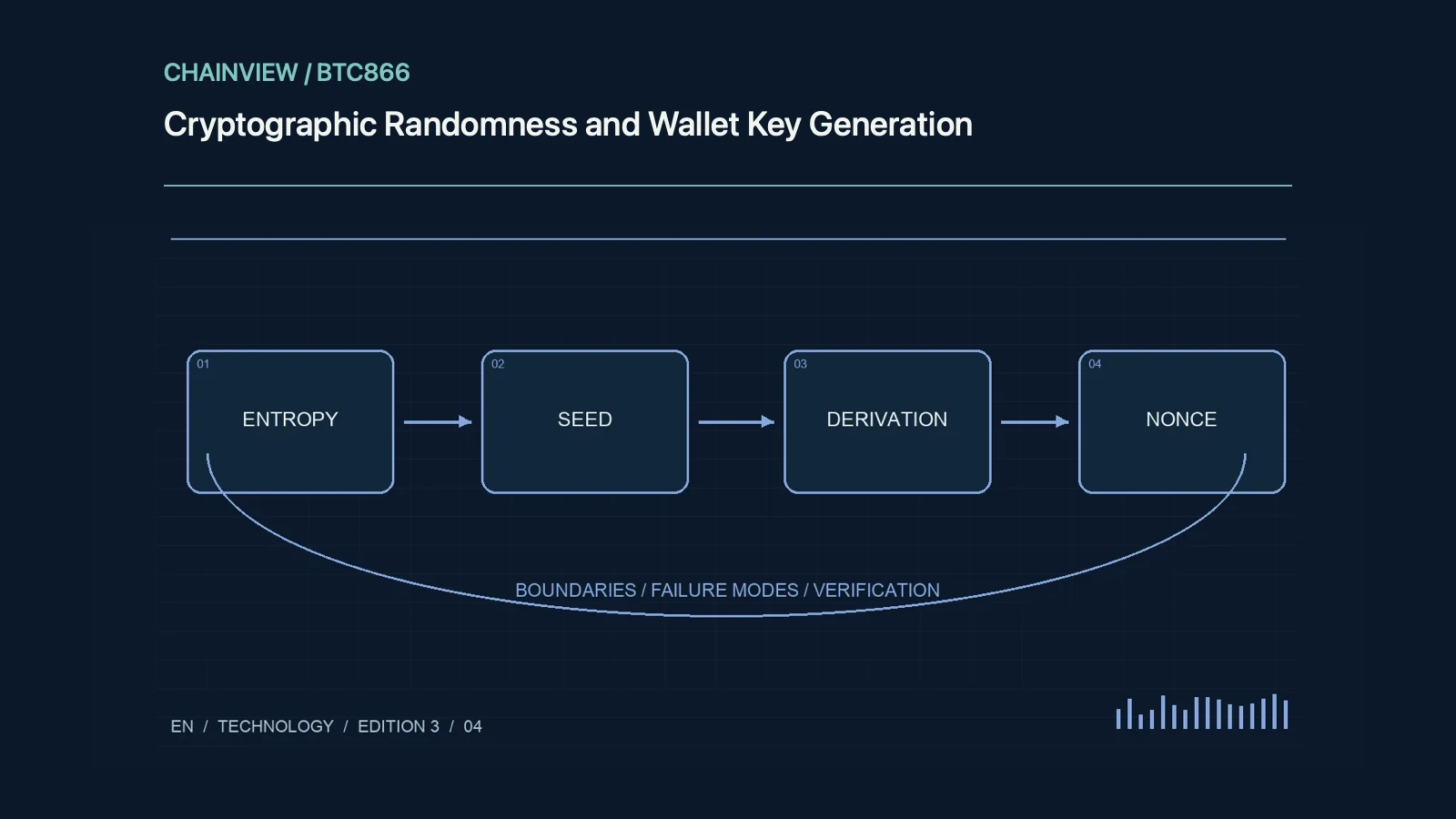
Key generation requires sufficient unpredictable entropy, not merely a messy-looking string. Birthdays, lyrics, keyboard improvisation, timestamps, and public block hashes are unsafe substitutes for vetted sources. Cryptographic generators differ from ordinary statistical random functions. Use established implementations with failure handling. Do not invent memorable key formulas or upload real recovery phrases to online tests; statistical appearance cannot prove that a secret is unknown to someone else.
Deterministic derivation does not create entropy
Deterministic derivation produces many keys from a seed but cannot repair weak initial entropy. A guessable seed remains guessable despite a complicated path. Separate random generation, password hardening, derivation, and address encoding. Recovery also depends on wallet type, network, and path information. An empty restored view calls for checking supported parameters, not repeatedly submitting the seed to unfamiliar websites and expanding exposure.
Signature nonces are a security boundary
In some signature schemes, repeated or biased nonces can expose the long-term private key. Security therefore extends beyond wallet creation. Standardised deterministic nonce generation is not permission to use arbitrary constants. Review algorithms, library versions, side-channel controls, and errors. Incident response should match affected versions and signing conditions. Moving to another address derived from the same compromised seed does not remove the underlying key exposure.
Review generation and recovery evidence
Review implementation, independent assessment, distribution provenance, and advisories; open source alone is not a security conclusion. Test recovery with a dedicated test wallet and minimal exposure without filming secrets. Suspected device compromise can require a new wallet generated in a trusted environment, rather than repairing an exposed seed. Records need versions, procedures, and verified public addresses, not copies of private keys or recovery words.