Original topic illustration: ChainView BTC866 original topic diagram · ChainView BTC866 Editorial · CC BY 4.0
Start with a testable question
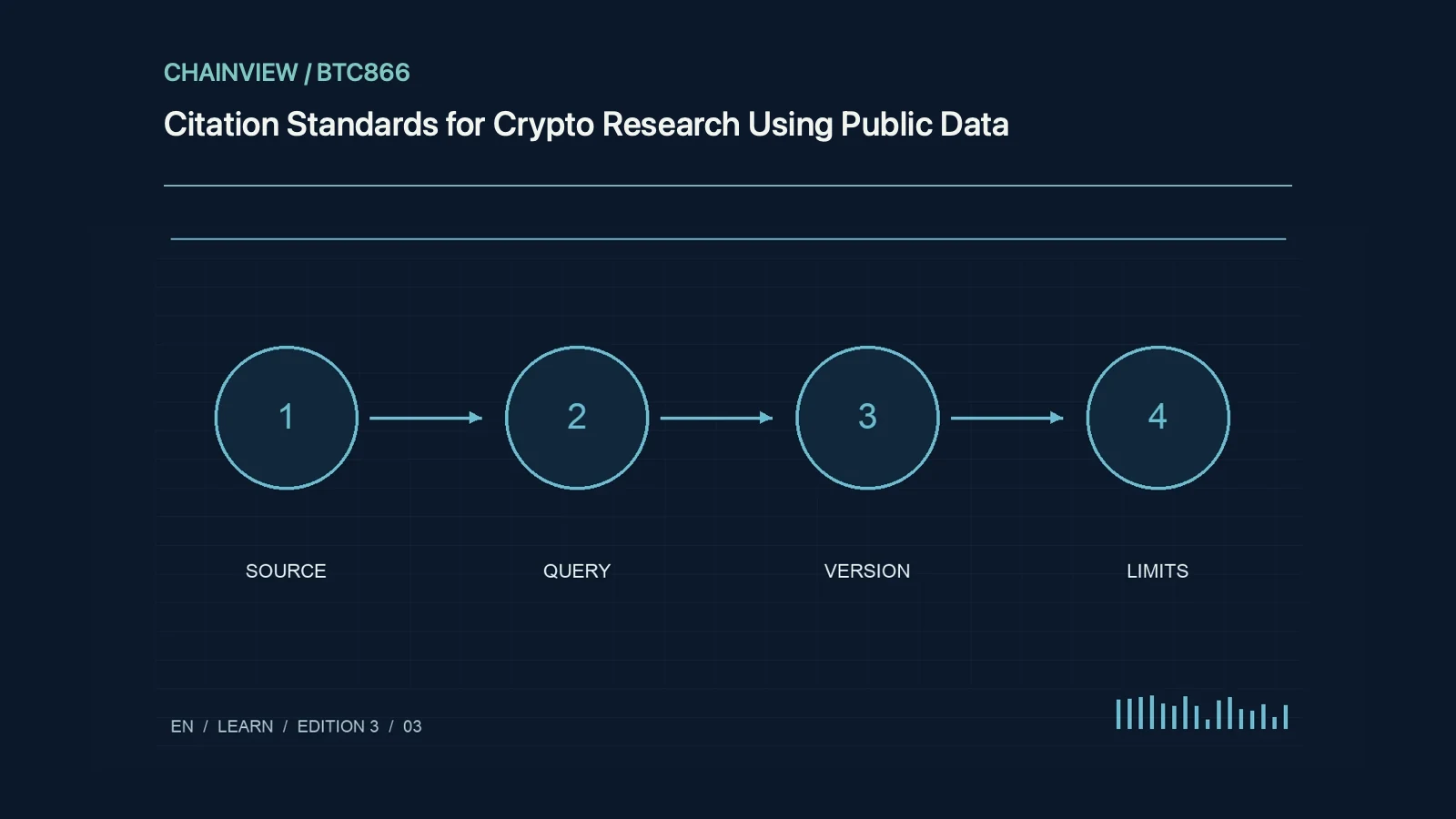
Define the question before selecting data. Active addresses are not people, transaction counts are not payment demand, and dollar-value changes are not necessarily flows. Specify metric, units, networks, contracts, and window in advance. Prioritise primary data, official documents, and reproducible methods. Secondary reporting can guide discovery. Citing an organisation does not imply endorsement of the author's inference, which should be separated from sourced facts.
Save queries and versions
Record provider, endpoint or file, retrieval time, block range, timezone, tool version, and parameters. A dynamic link may not reconstruct an earlier figure; preserve permitted originals or hashes and revision policy. Examples must exclude credentials and personal records. Disclose paid or restricted access. Reproducibility means inspectable methods, not bypassing legitimate access controls or pretending every reader can obtain the same proprietary dataset freely.
Limits of calculations and labels
Attribution, classification, and decimals can be wrong or change. Record label provenance and confidence instead of presenting guesses as identities. Deduplication, reorganisations, missing data, pricing, and outlier policies affect totals. Captions need sample size, cutoff, and material exclusions. Agreement can share an upstream source. Sample public transactions independently and disclose unexplained residuals rather than forcing datasets to match through undocumented adjustments.
State conclusions and corrections
Match conclusions to evidence: observed activity is not a direct measure of every user's confidence or future price. Publish calculations, assumptions, and alternative explanations. If duplicate counting is discovered, update charts and summaries with old value, new value, date, and reason. Respect licences and personal privacy. Clear methods and explicit uncertainty help readers assess reliability more than a long list of loosely connected links.