Original topic illustration: ChainView BTC866 original topic diagram · ChainView BTC866 Editorial · CC BY 4.0
A balance is not a profit report
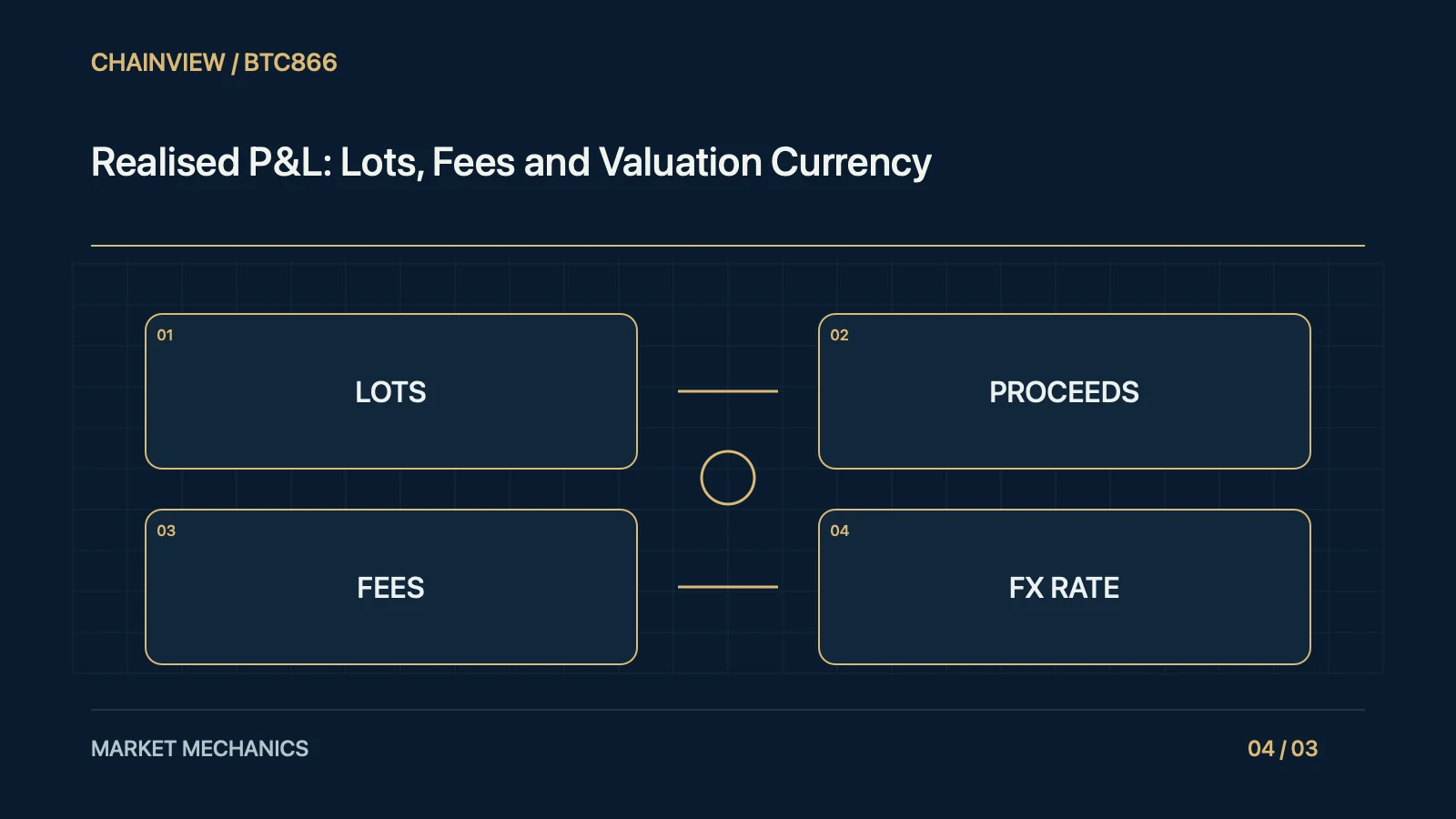
An account balance can increase through deposits, rewards, transfers, exchange-rate changes, or unrealised appreciation. None of those observations alone establishes realised profit. A realised calculation generally matches disposal proceeds with the relevant acquisition cost and expenses, under an explicit valuation currency and lot method. The legal treatment of disposals, rewards, and fees depends on the person's jurisdiction and facts. This article explains the record structure rather than electing a tax method. Preserve quantities, timestamps, trade identifiers, currencies, and fees before using a portfolio application's displayed total. A household economic estimate and a formal filing can use different classifications, so one number should not silently substitute for the other.
Lots change the worked example
Suppose a fictional investor buys two units at one hundred each, later buys two at one hundred fifty, and then sells two at one hundred eighty. Under a teaching example using first-in-first-out and ignoring fees, proceeds are three hundred sixty and matched cost is two hundred, producing one hundred sixty of illustrated profit. Another method can produce a different figure if that method is legally applicable. This example does not make a tax election or permit arbitrary selection of favourable lots. Track the remaining quantity and unused cost of every acquisition so that one cost is not deducted twice. If history is incomplete, mark cost as unresolved rather than inventing zero cost or substituting today's market price.
Connect transfers between owned accounts
Moving assets between wallets belonging to the same owner usually does not represent an economic purchase followed by a sale, although legal classification still depends on the arrangement. An importer that treats the outgoing leg as a disposal and the incoming leg as a fresh purchase can create false gains or duplicate basis. Link both sides using the network, transaction hash, quantities, timestamps, and ownership record. Record network fees separately because the received quantity may legitimately differ from the amount sent. Internal platform transfers may have no blockchain hash; retain both ledger references and account scope instead. Matching only by amount is unsafe when several similar transfers occurred close together or when a service batches customer withdrawals.
Record fees and valuation separately
A fee paid in a third token is not merely a percentage deducted from proceeds. It has its own quantity, timestamp, valuation evidence, and potentially a separate disposal treatment under local rules. Preserve the actual charged amount rather than a promotional fee schedule. A fiat report also needs a named exchange-rate source and a rule for the valuation time. Token migrations, redenominations, rewards, rebates, and changes in wrapped representation need their own links to previous records instead of being forced into ordinary buy or sell rows. Where a reliable price is unavailable or liquidity is thin, retain raw quantities and explain the valuation uncertainty. Apparent precision from a spreadsheet does not resolve missing economic facts.
Reconcile quantities before trusting totals
For each asset, compare opening quantity plus inflows minus outflows with closing quantity, then review the profit calculation as a separate control. Differences can arise from missing partial fills, duplicate imports, time-zone cutoffs, omitted staking accounts, or fees assigned to the wrong asset. Keep an unresolved-difference schedule with evidence and a responsible reviewer rather than creating a fictional balancing trade. Cross-border users should retain both the original transaction currency and the reporting currency required for their own circumstances. Give a qualified adviser the source exports and method notes, not only a polished summary. Save a version whenever a correction changes the result so that a transaction remains traceable from the venue statement through the final report.
If costs or fees remain unknown, label the result provisional and state the affected scope. Missing information is not evidence of zero cost. Recalculate after source records arrive and retain the old result with a correction note. This is particularly important when a prior summary has already been supplied to an adviser or used for a household decision.