Original topic illustration: ChainView BTC866 original topic diagram · ChainView BTC866 Editorial · CC BY 4.0
Mechanism and rights
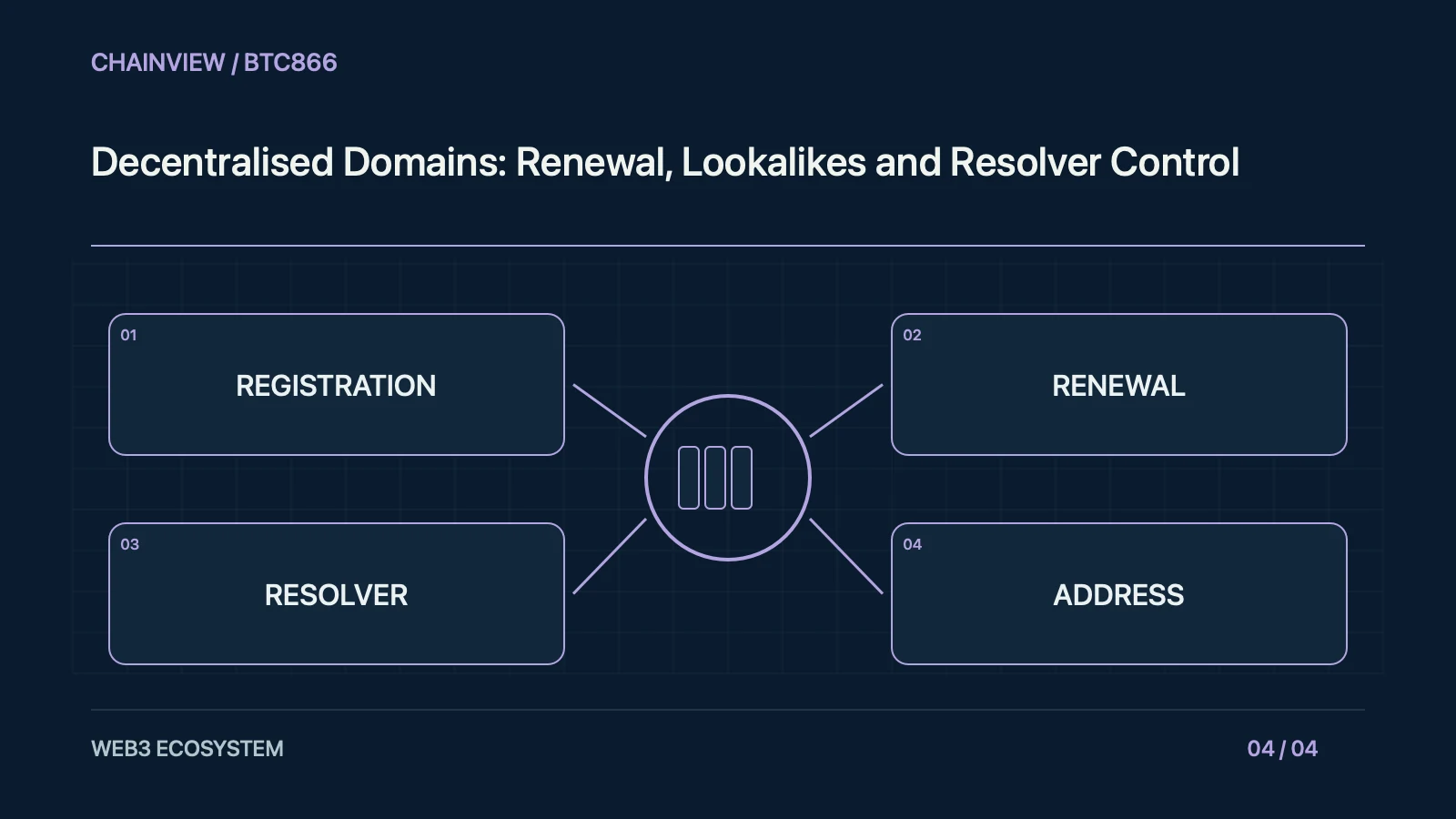
A blockchain name connects a registration system with resolver records. The registered holder, resolver administrator, and displayed reverse-name controller can be different roles. A familiar name in a wallet does not authenticate a recipient or establish that a record applies to the chosen network. Verify the registry, name type, and final resolved address. Treat readable display as a convenience rather than a substitute for an independently confirmed address book.
A name can contain several records, so a correct address for one asset does not establish correctness for another network. Record the coin code, network, and resolver tool version. A recipient should specify the intended route rather than asking a sender to infer it from a familiar symbol. Resolve the actual requested record and compare its complete result with independent evidence.
Records and verification
Renewal, expiry, grace, and redemption rules depend on the registry and name type. Some names require periodic renewal, while subnames can have different control arrangements. Check fees, expiry times, renewal authority, and update permissions. A single purchase does not prove permanent ownership. Use independent reminders and retain registration receipts. Before renewing, authenticate the official route instead of sending funds to an urgent renewal address delivered through an unsolicited private message.
Transfer, grace, expiry, and redemption periods can have different control rules. Whether the previous holder can still update records depends on the registry. Set reminders early and check fees and available payment methods before urgency develops. A last-minute renewal warning can be a phishing lure, so authenticate the destination even when the expiry date itself appears plausible and relevant.
Worked limits and controls
Unicode lookalikes can make different names appear similar, and misleading reverse records can display a trusted-looking label. Fonts, copying, and QR codes can obscure the difference. Use trusted tools to inspect normalised forms and complete resolved addresses, then compare them with an independent recipient record. Checking only the first and last characters is insufficient against deliberately similar addresses. The network and complete destination still require review when an interface presents an attractive human-readable name.
Lookalike inspection should cover the full name and suffix, not only its opening characters. Validate the resolved value against the intended address format. An empty or malformed record should not be guessed into a familiar contact by the interface or the user. Resolve uncertainty through another channel instead of assuming that a pleasant display label implies a usable or authenticated destination.
Exceptions and actions
Resolver upgrades, record edits, proxy permissions, and subname administrators can change future destinations. A name that worked previously may no longer belong to the same recipient or have correct records for every network and asset. Read current records before sending and confirm important transfers through a separate channel. A successful small transfer tests one route at one moment; it does not authenticate later clipboard content, future resolver changes, or every supported chain.
An organisation receiving repeated payments can publish independently verifiable addresses and an address-change procedure, with the name as one access route. A new-destination request should not be confirmed only within the same email thread if that account may be compromised. Use an established independent contact path. Domain convenience works best when supported by operational verification rather than treated as the organisation's sole identity proof.
Ongoing maintenance
Maintain expiry, controllers, resolver, asset records, reverse records, and recent changes together with public verification evidence. After an error, preserve the name, resolution result, timestamp, network, and transaction hash instead of repeatedly sending to investigate. Explain that a name is not legal identity, guaranteed permanent availability, or a promise of recovery. Update renewal and resolution instructions when registry rules change. Readers can benefit from readable names while retaining the full-address checks that protect an actual transfer.
An incident report should distinguish registration takeover, resolver changes, clipboard replacement, and user misreading instead of calling every problem a stolen domain. Different causes imply different follow-up actions. Accurate evidence helps official support and avoids accusing an unrelated name holder. Preserve the observed resolution at a stated time, since later records can legitimately differ and cannot reconstruct the earlier state without historical evidence.