Original topic illustration: ChainView BTC866 original topic diagram · ChainView BTC866 Editorial · CC BY 4.0
Identify the source of risk
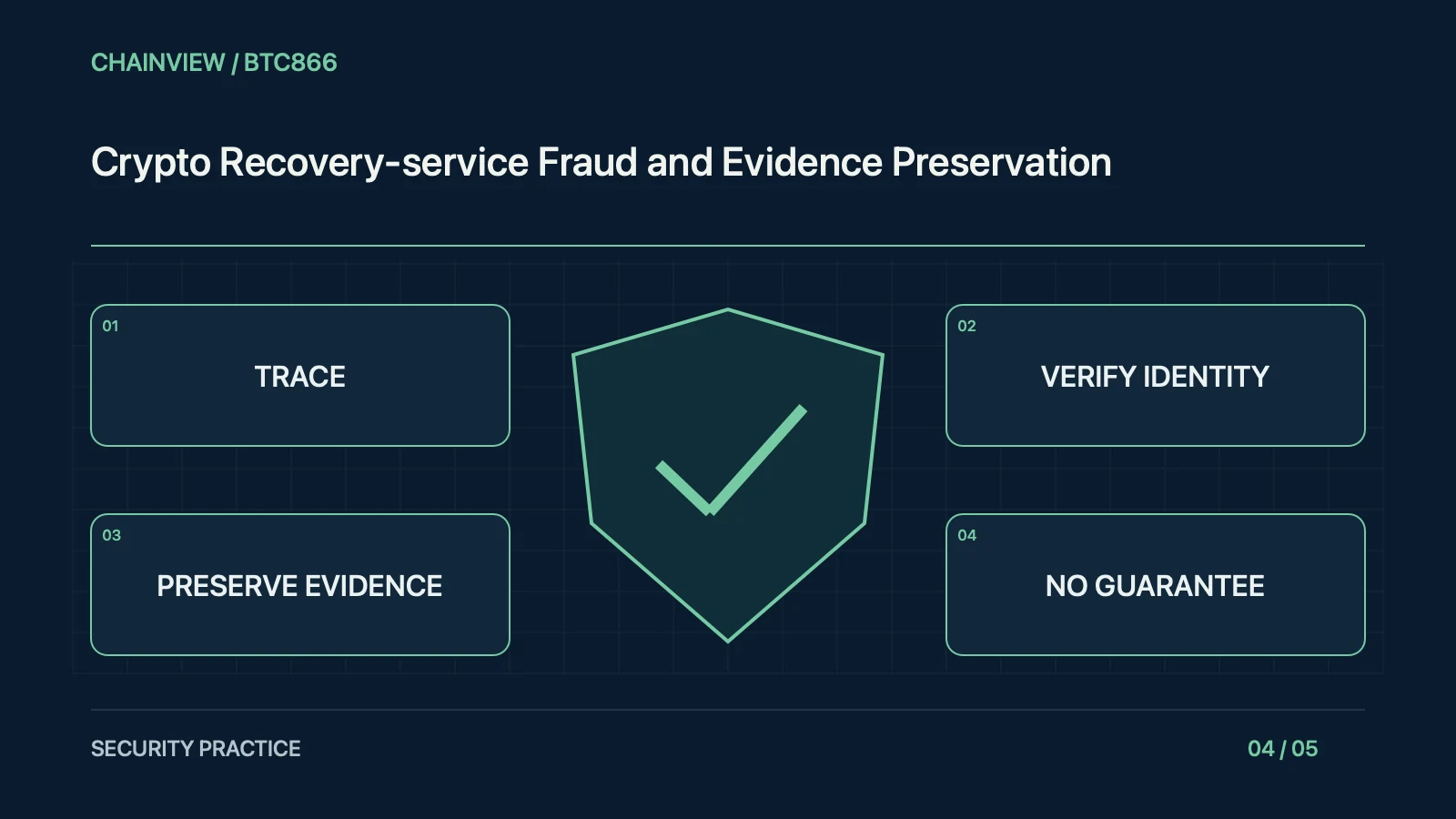
Public blockchain tracing can help identify transaction paths, but it cannot guarantee possession of keys, legal freezing powers, or recovery. Outcomes depend on destination, platform cooperation, legal authority, and case facts. Treat a promise of certain success cautiously. Knowledge of a familiar hash or some personal information does not authenticate an investigator; those details can come from public records or earlier exposure rather than any official power.
An impressive tracing diagram demonstrates an analytical presentation, not power to freeze or return assets. Ask the analyst to distinguish observed transfers, inferred address ownership, and legal advice. Unknown attribution should remain unknown. A clustering output is not a court finding, and an apparently clear path may still end at a service whose cooperation depends on independent legal and operational requirements.
Inspect each relevant field
Secondary fraud often requests an advance investigation fee, release tax, deposit, or payment to a personal wallet under a false enforcement identity. A website showing recovered funds can be fabricated and does not prove that anyone controls returnable assets. Do not supply recovery phrases, private keys, remote access, or a complete identity file to an unknown claimant. An unclear signature requested to prove ownership can itself grant valuable permissions and should not be approved blindly.
Real institution names and badges can be copied. Caller identification and profile images do not verify an official. Independently locate a public contact route and confirm the case and person there. Accepting every verification method from the same unsolicited contact creates a closed loop controlled by the claimant. Authentication needs an outside anchor, not another document or phone number supplied within the same conversation.
Understand the limits
Preserve hashes, addresses, networks, quantities, times, platform references, communications, and payment evidence. Keep original files unchanged and build a separate timeline. Do not make further transfers to gather more evidence from the fraudster. Share only necessary information through verified secure channels. For identity documents, record the recipient and purpose; follow legitimate redaction requirements without altering facts or manufacturing documents. A coherent evidence package is more useful than scattered screenshots stripped of dates and transaction context.
The timeline should preserve original time zones and event types, while communication exports retain attachments and context. Hash important files where useful. Avoid publicly exposing full identity records, family details, or nonpublic case information. Preserving evidence for a verified authority and broadcasting it on social media have different standards. More public disclosure can create additional targeting without improving the chance of lawful recovery.
Respond safely
Find platform and public-authority contacts independently on official sites instead of using a stranger's supplied number or link. Before considering a lawful professional service, verify credentials, legal entity, written scope, fees, conflicts, and confidentiality terms. Technical tracing and legal power to obtain a freeze are distinct capabilities. Seek advice in the relevant jurisdiction when needed. A successful case elsewhere is not a promise that another country, platform, or set of facts will produce the same result.
A written agreement should define scope and non-guaranteed outcomes. Transparent fees do not prove effectiveness, and genuine credentials do not remove conflicts. For cross-border work, establish representation authority, jurisdiction, and personal-data handling, obtaining local legal advice when appropriate. A professional title from one location is not automatic authority to act against every foreign platform or to promise a particular enforcement measure.
Maintain controls
Track case numbers, formal reports, submitted evidence, and responses. Separate confirmed destinations, analytical inferences, and unknowns. New recovery solicitations require fresh verification rather than another payment, particularly when urgency is used to exploit distress. Educational reporting should preserve evidence and reduce secondary loss without exposing identifying victim details or promising recovery. Update verified developments through official records and avoid repeating a supposed law-enforcement endorsement that has not been independently authenticated.
Pausing new solicitations and using a trusted person to help organise evidence can reduce pressure-driven payments. Reporting should remain factual and avoid blaming victims or manufacturing immediate recovery hopes. Updates should contain verifiable developments and usable official routes. The practical aim is to preserve options and prevent secondary losses while the actual case proceeds, rather than replacing one unsupported financial promise with another.