Original topic illustration: ChainView BTC866 original topic diagram · ChainView BTC866 Editorial · CC BY 4.0
Distinguish categories and perimeters
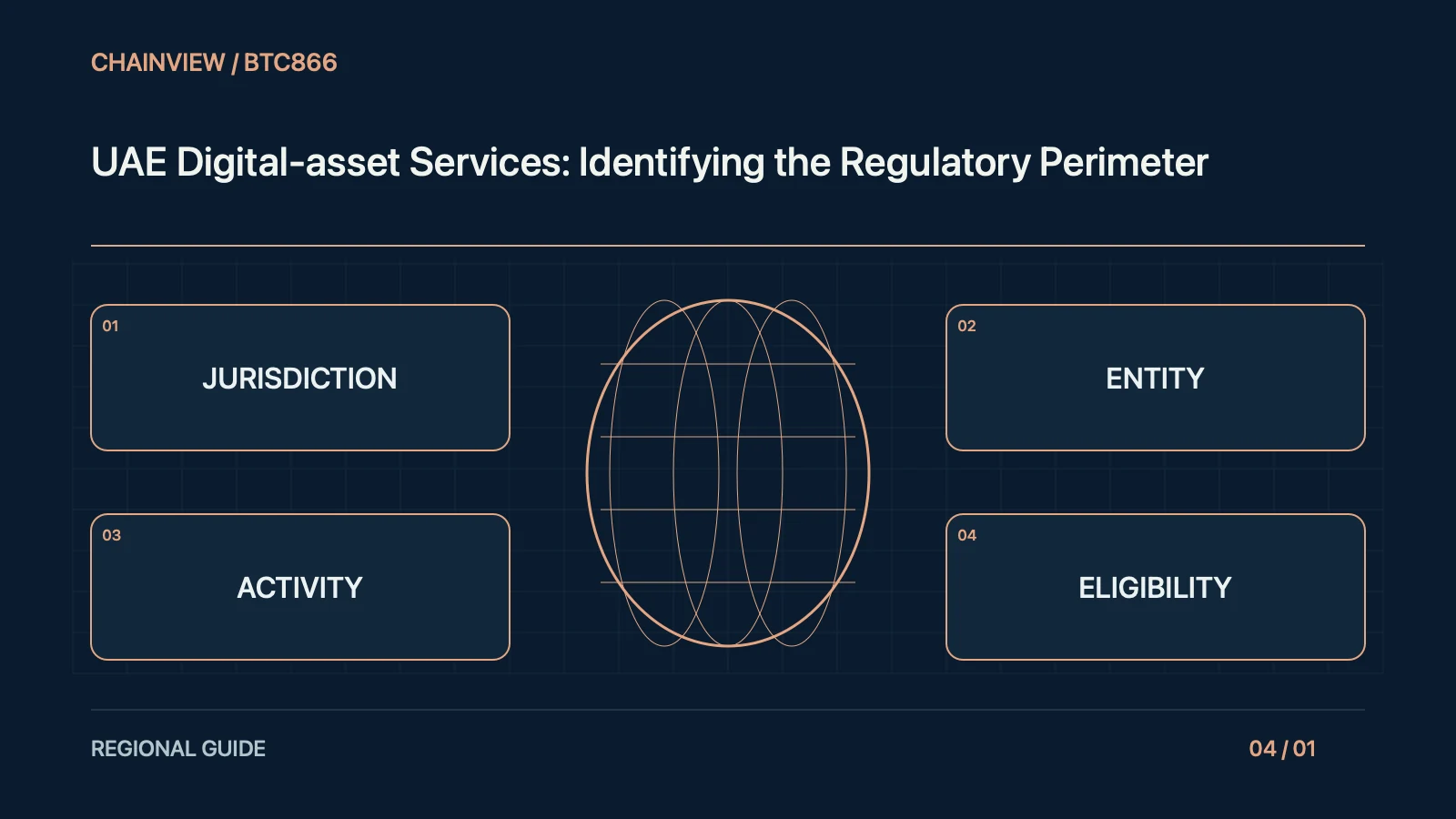
Digital-asset oversight in the UAE has multiple geographic and activity perimeters. The country name is not a single licence. Dubai VARA's perimeter excludes the DIFC, ADGM has its FSRA framework, and DIFC involves DFSA rules. Identify the contracting legal entity, location, activity, and customer category first, then consult the relevant authority's current materials. A regional marketing page cannot resolve those separate questions.
Search the register by the complete legal name rather than only a short brand. Distinguish active, restricted, suspended, and withdrawn states. If a listed website and a promotional domain differ, verify through the authority's own directory. An imitation site can borrow a genuine reference number, so matching the number alone does not authenticate the destination or contracting entity.
Verify current records
Licences, preliminary approvals, registrations, sandboxes, and operational status can differ. An authorisation for one activity does not automatically cover every product, emirate, or overseas solicitation. Match the public record's legal name, reference, status, activities, restrictions, and official domain, retaining the query date. A regulatory logo on a promotional page is a lead to verify rather than a substitute for the register, and authority over one group entity need not extend to all affiliates.
Preliminary approval can have conditions still to be satisfied. A public announcement date is not necessarily the date on which customer operations became permitted. Preserve original status wording and activity descriptions rather than compressing a translation into fully licensed. Do not predict a future approval deadline on behalf of the authority or assume that an earlier sandbox participation automatically matured into unrestricted operations.
Read applicable terms
Residence, incorporation, and a local office do not guarantee onboarding or a particular protection. Overseas readers should use their genuine residence, contracting entity, customer category, and product terms, distinguishing spot trading, custody, lending, and derivatives. Do not use false addresses or another person's identity to evade eligibility. A country option in an interface is not a completed legal assessment, and a service available to one class of client may remain unavailable to another.
Eligibility can distinguish professional and retail clients, with different evidence and risk conditions. Nationality, visa status, and tax residence are not synonyms. Supply genuine facts rather than rewriting residence to fit a menu option. If a provider's classification is unclear, request written guidance through a verified channel. The ability to begin an online form does not establish eligibility to finish onboarding or use every product.
Keep personal evidence
Custody, segregation, complaints, and insolvency arrangements require the actual contract and applicable rules. Supervision does not guarantee a token's price, technical safety, or uninterrupted service. Review charges, asset-return procedures, risk disclosures, and dispute resolution, and ensure the authorised activity matches the product actually used. If the public evidence does not establish a protection's scope, preserve that uncertainty rather than describing all customer assets as insured or unconditionally recoverable.
Describe protections by asset type, contracting party, custodian, and dispute route. Any group guarantee or insurance needs its own conditions and evidence. In the absence of public support, do not write that everything is covered. Regulatory presence does not remove the need to read the agreement governing the customer's particular claim, nor does it guarantee that a future dispute produces a full and prompt refund.
Maintain and seek qualified review
Maintain entity, perimeter, activities, restrictions, domain, and terms version together and recheck after a status change. Rules can evolve, so an article should direct readers to current official records rather than treating an old screenshot as permanent fact. Seek qualified advice for personal legal or tax obligations. This is a verification route, not a judgement of investment quality or a claim that UAE residence and incorporation provide a universal safety endorsement.
Save official references and query dates periodically, updating text and translations after material changes and explaining which condition invalidated an older conclusion. Where uncertainty remains, postponing use is a reasonable option. Reporting should not omit restrictions to make access sound convenient. A clear verification path supports readers better than a broad statement that a country or licence makes every product safe for every overseas customer.