Original topic illustration: ChainView BTC866 original topic diagram · ChainView BTC866 Editorial · CC BY 4.0
A listing is not the whole order
An NFT offer may be signed off-chain and fulfilled later on-chain. A website's display state is not the full execution state. Read the marketplace protocol before assuming that hiding a listing invalidates a signature.
Some protocols permit fulfilment outside the marketplace's own page, so disappearance from search is insufficient evidence of cancellation. Read signature type, expiry and invalidation rules before acting. A signed order may contain variable criteria, and the user needs to know which conditions were fixed when the signature was made.
An NFT offer can be represented by an off-chain signed order that is fulfilled on-chain later, so a listing page is not the complete order state.
Inspect the signed terms
Check collection, identifiers, quantity, payment asset, recipient and expiry. Criteria-based offers may accept several qualifying assets, while partial-fill rules affect what remains open. A thumbnail alone cannot communicate those conditions.
An offer may accept any qualifying NFT in a collection rather than the one shown in a thumbnail, and quantity can be partially filled. Check scope, payment-token decimals and recipient. Both sides should inspect native terms instead of relying solely on a converted fiat total beside the image.
Check collection, token identifiers, quantity, consideration assets, recipient, expiry and any criteria or partial-fill rules before authorising an offer.
Understand cancellation semantics
Removing a web listing, revoking approval and cancelling an order can have different consequences. Some systems require an on-chain cancellation or counter change. Clearing browser history does not revoke a previously valid order signature.
Revoking approval can block current fulfilment, but restoring approval may make some uncancelled orders executable again, depending on the protocol. Avoid a universal permanent-safety claim. Preserve cancellation or counter-change evidence, and interpret expiry according to the actual chain-time rule rather than the browser's local clock.
Removing an item from a website, revoking approval and cancelling an order can have different effects under the specific marketplace protocol.
Do not guarantee fulfilment
Ownership, balances and approvals can change after signing. A displayed offer is therefore not guaranteed proceeds. Never prepay an unfamiliar address merely to validate a bid or unlock a supposed marketplace payment.
NFT ownership does not establish full copyright, and an order does not automatically transfer every off-chain usage right. A bid can fail through insufficient balance or changed ownership. Recognise proceeds only after completed settlement and fees, not as certain household cash derived from a still-open displayed price.
Balances, ownership and approvals can change between signing and fulfilment; monitor outstanding offers and never treat a displayed bid as guaranteed proceeds.
Track outstanding commitments
Keep identifiers, signed terms, expiry and cancellation evidence. Review open offers through a verified interface on the correct chain. Support staff do not need a private key or recovery phrase to explain an order's status.
In an incident, establish whether the order was filled, cancelled, expired or remains open, then confirm protocol version. A support case can use public identifiers without recovery secrets. Revocation itself can cost network fees; understand the action before signing, so a cleanup process does not introduce a fresh unfamiliar permission.
A practical open-order review can sort commitments by expiry, asset and protocol. Check whether a cancellation applies to one order or a broader counter affecting others. A broad action may remove desired offers as well as unwanted ones. Explain that scope before signing. The goal is to understand existing commitments, not to invite fresh bids or connect a valuable wallet to a new third-party cancellation service merely because it advertises a convenient shortcut.
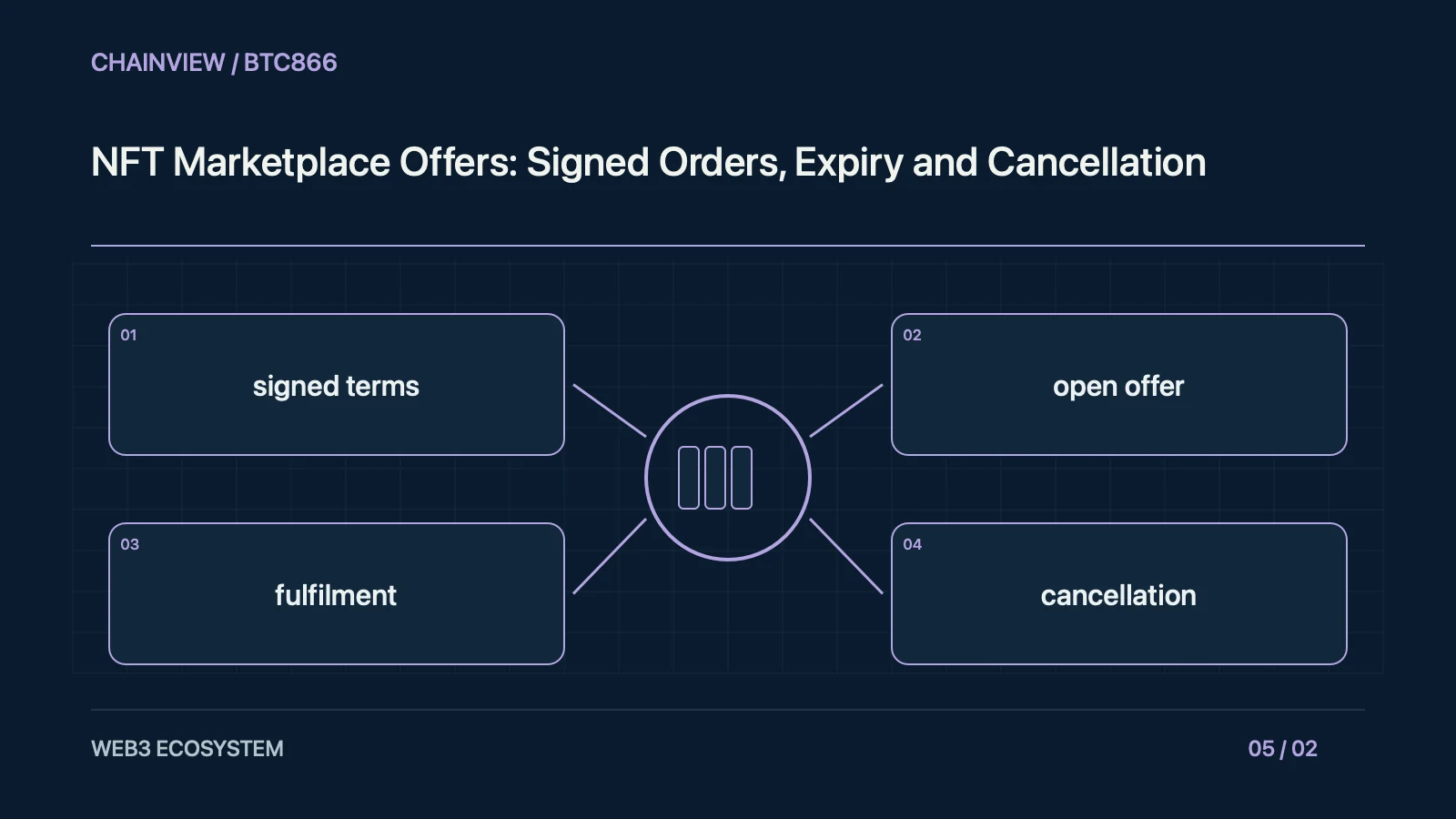
Build a rights-and-execution table around signed terms, open offer, fulfilment and cancellation. Record who can act, which condition must be satisfied, when funds become available and what happens if the step fails. Separate interface display, signed commitment and completed transaction; the same claim shown in two places must not become two assets in a ledger. Keep the rule version and exit conditions, explicitly marking unknown powers. This exercise supports an assessment of real obligations and control. A headline return, community vote or popular application can be relevant context, but does not replace the specific contractual and technical facts of the operation.