Original topic illustration: ChainView BTC866 original topic diagram · ChainView BTC866 Editorial · CC BY 4.0
Check whether funding is committed
A payment stream may gradually make a balance withdrawable, but funding models vary. A future schedule does not prove every promised unit is already locked. Inspect the funding source and ongoing conditions.
Check whether the full funding actually entered a contract or was only configured in a user interface. Token approval is not the same as locked funds. A cancellable future funding arrangement has different credit risk from full prefunding. A recipient should know which amounts have existing on-chain backing and which depend on later action.
A time-based payment stream can make a balance withdrawable gradually, but implementations differ in funding model and accrual schedule.
Separate accrued and withdrawn amounts
Total commitment, elapsed accrual, withdrawals and remaining balances describe different stages. Linear accrual is only one design. Start time, pauses and rounding can make a salary-like display different from immediately withdrawable funds.
If accrual is calculated in seconds, align start and end times to an explicit zone and state whether pauses continue accrual. Rounding can affect the last amount. A monthly display may simply be a conversion rather than the protocol's native payment period or a legally compliant wage schedule.
Distinguish total committed funding, elapsed accrual, already withdrawn amounts and the remaining refundable or locked balance.
Read cancellation and transfer powers
Check who can cancel, pause, transfer or change the beneficiary. Treatment of unaccrued funds depends on the implementation. Experience with one streaming protocol cannot establish another product's refund or continuation rules.
Transferability of the recipient right can change who is paid. Cancellation and already-accrued claims cannot be inferred from button names. Include administrators and emergency modules in the rights map if they can pause the system. Only then assess whether the design suits a particular recurring payment relationship.
Read cancellation, pause, transfer and beneficiary-change rules; a streaming interface does not by itself create employment rights or ensure future funding.
Keep legal and technical claims separate
A stream does not itself establish employment rights or guarantee future funding. Token volatility, network charges, transfer restrictions and administrators affect outcomes. Cross-border users must assess relevant local obligations separately.
Cross-border compensation can raise employment, tax and payment obligations that a blockchain schedule does not automatically satisfy. Falling token prices can reduce purchasing power even when the native quantity arrives on time. Keep both units and local valuation; technical punctuality does not mean fixed economic value.
Account for token volatility, network fees, blocked transfers and administrative risk, and keep dated records for both payer and recipient.
Reconcile by time and movement
A hypothetical ledger can link funding, accrual, withdrawal and refunds without double counting. Preserve transactions and terms while limiting disclosure of salary and identity data. Visibility into a schedule does not remove counterparty or legal risk.
A fictional 100 units over ten days, withdrawal on day three and cancellation on day five can reconcile paid, accrued and returned amounts. Rounding, timing and pauses may change the answer. The example teaches rights and should not encourage publishing another person's salary or identity on a public chain without consent.
When a recipient changes devices, access to the same account and access to a transferred stream are not necessarily the same issue. Verify the beneficiary address and any ownership token or transfer mechanism defined by the protocol. Do not assume an email change updates an on-chain recipient. Keep legal payment instructions and technical address records aligned through an agreed process, especially when a recurring relationship spans countries and several local time zones.
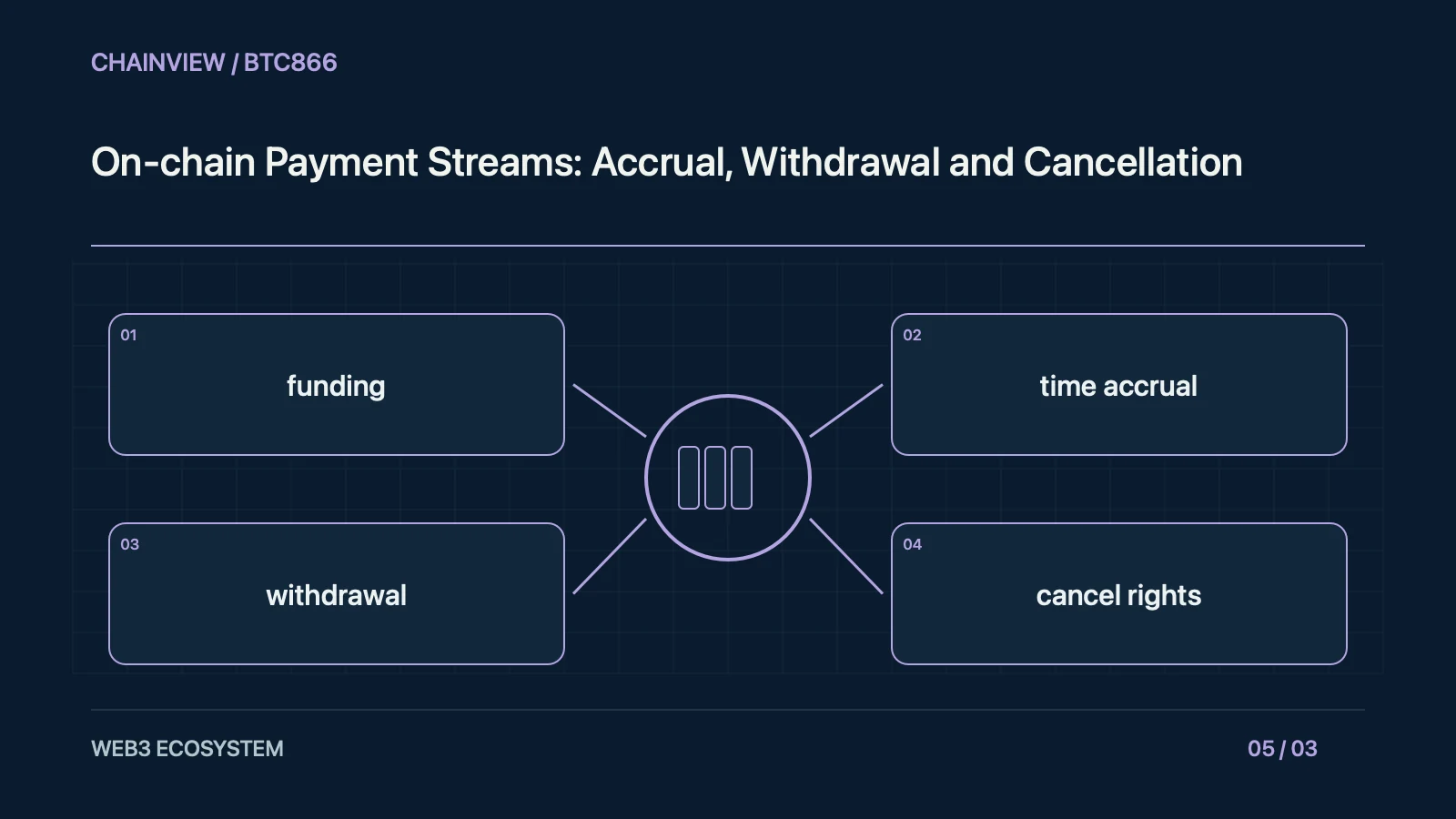
Build a rights-and-execution table around funding, time accrual, withdrawal and cancel rights. Record who can act, which condition must be satisfied, when funds become available and what happens if the step fails. Separate interface display, signed commitment and completed transaction; the same claim shown in two places must not become two assets in a ledger. Keep the rule version and exit conditions, explicitly marking unknown powers. This exercise supports an assessment of real obligations and control. A headline return, community vote or popular application can be relevant context, but does not replace the specific contractual and technical facts of the operation.