Original topic illustration: ChainView BTC866 original topic diagram · ChainView BTC866 Editorial · CC BY 4.0
Separate balance movement from performance
Ending minus starting value mixes deposits, withdrawals and trading. List each external cash flow and its timing. Internal wallet transfers should not be counted as new capital. Align valuation currency and fees.
Moving funds between household wallets does not change combined capital, but imports can classify the two ends as spending and income. Pair hashes, amounts and times, with fees separate. Mark unmatched entries for review instead of turning a balancing difference into investment profit.
Ending portfolio value minus starting value mixes investment performance with deposits and withdrawals, so a return calculation must identify external cash flows.
Time-weighted returns use subperiods
Time-weighted performance breaks a period around external flows and links the subperiod returns. It reduces the effect of when the investor contributed, but still requires consistent valuations, prices and fees.
Each subperiod boundary needs a credible valuation. An illiquid asset may not be executable at its display mark. Confirm consistent denominators and fee treatment before linking returns; percentages should not simply be added. If flow timing is unavailable, disclose the approximation and its error sources.
Time-weighted returns link subperiod performance around flows and aim to reduce the effect of the investor's funding decisions.
Money-weighted returns include timing
Money-weighted performance reflects the size and timing of cash flows. An internal-rate-of-return calculation can be ambiguous or lack a useful solution. A high result may describe the investor's funding path rather than a portable strategy outcome.
Money-weighted results are sensitive to large contribution dates, so two investors using similar asset choices can obtain different outcomes. Alternating positive and negative flows may produce multiple mathematical solutions. Do not select only the most attractive solution; explain it alongside a net-cash table or another appropriate measure.
Money-weighted returns reflect the size and timing of cash flows; an internal-rate-of-return calculation can have ambiguous or unavailable solutions for some patterns.
Work a small ledger
Suppose an account starts at 100, receives 50 and later withdraws 20. Compare subperiod valuations under both methods. The fictional numbers teach the distinction and make no claim about an asset's return or local tax treatment.
A teaching example can let the account rise before the additional deposit, then compare methods at the same final value. Label the order of valuations. Do not replace unknown intraday timing with invented precision. Explicit simplifications help prevent a classroom model being mistaken for a personal tax calculation.
Use consistent valuation times, fees and currency in a small hypothetical ledger, and reconcile internal wallet transfers so they are not counted as new capital.
Keep methods and versions
Record valuation dates, prices, currency, fees and missing-value treatment. Pair internal transfers before importing data. A household decision needs return measures alongside liquidity, risk tolerance and the balance actually available.
When historical quotes change, determine whether the source corrected prices or the currency conversion changed, retaining the earlier report. Performance and taxable profit are distinct. A return rate is not automatically an assessable amount; complete source records are more useful to an adviser than a polished curve alone.
A spreadsheet should state whether fees are deducted from the account value or listed as a separate flow, ensuring they are not charged twice. The same care applies to cash held outside an exchange but inside the chosen household portfolio boundary. Changing that boundary changes the interpretation. Write the boundary before calculating, then keep it consistent across comparison periods. A return measure becomes useful only when the reader knows whose money and which assets it actually covers.
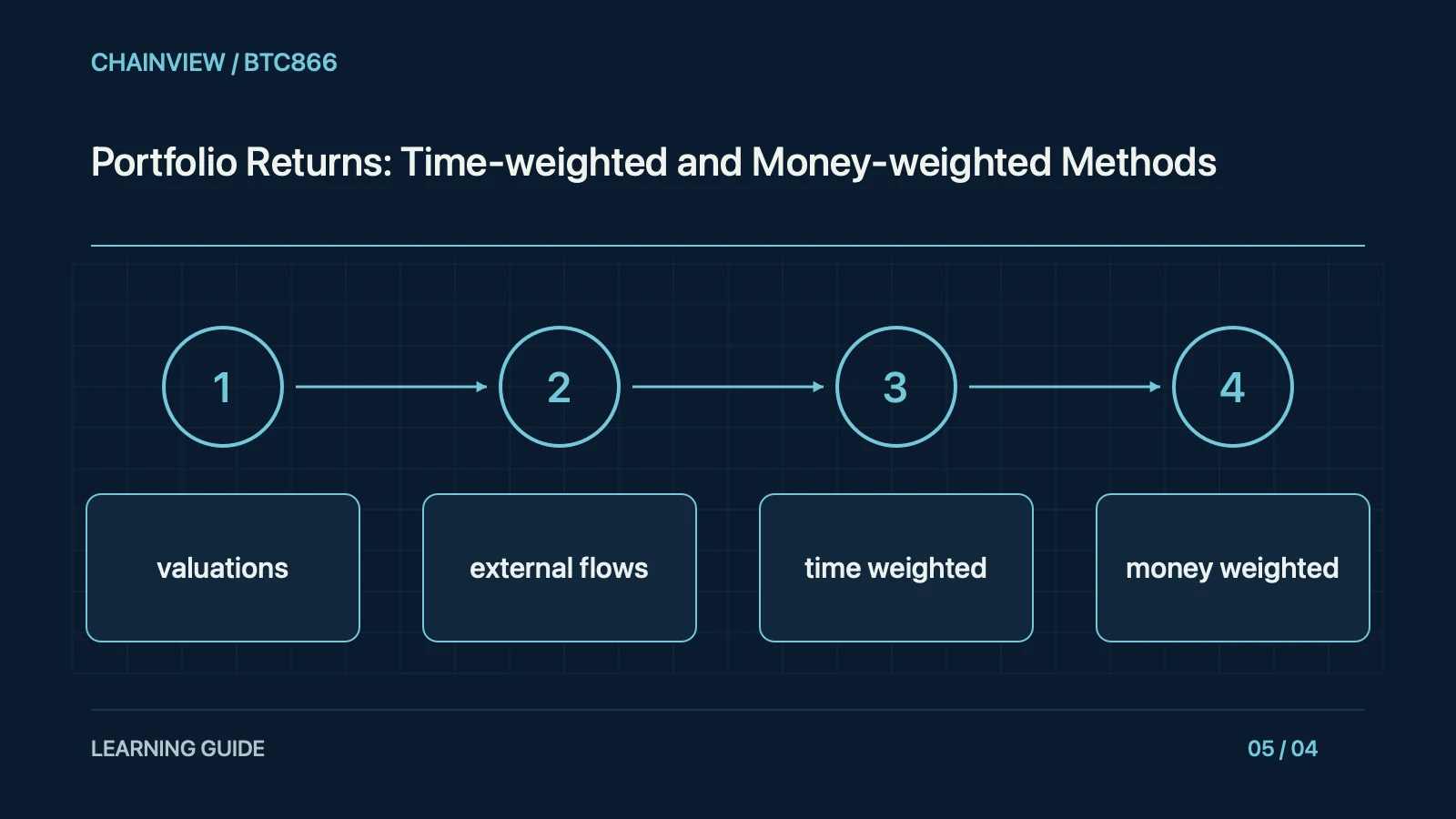
For the practice record, organise valuations, external flows, time weighted and money weighted into concept, fictional input, observed result and limitation. Check units and timing step by step, distinguishing a mathematical result from a tool interpretation. Leave an uncertain field unresolved instead of guessing merely to complete the table. Learning does not require a live private key or a large transaction; preserving method and version is sufficient. Before carrying the lesson into a real service, recheck present software behaviour, charges and local eligibility. A walkthrough teaches a way to ask better questions rather than certifying every provider that uses similar labels.