Original topic illustration: ChainView BTC866 original topic diagram · ChainView BTC866 Editorial · CC BY 4.0
Follow the legal entity
For a South African service, identify the contracting name and activity before checking FSCA information. Different group companies may trade, custody or promote. One entity's record cannot establish equivalent authority for every affiliate.
Copy the full legal name from account terms before searching, excluding similarly named impostors. If register contact details differ from a promotional message, verify through a known official entry point. Do not call an alleged regulator help line simply because it appears in an unsolicited advertisement beside a familiar institution's logo.
Identify the South African legal entity and specific crypto service before checking FSCA authorisation details and any stated conditions.
Read authorisation conditions
A financial-services authorisation is not a universal guarantee for all crypto products. Verify scope, conditions and status date. A regulator's logo cannot replace a current official record or guarantee against asset loss.
A status can have conditions, changes or revocation, so finding a name is only the first step. FSCA information concerns the relevant financial service; it does not certify every token or remove custody risk. Claims of government-guaranteed returns require separate scrutiny rather than acceptance because a firm appears in a register.
Financial-services authorisation does not automatically resolve separate South African Reserve Bank exchange-control or cross-border payment questions.
Check cross-border rules separately
South African Reserve Bank exchange-control and payment questions are separate from service authorisation. Availability on a platform does not permit every funding route. Residence, source and purpose can affect an individual assessment.
Cross-border and exchange-control arrangements may need a bank or qualified adviser to assess facts. Do not invent a universal allowance or limit from incomplete material. When public guidance cannot resolve a personal plan, state the unanswered question. False payment descriptions are not an acceptable substitute for obtaining the required clarification.
Record residency, source of funds, bank transfer references and the actual contracting entity; do not treat a globally available application as permission for every transaction.
Connect bank and chain evidence
Keep local-currency valuations, transfer references, receiving entity, fees and hashes. Explain the purpose accurately when a bank asks. Do not use false descriptions or another person's account to avoid verification.
Match the bank debit to the platform credit, retaining currency, charges and actual recipient. If an intermediary participates, document the chain and terms. A confirmed blockchain transfer cannot establish that every bank-side settlement is complete. Cross-border processing can have several distinct completion timestamps that explain an apparent delay.
Use current official registers and dated notices, and obtain qualified local advice for an individual cross-border arrangement rather than relying on a generic licence badge.
Date the conclusion and its limits
Review current registers, notices and terms, recording what remains unknown. Complaints and personal cross-border arrangements belong with the relevant institution or qualified adviser. Technical access is not a general legal approval.
Distinguish provider complaints, bank-transfer issues and suspected crime when choosing a reporting channel. Keep evidence, but do not presume compensation from a general authorisation. Check the actual protection regime. Update articles faithfully from official material without publishing personal account details or asset claims derived only from rumours.
A final review should ask which institution can answer each unresolved point: provider scope, bank funding or a personal cross-border obligation. Sending the same broad question everywhere often produces answers to different parts of the problem. Split the enquiry, preserve written responses and check that they concern the same entity and date. This does not create a permission by correspondence, but it reduces the risk of combining unrelated guidance into a misleading conclusion for an overseas resident.
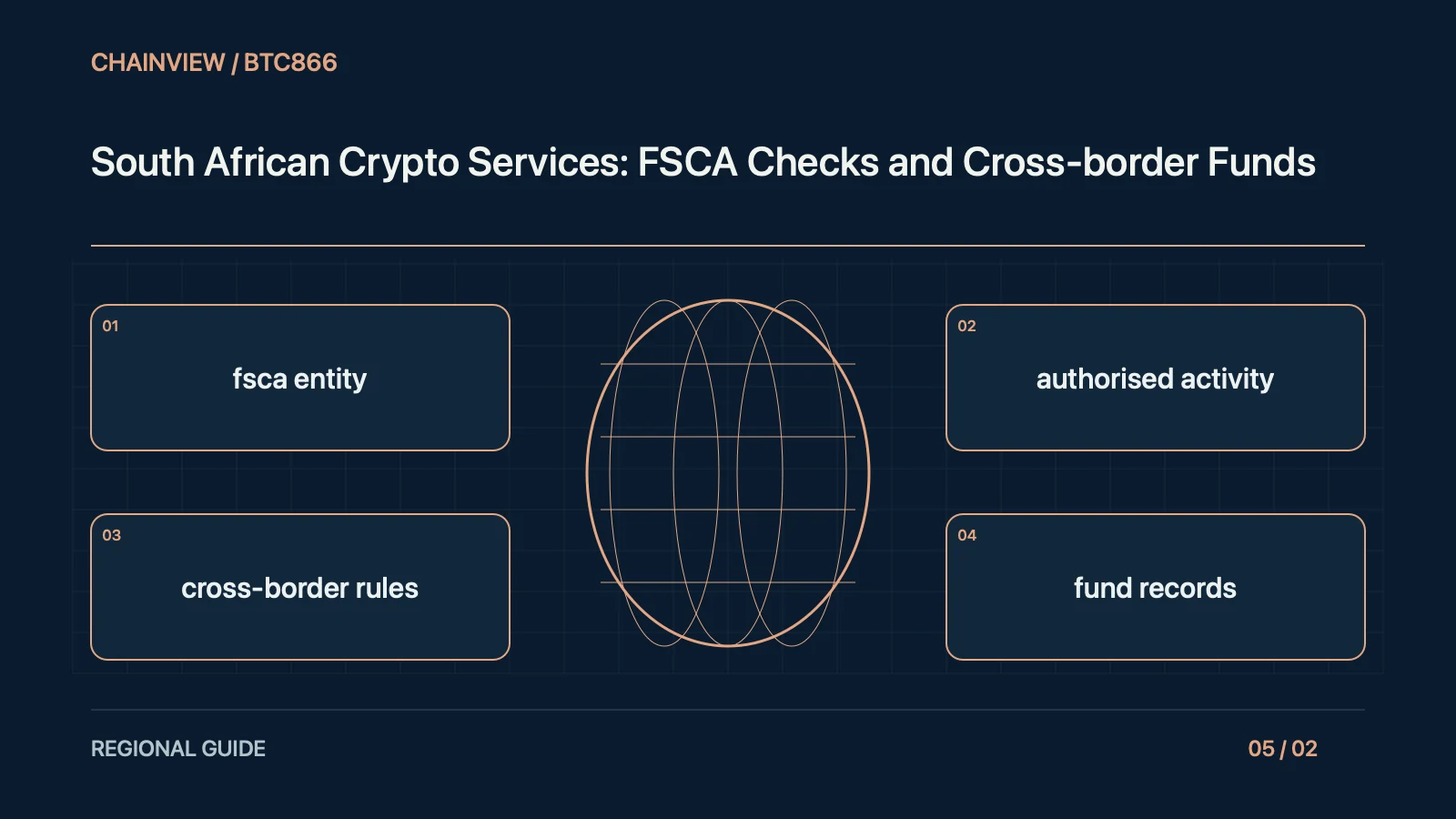
A regional verification record can begin with fsca entity, authorised activity, cross-border rules and fund records, linking each to official wording, retrieval date, contract and personal facts still requiring clarification. Preserve original terminology when translating. General rules, the firm’s status and the user’s eligibility are separate findings. An accessible page does not enlarge a legal permission, and incomplete facts call for a provider or qualified local assessment. Minimise disclosed personal data while retaining necessary evidence securely. Public educational material should never include identity documents, account passwords or recovery secrets. This record supports informed questions and future updates; it does not provide a universal authorisation for every reader abroad.