Original topic illustration: ChainView BTC866 original topic diagram · ChainView BTC866 Editorial · CC BY 4.0
Bound the experiment
A consensus experiment studies history selection, not asset prices. Choose a specific rule in a local or official educational environment and state excluded assumptions. A toy hash game does not reproduce signatures, networking, incentives, or attack costs. Bounded models are useful only when their conclusions stay within the behavior they actually implement.
Give nodes identical validation rules
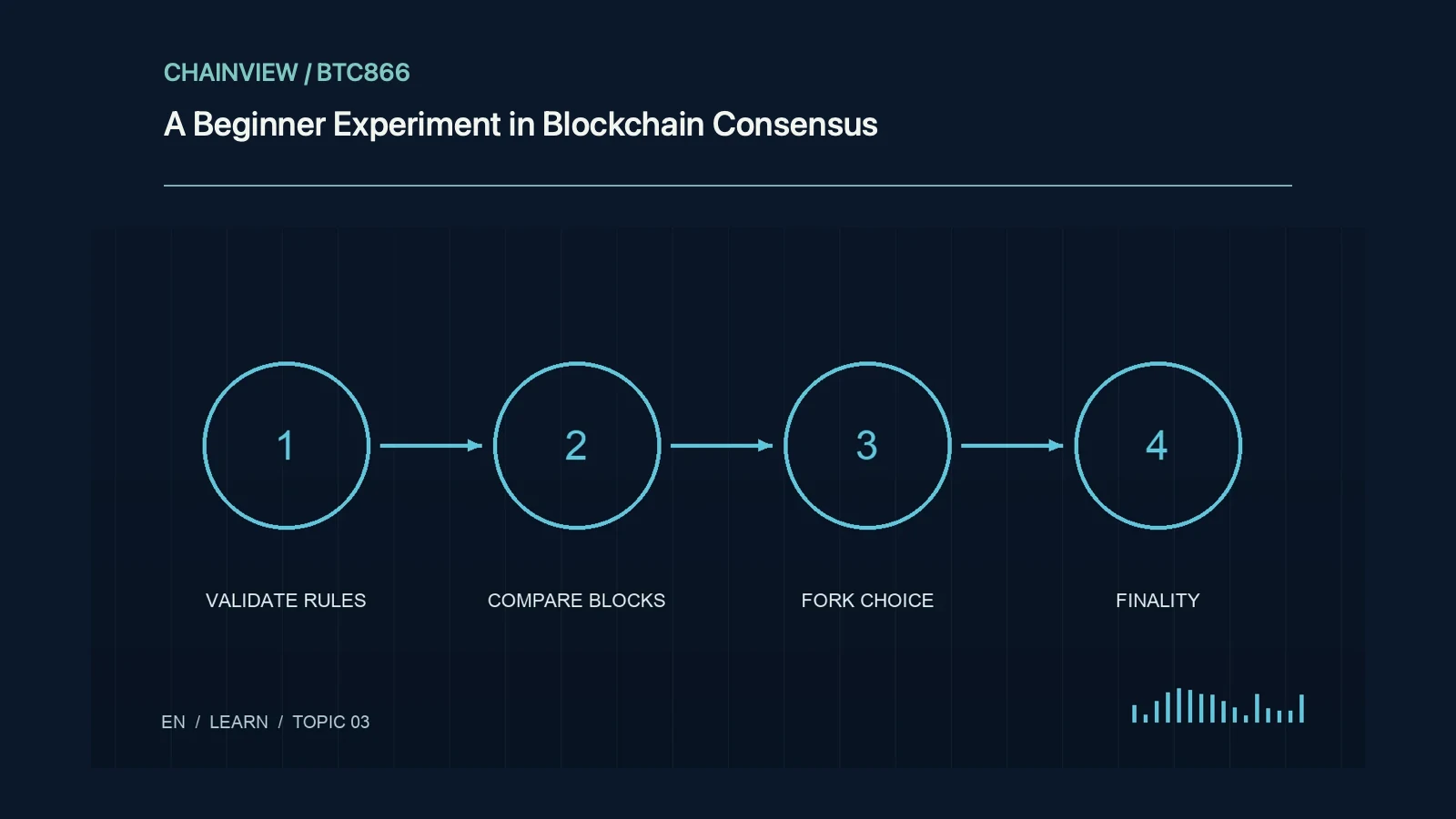
Start nodes from the same state and define transaction and block validity. Submit valid, overspending, and conflicting examples, recording rejection reasons. Consensus selection applies among valid histories. A longer invalid branch should not become acceptable merely through length; validation rules constrain which histories can be considered in the first place.
Introduce propagation delay
Temporarily isolate nodes, provide competing valid blocks, then reconnect them. Record arrival order, common ancestors, and displaced transactions. Change one variable at a time and repeat. The experiment demonstrates temporary forks, not a general statement that attacking the real network is easy or impossible.
Compare selection rules
Block count and accumulated work can select different branches when difficulty differs. Proof-of-stake models may add votes and checkpoints. Compare eligibility, costs, penalties, recovery, and finality using the appropriate specification. Attack assumptions from one consensus design cannot be transplanted unchanged into another.
Simulate a rule change
Apply stricter rules to some nodes, then test boundary cases and formats rejected by old rules. Record version-specific behavior. This illustrates compatibility directions, not the outcome of real social coordination. Preserve configurations and inputs so an implementation bug is not mistaken for an inevitable property of consensus.
Publish logs and limitations
Report goals, versions, initial states, input ordering, parameters, outputs, and reproduction steps. Use local data or test assets, not real payments to unknown teaching addresses. State omitted network scale, economics, and adversary capabilities. A successful demonstration is evidence about a configuration, not a complete security audit of the protocol.
Worked review example
Give two nodes competing valid blocks in different arrival orders, reconnect them, and observe the declared selection rule. Repeat after changing only propagation delay. State omitted signatures or incentives. A reproducible log lets another learner distinguish model limits from coding errors, but does not turn a toy experiment into a complete security conclusion about a production network.