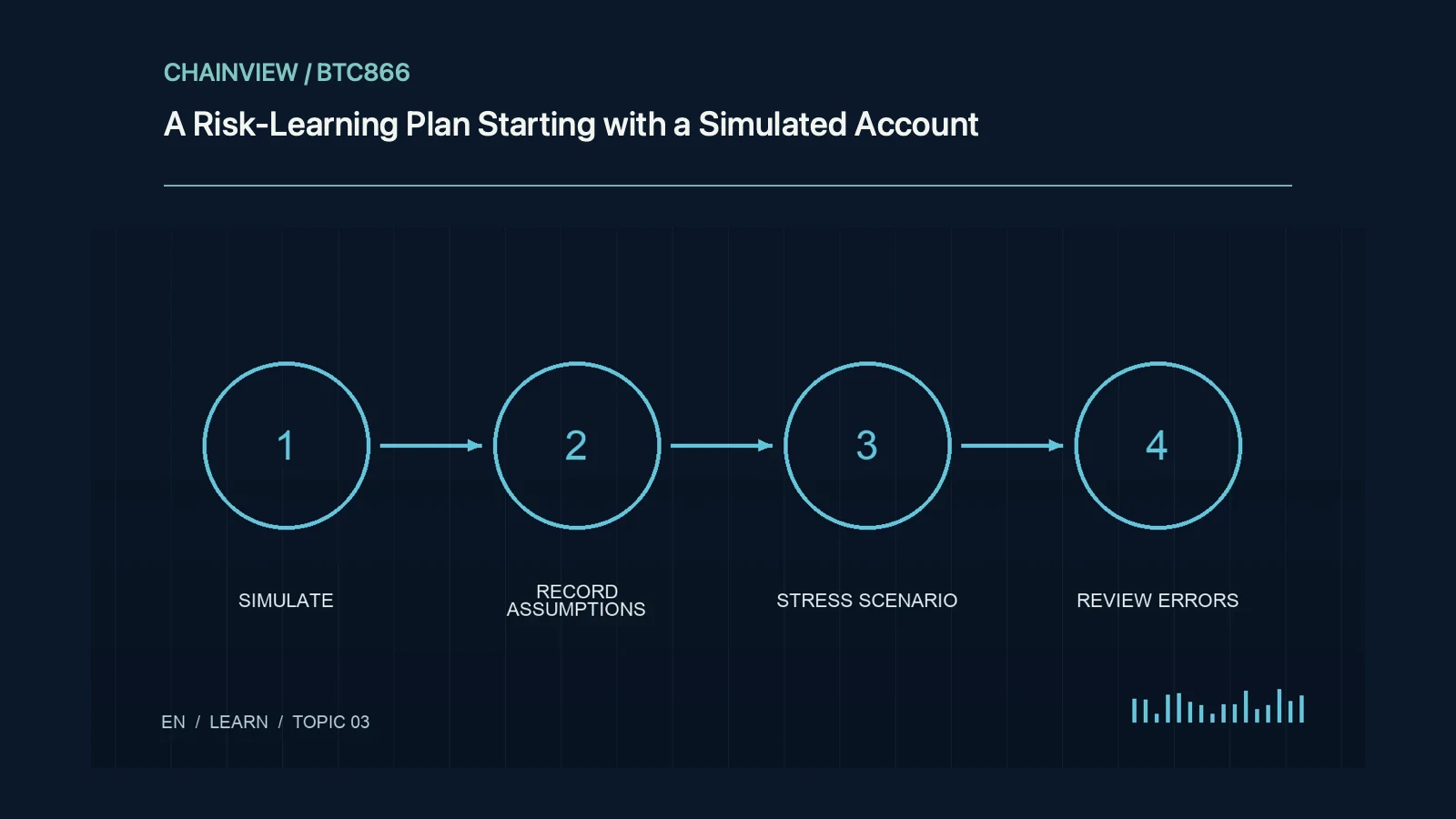
Original topic illustration: ChainView BTC866 original topic diagram · ChainView BTC866 Editorial · CC BY 4.0
Define learning goals
Use simulation to learn orders, costs, and decisions, not to establish future profitability. Set a bounded goal, period, and virtual capital. Preserve losing records and explain resets. Simulators omit some emotional and liquidity constraints, which must remain explicit when interpreting results.
Practice order types separately
Practice market, limit, and conditional orders separately, recording triggers, limits, duration, and remaining quantity. Check whether the simulator assumes ideal execution. Test gaps and partial fills, not just calm prices. Identically named orders can behave differently across platforms, so product-specific rules remain necessary before live use.
Include costs in every trade
Add fees, spreads, funding, and borrowing costs. Compare conservative and favorable assumptions and document sources. If small cost changes erase returns, state that sensitivity clearly. Withdrawals, taxes, and opportunity cost may remain outside the simulated net value, so avoid presenting it as a complete estimate of real-world performance.
Risk budgets and exit assumptions
Define loss tolerance, exposure, and exit reasons before entry, then simulate gaps through stops. Stops guide execution but cannot guarantee fill prices during illiquidity or outages. Do not hide failures with unlimited virtual deposits. Stress correlated positions together rather than assuming a larger number of trades necessarily means diversification.
Decision journals and error categories
Record hypotheses, evidence, parameters, simulated fills, and review notes. Separate rule violations, data errors, execution deviations, and ordinary unfavorable outcomes. Keep failures alongside successes. Evaluate whether the process was followed and when assumptions failed rather than selecting the most attractive historical equity curve after the fact.
Set completion and stopping criteria
At completion, check whether you can explain costs, order states, drawdowns, and sensitivity. Simulation success creates no obligation to trade real funds. Continuing study or stopping is valid when understanding or loss tolerance is insufficient. Any later live activity requires a fresh review of eligibility, custody, and risk rather than copying virtual position sizes.
Worked review example
Suppose gross simulated return is three percent and falls to half a percent after spreads and fees, then turns negative with slightly worse slippage. Report that sensitivity rather than the original curve alone. Inspect partial fills, realistic exits, and capital resets. Simulation remains a learning exercise, not an obligation to commit real funds or proof of future results.