Original topic illustration: ChainView BTC866 original topic diagram · ChainView BTC866 Editorial · CC BY 4.0
Raw data and derived metrics
Nodes expose blocks, transactions, and state; indexers transform them into searchable tables and metrics. Normalization, event decoding, token decimals, and timestamps introduce assumptions. Define the question first. An address count is not automatically a user count. Record indexer versions and query logic so the chart label describes what was actually computed.
Missing blocks and ingestion lag
Check contiguous heights, parent hashes, and batch outcomes. No activity is different from failed ingestion. Dashboards should display cutoff time and lag so unprocessed data is not interpreted as falling demand. Backfills need idempotent processing; retrying the same block must not multiply its transactions or events.
Consistency under reorganization
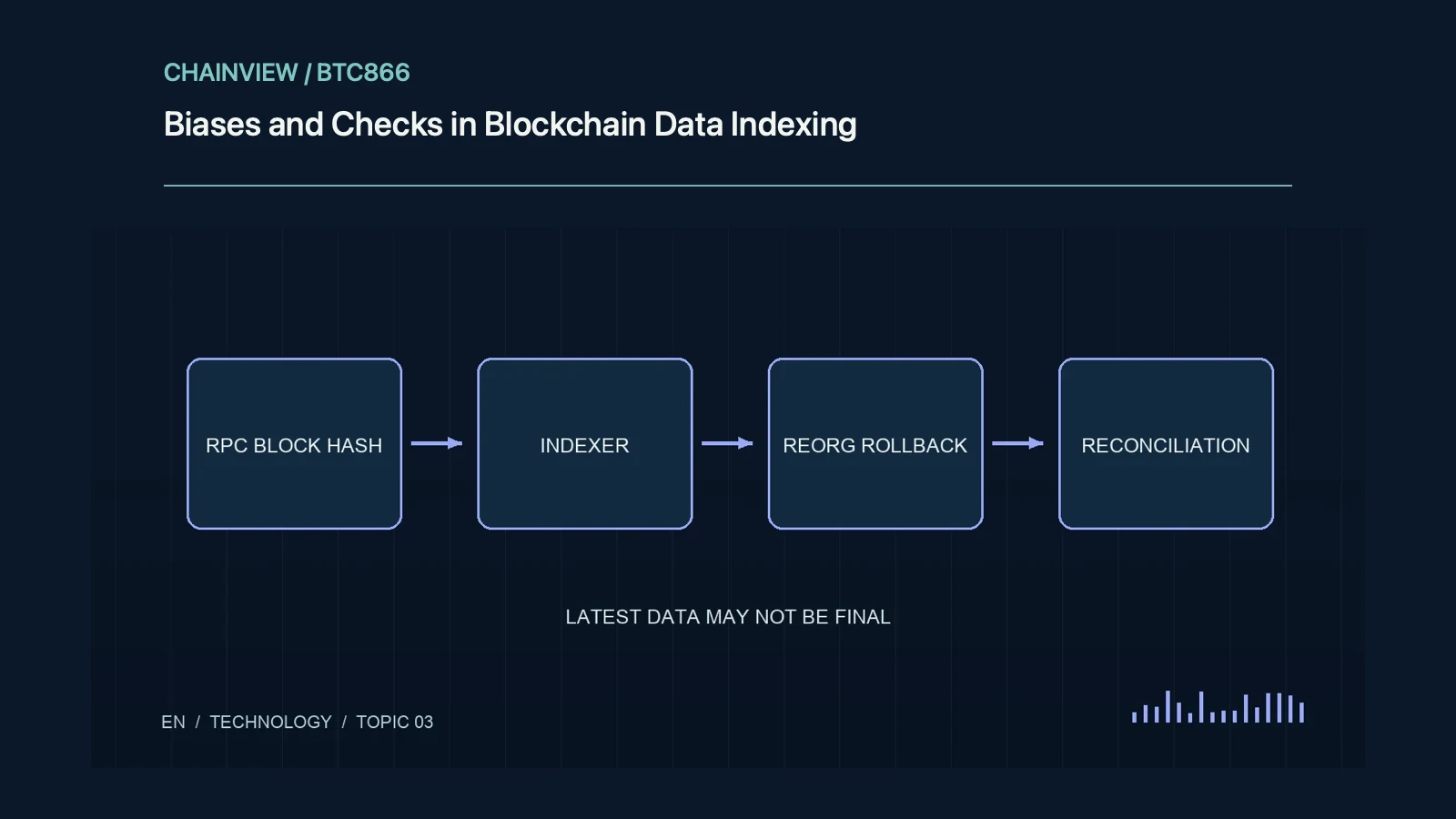
Indexers must invalidate orphaned blocks, reverse old effects, and ingest replacement history. Transaction-hash deduplication alone may miss changed inclusion positions. Consider block hashes, transaction positions, and log indexes in keys, and expose provisional versus stable data. Downstream consumers need the finality policy to interpret revisions correctly.
Token decimals and event meaning
Integer balances require correct decimal scaling. Identically named events can represent minting, burning, transfers, or specialized fee logic. Match contract addresses and code with known test transactions rather than grouping tokens by symbol. Proxy upgrades can change semantics, so decoder compatibility must be reviewed after implementation changes.
Reconciliation and sampling
Sample different dates, sizes, and contract families against a node or independent explorer. Rebasing, internal calls, fees, and decoder omissions can explain discrepancies between balances, events, and receipts. Preserve queries and raw responses. Agreement between dashboards is weak evidence if both depend on the same upstream provider.
Publish reproducible methods
Document networks, contracts, start heights, finality thresholds, deduplication, and revision policy. Export query versions and generation times without revealing credentials. State access restrictions. Transparent methods make discrepancies explainable, but do not eliminate labeling errors or unknown contract behavior; conclusions should remain proportionate to the evidence.
Worked review example
Suppose ingestion stops at height 10,000 and later hours are filled with zeros. The chart may falsely imply activity vanished. Backfill missing blocks with idempotent event keys and distinguish missing, genuinely empty, and pending-finality states. Record revision versions. This example shows why an infrastructure failure should not become a claim about user demand or market behavior.