Original topic illustration: ChainView BTC866 original topic diagram · ChainView BTC866 Editorial · CC BY 4.0
What a receipt tells you
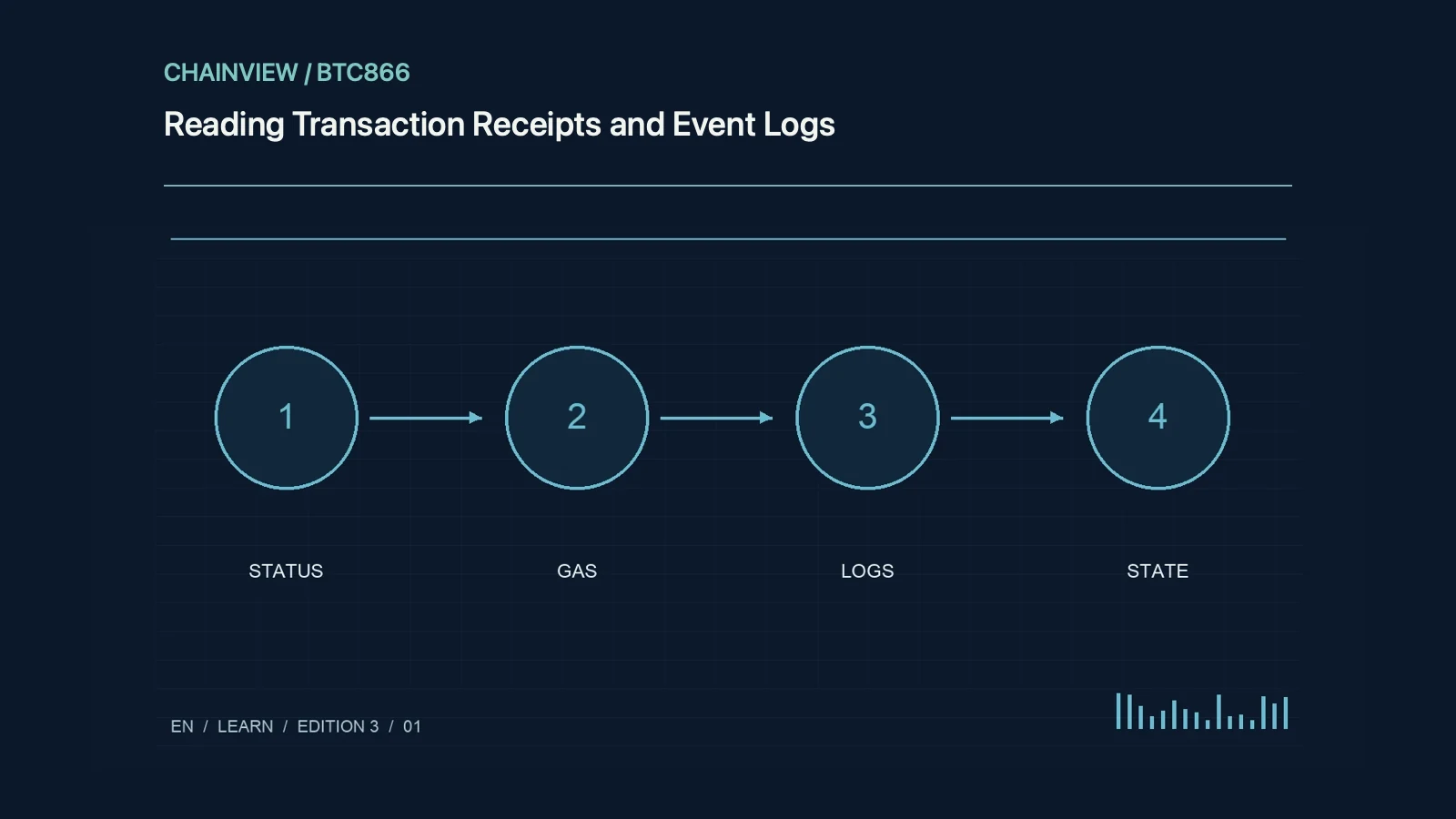
A receipt can show inclusion, status, gas, and logs, but not every business outcome. Success means execution completed under the rules, not that the intended asset was correct or economically safe. Reverted execution can still cost gas. Verify chain, transaction hash, block hash, and stability, noting possible reorganisations. Historical public examples are sufficient for learning without exposing personal addresses or making unnecessary real transfers.
Events need contract context
Logs are emitted by contracts; a familiar event name does not establish identical economics or authenticity. Verify emitting address, topics, data, index, interface, units, and decimals. A transfer-like event can represent minting, burning, or special fee behaviour. Proxy upgrades may change decoding assumptions. Save implementation and ABI evidence, and label undecoded data instead of grouping assets or interpreting flows from symbols alone.
Logs differ from traces
Explorer internal transactions are execution traces, not necessarily separate signed transactions or logs. Providers differ in tracing and historical coverage. Inspect call depth, transfers, reverts, and errors without counting the same economic flow multiple times across transaction, event, and trace views. State queries can help reconcile balances but should use an appropriate stable block; current state alone may not explain an old transaction's immediate effect.
Complete a reproducible exercise
Choose a public transaction and retain receipt, contract, ABI version, and block. Link status, fees, and events to each business conclusion. A successful swap into a counterfeit same-named token illustrates why status cannot replace address verification. Compare expectations with evidence and identify required state or contractual context. Publish reproducible methods and timestamps without credentials or personal data, rather than relying on an explorer's green checkmark.