Original topic illustration: ChainView BTC866 original topic diagram · ChainView BTC866 Editorial · CC BY 4.0
Separate reads from submissions
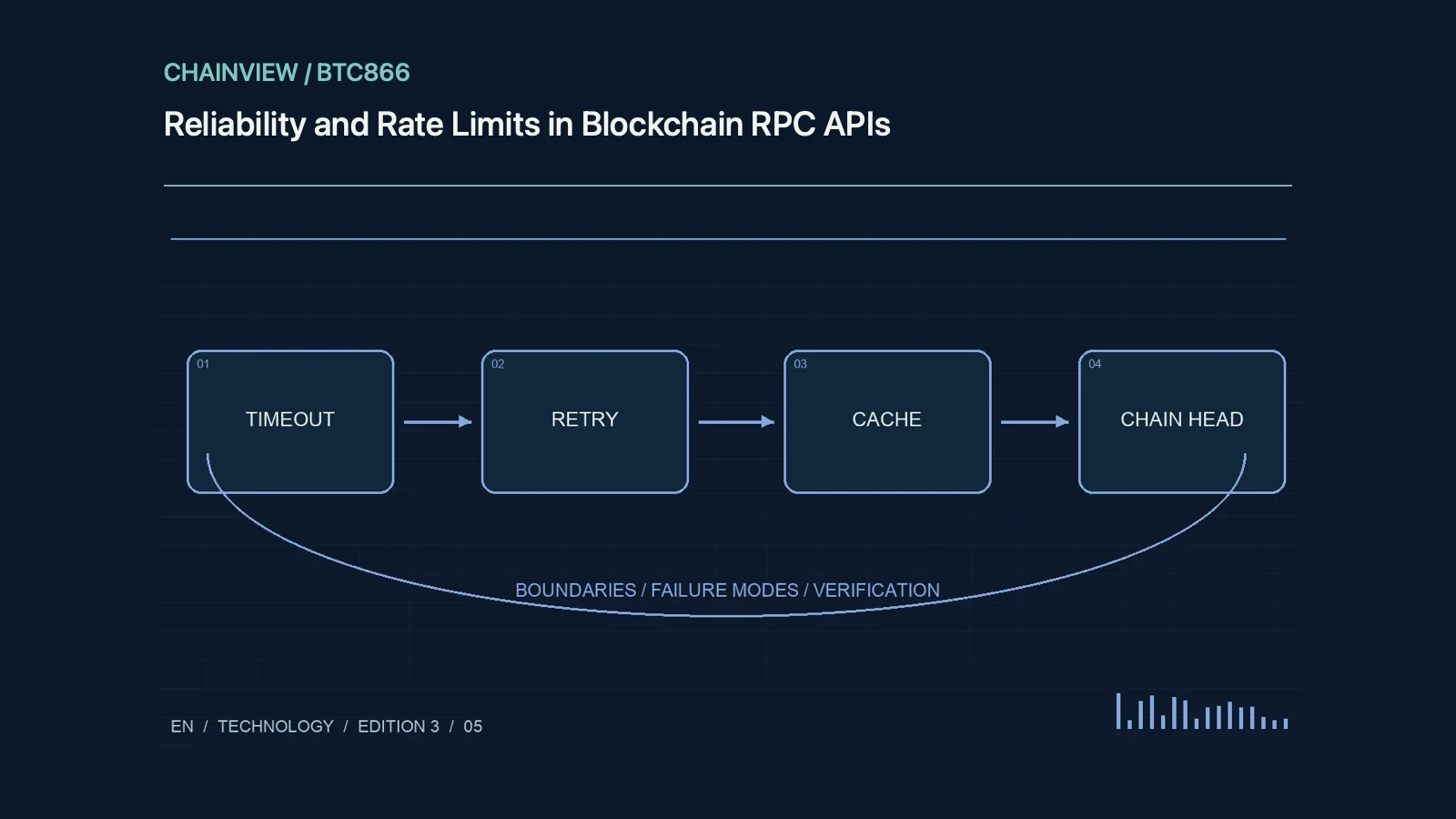
RPC reads and signed-transaction submissions need different retry policies. A submission timeout can mean acceptance with a lost response. Query the known transaction hash before creating another payment. Record method, chain identifier, time, node head, and error category, while removing credentials and unnecessary personal data. A transport failure describes communication; it does not by itself prove that the underlying transaction failed or never entered the network.
Timeouts, backoff, and rate budgets
Providers can limit request count, compute cost, or concurrency. Aggressive retries amplify outages. Set connection and response timeouts, bounded attempts, exponential backoff, and jitter. Separate transient errors from invalid parameters. Batching may have its own charging rules. Monitor latency distributions, limits, and queues, reserving capacity for important operations. Before failover, confirm supported networks and historical coverage rather than assuming every endpoint supplies equivalent data.
Caching must understand chain state
Latest-state results change, and reorganisations can replace the hash at a height. Cache keys need chain, method, parameters, and appropriate block references. Use different policies for provisional and stable history. Address-only balance caches can become stale; height-only event caches can retain orphaned data. Implement invalidation and backfills, monitor sync, and assess freshness and canonicality. Fast cache responses are not evidence that the answers remain correct.
Failover and consistency checks
Validate backups before an incident: network, head, finality, permissions, and quota. Sample important results by block hash against independent sources. Preserve discrepancies; majority agreement can still share one upstream failure. If a backup lags a hundred blocks, show staleness rather than presenting an old balance as current. Define degraded display, submission pause, and alert conditions so reliability addresses wrong answers as well as unreachable endpoints.