Original topic illustration: ChainView BTC866 original topic diagram · ChainView BTC866 Editorial · CC BY 4.0
Separate execution, data, and settlement
A rollup separates execution from data publication, state commitments, proofs, and base-layer settlement. Identify where reconstruction data are published and what the settlement contract verifies. External data availability creates different assumptions from publishing necessary data on the settlement chain. Low fees alone do not establish security. Map sequencers, data providers, provers, and upgrade administrators separately instead of merging their powers into a decentralisation label.
Proof paths and waiting windows
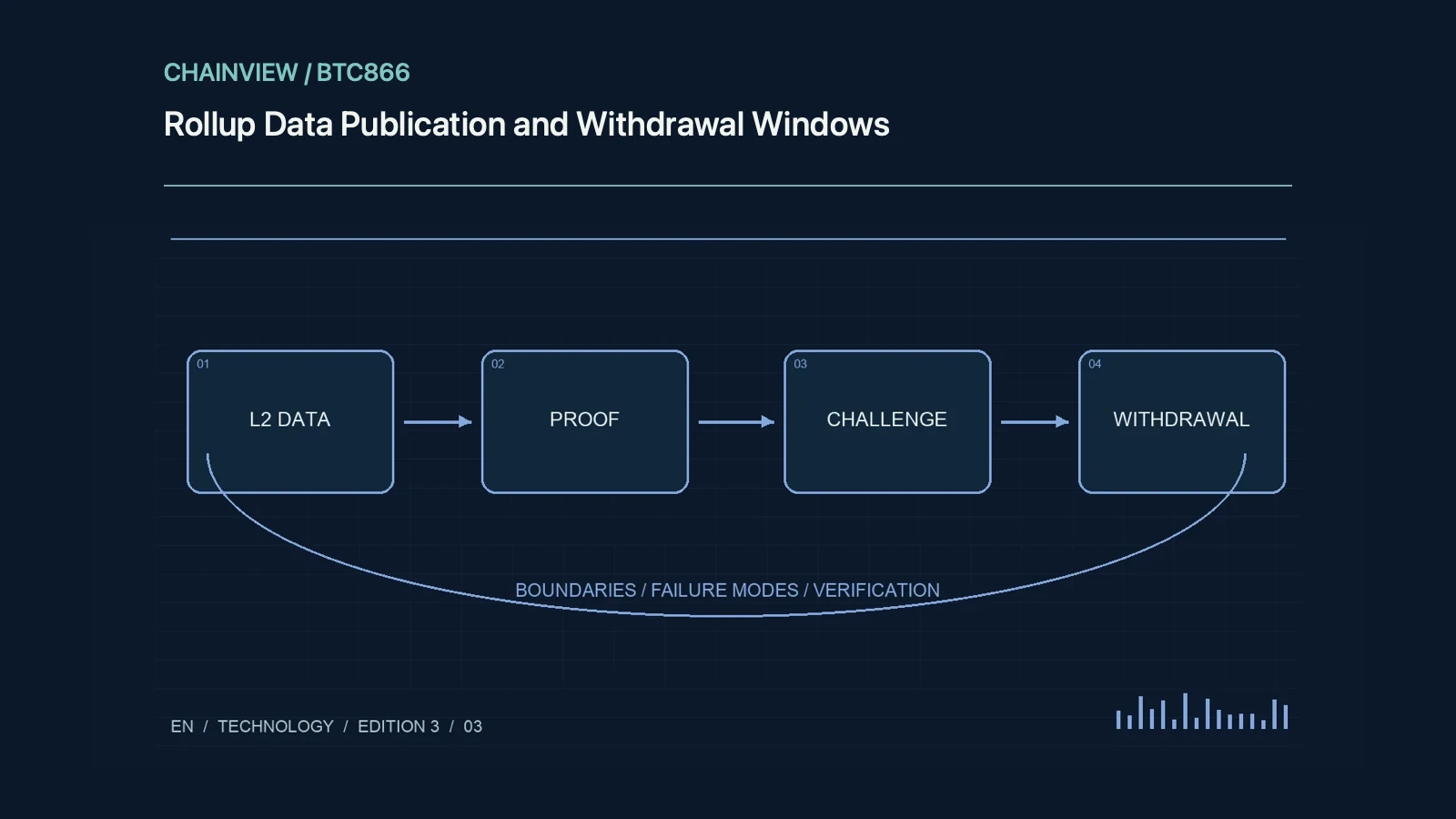
Optimistic systems allow challenges to state claims; validity systems submit proofs meeting a verifier's rules. Exit timing can involve challenge periods, proof generation, batch publication, contract steps, or intermediary processing. Inspect the actual implementation and user-initiated alternatives. A fast withdrawal can be a liquidity provider's advance, with fees, limits, and counterparty conditions, rather than native final settlement through the canonical bridge.
Pauses and upgrades affect exits
Exit routes depend on upgrades, pause powers, sequencer outages, and available data. Review controllers, thresholds, timelocks, scope, forced inclusion, and escape mechanisms. An escape function may still require data, software, base-layer fees, and practical expertise. Testnet demonstrations are weaker than deployed evidence. Record contract versions and document dates, and flag unclear terminology rather than assuming every advertised emergency route is cheap or immediately usable.
Reconcile each withdrawal stage
Track the L2 transaction, batch, proof or challenge status, base-layer claim, and receipt as applicable. A pending screen may require a user claim rather than a second withdrawal. Keep fast-service and canonical-bridge records separate. Parameters evolve, so illustrative waiting times must not become promises. Current documentation and on-chain status govern a particular exit; an interface estimate alone cannot guarantee completion within a fixed number of hours.