Original topic illustration: ChainView BTC866 original topic diagram · ChainView BTC866 Editorial · CC BY 4.0
Interpret the reward as conditional
A bug bounty advertises rewards for reports that meet a programme's rules. Its maximum amount is neither an insurance reserve nor a promise that every user loss will be reimbursed. Payment can depend on severity, exploitability, novelty, scope and reporting conduct. A large headline reward says little about components excluded from testing or risks already acknowledged by the operator. Begin by reading the programme page and effective date. Identify who funds and administers the bounty, whether it is currently active and which software versions it covers. A protocol might offer rewards for a contract while excluding its website, oracle dependencies or third-party bridge. Those exclusions can materially change what the announcement means for users. Describe the coverage rather than ranking security solely by the largest number in the reward table or by the prestige of the programme's host.
Match the scope to the product in use
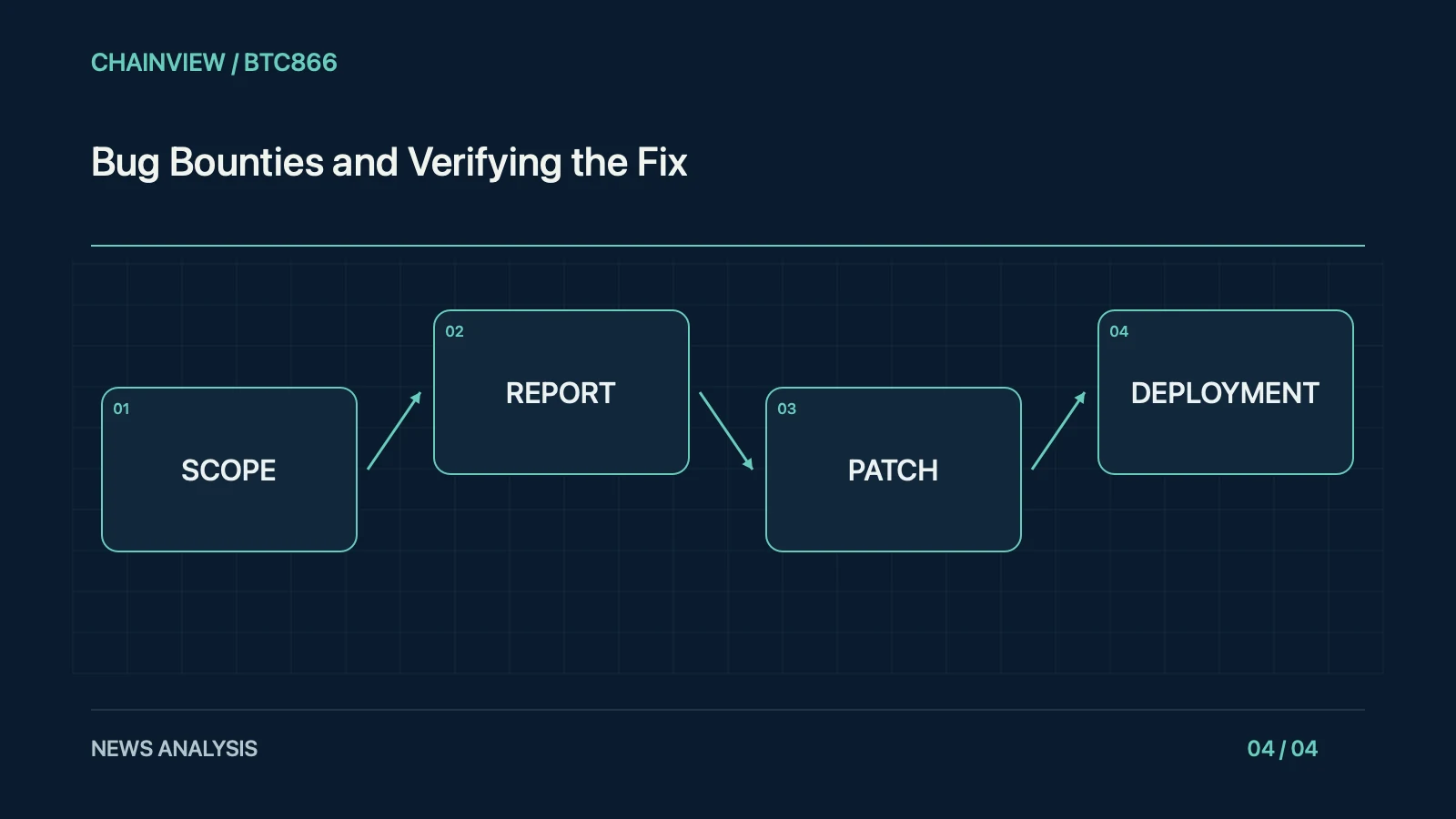
A security review becomes useful when its target can be matched to deployed software. Read repository names, commit identifiers, contract addresses, networks and excluded environments. A report covering a test release does not necessarily apply to the production system after upgrades. For an upgradeable contract, identify the implementation behind the proxy and the authority able to replace it. A mobile application's app-store version can also lag behind an upstream repository tag. Consider an illustrative patch affecting a transaction parser: users running an older parser remain exposed even if a different module has a generous bounty. Scope is not a technical footnote; it defines which claims can be supported. If the project does not disclose a mapping between reviewed code and deployment, state that limitation clearly instead of inferring complete coverage from the existence of a public repository.
Follow a finding from report to deployment
A finding can pass through acknowledgement, severity assessment, development, review, release and production deployment. Closing an issue or paying a reporter does not establish that the affected product has been updated. Look for an advisory identifying affected versions, a patch or fixed release, and an instruction for users or operators. Some details may remain confidential until coordination is complete; a lack of public exploit code is not evidence that a problem never existed. When a fixed version is available, compare it with the version actually served or installed through official methods. In a contract system, a release note alone may not prove that an upgrade transaction occurred. Record each confirmed milestone separately. This prevents a headline saying vulnerability fixed from concealing the practical question users need answered: which action, if any, remains necessary for the system they are using?
Respect disclosure boundaries while reporting
Responsible reporting explains risk and remediation without supplying unnecessary instructions for exploiting an unresolved weakness. Use the details the programme or coordinating parties have authorised for publication, and avoid encouraging readers to test production assets. A journalist can describe the affected component, likely impact category and patch status without reproducing attack parameters. Do not publish private correspondence, personal information or unverified claims that a particular researcher stole funds. If a report concerns an active incident, distinguish observed losses from theoretical maximum exposure and identify the source of each figure. A request to keep technical details confidential should not be transformed into a guarantee that users are safe. The useful middle ground is precise status reporting: what is known, what has been remedied and what remains uncertain, with a direct link to the operator's current instructions for affected users.
Give readers a practical verification route
A good bounty story ends with concrete ways to check the relevant product. Name the official advisory channel, affected version range, fixed version and any published deployment evidence. Explain whether an upgrade is automatic, requires an application update or depends on a service operator. Readers should verify downloads through official distribution channels rather than searching for a patch file advertised in replies. Where a product offers signed releases, the verification instructions can support authenticity checks, but an unexplained checksum copied from the same suspicious page is insufficient. Retain the original programme terms and advisory date so later revisions are visible. If no user action is required, attribute that statement and identify its scope. The goal is to turn a reward announcement into an accurate account of security work and remaining dependencies, without confusing disclosure activity with a permanent guarantee of safety.