Original topic illustration: ChainView BTC866 original topic diagram · ChainView BTC866 Editorial · CC BY 4.0
Identify the source of risk
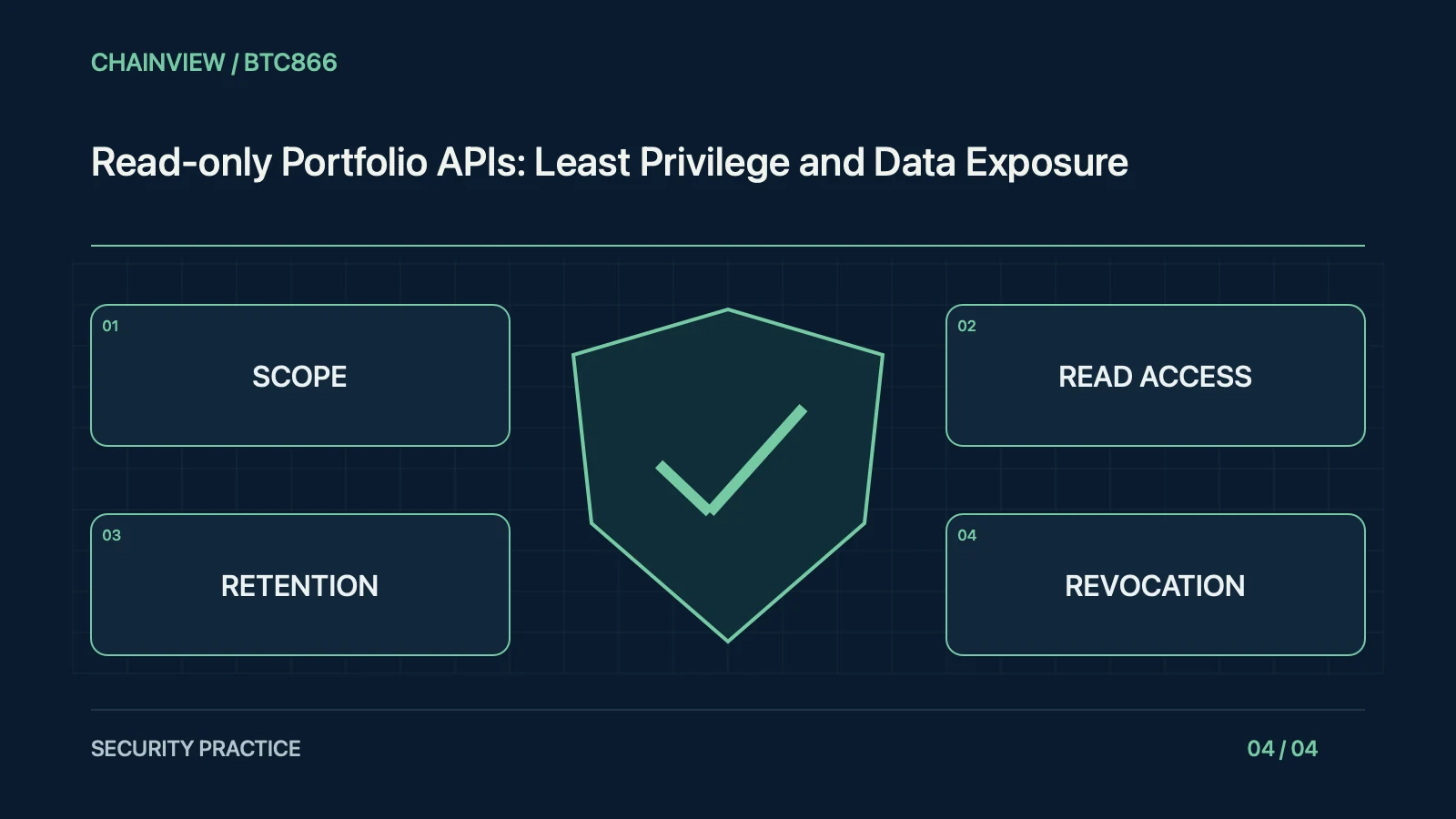
A read-only API key can expose balances, trades, subaccounts, and financial patterns even when it cannot withdraw. Public market-data endpoints and private account-reporting endpoints are different resources. Establish exactly which fields a tracker needs. Read-only does not mean safe to publish: active credentials belong in neither screenshots, research files, repositories, nor chat logs. Privacy consequences can persist without a single asset transfer.
A reporting provider can infer trading habits, financial scale, and active time zones from read access. Even data without an explicit name can be linked with other records. Review intended use and onward-sharing policies when selecting a service. An address described as anonymous is not necessarily unidentifiable, especially when account-level exports reveal repeated relationships and patterns over time.
Inspect each relevant field
At creation, inspect default permissions, account scope, and endpoint capabilities. Explicitly disable trading, withdrawal, and unnecessary account-management functions. Some venues combine several permission groups or offer separate subaccount scopes, so one label is insufficient. Create a distinct credential for each service and record its purpose, owner, and date. If one integration is compromised, separate credentials make it possible to revoke that integration without unnecessarily disrupting every other authorised workflow.
Permission screenshots can aid review only if active keys and signing secrets are hidden. Recheck the actual credential list after creation to ensure that a preset did not enable unwanted functions. In a subaccount or organisational setting, also record who can create and modify keys. The authority to issue credentials is a separate control from the limited permissions on any single key.
Understand the limits
Where supported, apply appropriate IP restrictions, narrow account scope, and limited data retention. Understand that a provider can change outbound addresses and that a mistaken restriction can interrupt reporting. Store signing secrets through secure credential handling and log only redacted identifiers. A recipient may retain already exported history after the key is revoked. Read deletion, backup, and privacy policies rather than treating revocation as proof that every stored copy vanished.
An IP allowlist does not replace encrypted secret storage and does not protect CSV files already exported. When ending a relationship, ask about retention and deletion and preserve any confirmation. A deletion email should not be interpreted as evidence that every backup copy vanished immediately. State the documented process and its limitations rather than promising a stronger result than the provider actually describes.
Respond safely
Changing a password, ending a web session, or enabling two-factor authentication may not revoke API keys. Review the credential list independently. Deleting a tracker application can stop local use while leaving server-side authority active. After revocation, verify that the old credential can no longer access the account and inspect sessions, exports, and unusual queries. Suspected exposure calls for stopping use and rotating credentials, not pasting the old secret into a support message to prove that it existed.
For routine rotation, create a minimally scoped replacement, verify necessary reads, revoke the old credential, and record any overlap window. An active compromise can instead justify immediate revocation before continuity testing. Explain those different sequences rather than mechanically applying one maintenance checklist to every incident. Restoring a dashboard is less important than containing a credential that may still expose sensitive financial data.
Maintain controls
Maintain service, permissions, account scope, IP policy, last use, retention, and revocation evidence together. Remove unused connections periodically and coordinate replacement keys so that reporting failures do not tempt an operator to enable withdrawal permissions temporarily. Explain both the privacy value of read access and the difference between stopping future access and deleting previously disclosed data. The result is a controlled sharing process rather than the false assurance that any credential without withdrawal capability is harmless.
When logs exist, inspect unexpected endpoints, times, and account scopes. If a venue provides no usable access log, label that visibility gap. Do not claim that no abnormal access occurred simply because no transfer was seen. Read-only exposure can leave no on-chain asset movement while still creating privacy and identity risks, requiring a different assessment from the one used for stolen withdrawal authority.