Original topic illustration: ChainView BTC866 original topic diagram · ChainView BTC866 Editorial · CC BY 4.0
Separate a unit change from a new asset
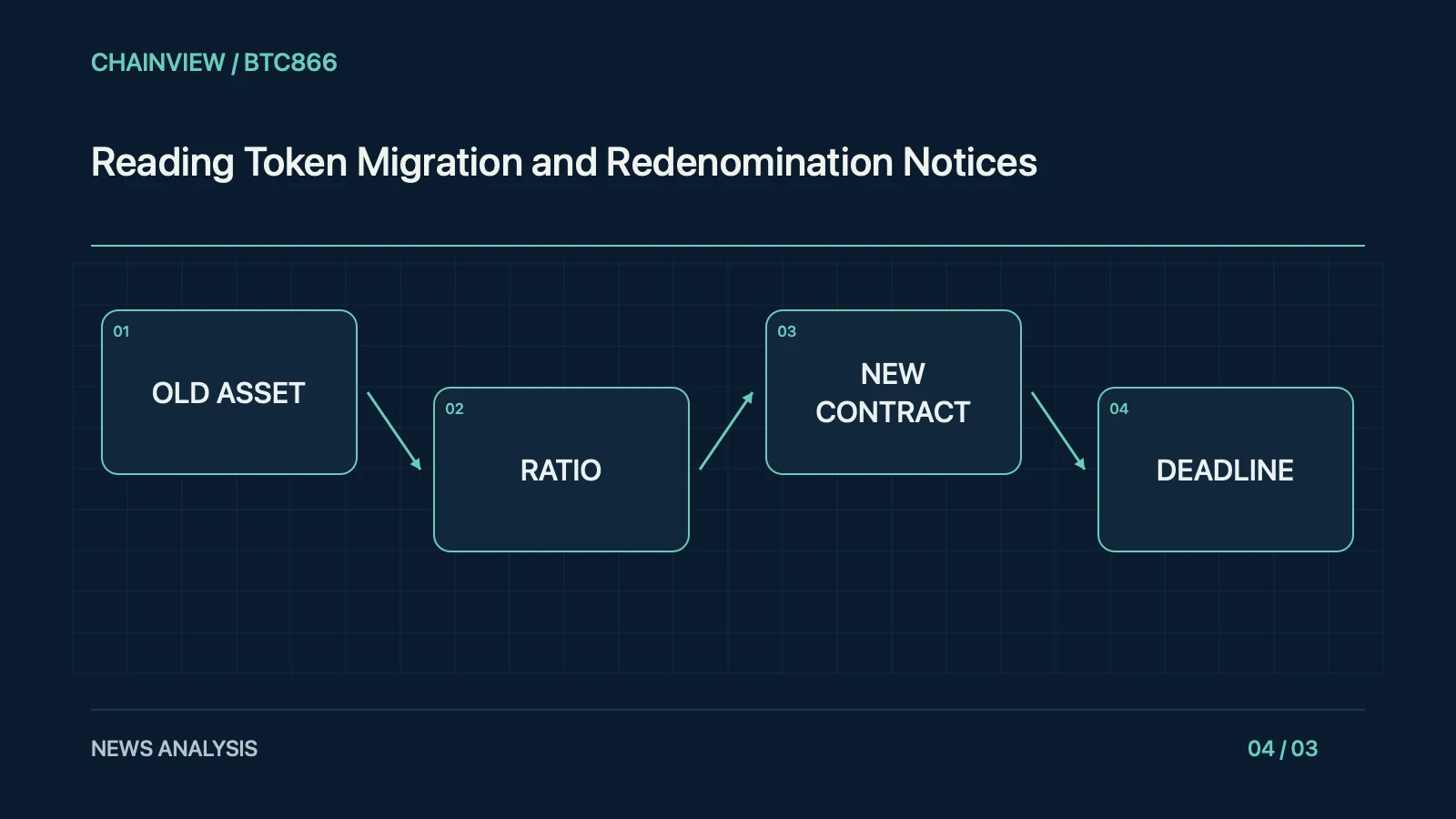
A token redenomination changes the units used to express a balance. If an illustrative project replaces one old unit with 100 new units, a balance of two becomes 200 before other effects. That arithmetic alone does not multiply the owner's economic interest. Market prices, fees and actual rights can change independently. A migration can instead replace a contract, move assets to another network or introduce different token behaviour. Begin with the exact operation described in the official notice rather than treating every change as a split. Record the old asset's network and contract address, the destination asset and the conversion ratio. Token symbols are not unique identifiers. A copied symbol on another chain can represent an unrelated asset, so the name displayed in a wallet cannot establish that the correct migration has taken place.
Build a migration fact sheet
A reliable fact sheet includes eligibility, the snapshot rule, conversion formula, deadline and responsible administrator. Ask whether the snapshot measures a particular block, a time window or balances held by a custodian. Vesting contracts, liquidity positions and assets locked in another application may follow special treatment. Check whether old tokens are burned, locked or simply left in circulation, and whether conversion is one-way. A deadline should include a time zone and the action that must be completed by that time. Submission, transaction inclusion and custodian processing are different milestones. Note any administrator power to pause, change the ratio or recover unclaimed balances. Where documentation is unclear, preserve the question rather than improvising an answer. These details determine the practical process much more directly than a promotional description of the project's new identity or technology.
Distinguish custodied and self-custodied holdings
An exchange may manage a migration for its own customers, suspend deposits temporarily or decline to support the replacement asset. Its procedure does not automatically apply to a self-custody wallet. Conversely, a self-custody claim contract does not prove that sending old tokens to a platform will produce a credit. Check the official notice of the actual custodian and confirm the account's region, asset network and supported deadline. For self-custody, open the migration route from independently verified project documentation. Read the permissions requested by the wallet before signing. A request for broad token approval can create continuing exposure beyond the intended conversion. No legitimate migration requires a recovery phrase to be sent to a support agent or entered into a shared form. The safest preparation is a verified procedure and accurate records, not hurried interaction with a link received by direct message.
Check the conversion without guessing value
Before interaction, record the source balance, expected destination quantity and potential network fees. Use integer-aware arithmetic when token decimals differ. In a hypothetical conversion of three old units at a ratio of 1:100, the expected 300 new units must still be represented using the destination contract's own decimal scale. A wallet can temporarily show the old symbol, an outdated price or both tokens together. That display does not establish a doubled portfolio. Verify the actual receipt and destination balance through the documented contracts. If the transaction fails, inspect its receipt before trying again; a pending or successful transaction may only be missing from the interface. Avoid using a speculative token price to decide whether a migration was mathematically correct. Quantity conversion, execution status and market valuation require separate checks and separate explanations.
Preserve a record for later reconciliation
Save the dated notices, contract addresses, balances and transaction hashes in a private migration record. For a custodian, retain the account statement and its explanation of any renamed ledger entries. Record how the service treats historical cost and transaction exports, since a redenomination can make an unchanged economic holding appear as a new purchase. Do not overwrite old records merely to make a portfolio tracker look tidy. If there is a mismatch, contact support through a verified official channel with public transaction details and the case number, excluding secrets. A migration article should state whether steps are announced, available or completed, and update amended deadlines visibly. This helps readers who encounter the guide later avoid expired forms and confusing legacy assets. It also prevents a change in displayed units from becoming a misleading claim about gains or entitlement.