Original topic illustration: ChainView BTC866 original topic diagram · ChainView BTC866 Editorial · CC BY 4.0
Think in UTXOs
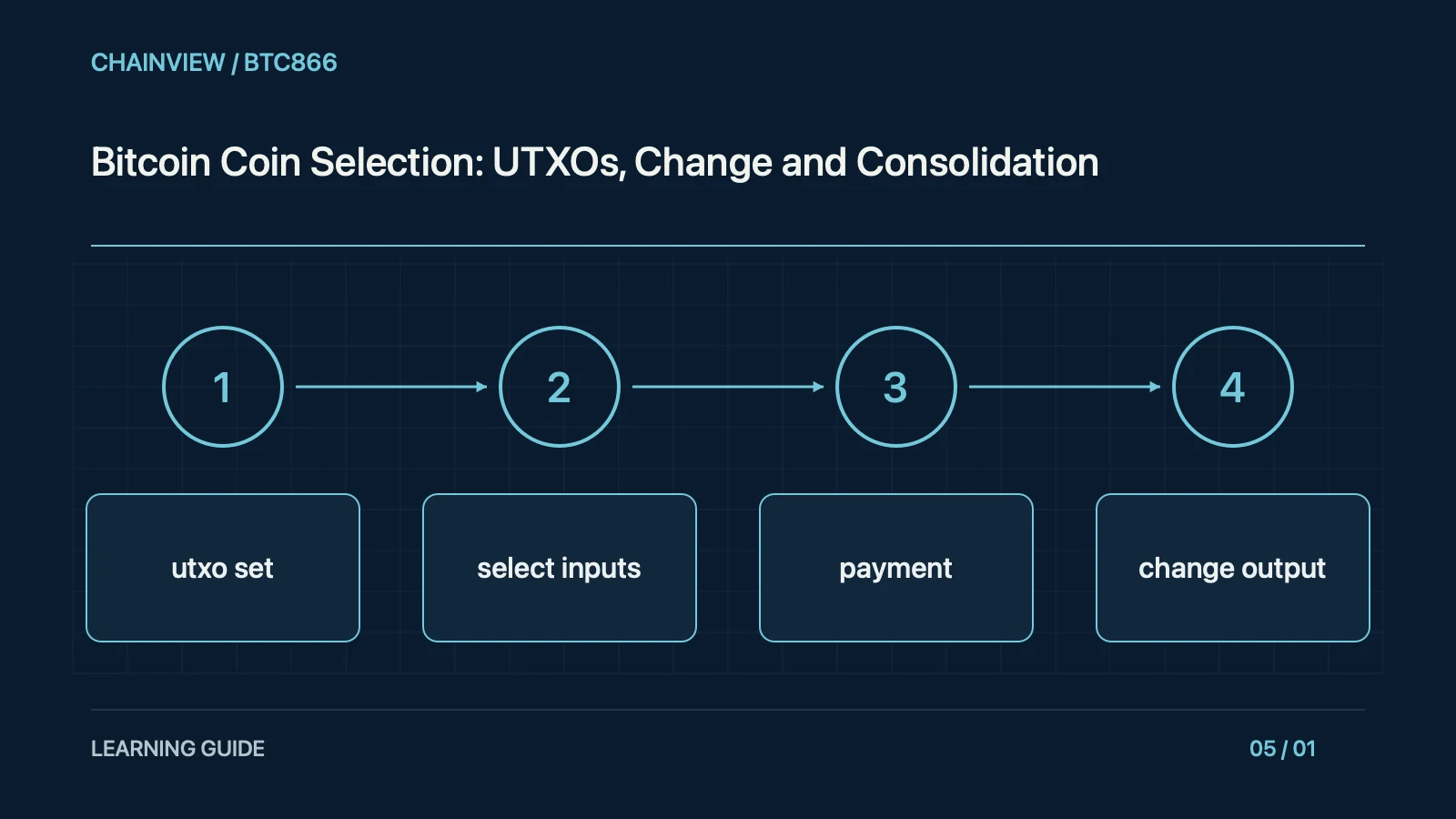
A bitcoin wallet balance is a set of unspent transaction outputs. A payment selects whole inputs instead of subtracting from one account total. Each input carries a prior amount and spending condition.
Each UTXO has a transaction identifier and output index, which a ledger should retain rather than only an address. One address can receive several independent outputs. A wallet's summed display does not mean those outputs were merged, and confirmation state and spending conditions can differ.
A wallet balance can consist of many unspent transaction outputs, and a payment spends selected outputs in full rather than subtracting from a single account row.
Input selection changes size
Selecting many small UTXOs generally increases transaction data and fees, while script type also matters. A wallet may optimise for cost or privacy. A balance number alone does not reveal the eventual input structure.
If coin control offers freezing or labels, understand their effects before changing settings. Manual selection is not always cheaper than automatic selection. Input script, change and current rate all matter. An insufficient-fee rejection is not automatically evidence of frozen assets or provider failure.
When selected input value exceeds the payment plus fee, a change output returns the remainder to a wallet-controlled destination.
The remainder becomes change
When inputs exceed payment plus fee, a change output normally returns the remainder to a wallet-controlled destination. It is not profit. Confirm the output and status because explorers may display change separately from the recipient.
For a fictional example, inputs of 70 and 50, a payment of 80 and fee of two leave change of 38. These numbers teach arithmetic, not current prices. If a tool creates no change output, inspect whether the excess becomes a fee instead of assuming it returns automatically.
Using more inputs generally changes transaction size and cost; consolidation trades a fee now for a different future spending structure.
Consolidation has trade-offs
Combining small outputs during a low-fee period can reduce future input count, but the action itself costs a fee. Combining inputs can also reveal links between holdings. Avoid using personal balances in a learning demonstration.
Combining inputs can reveal a common-control clue, but not every joint input unconditionally identifies the same natural person. Transaction structures and service arrangements create exceptions. Explain privacy cautiously without offering illegal concealment methods, and encourage legitimate users to keep cost and source records.
Combining outputs can reveal links between holdings, so review the wallet's coin-control display and use a hypothetical example rather than exposing personal balances.
Reconcile a fictional transaction
List three inputs, a payment output, change and fee, verifying that inputs equal outputs plus fee. Change input count and compare virtual size. No broadcast is needed to learn the arithmetic; live transfers still require a final address and network check.
Save structure, not keys, after practice. Public transactions should not invite speculation about personal identities. Wallet updates can change automatic selection, so date the tutorial and version. Mastering the equation helps prevent the common mistake of treating a change output as an additional fee.
The worksheet can mark each selected output as unspent, pending-spent or confirmed-spent according to the wallet's current view. An output already used by a pending transaction may not be available for a second independent payment. Software behaviour varies, so avoid treating a displayed total as immediately spendable under every condition. This final state check connects the arithmetic example with what a user sees without requiring a live transaction or making promises about confirmation timing.
For the practice record, organise utxo set, select inputs, payment and change output into concept, fictional input, observed result and limitation. Check units and timing step by step, distinguishing a mathematical result from a tool interpretation. Leave an uncertain field unresolved instead of guessing merely to complete the table. Learning does not require a live private key or a large transaction; preserving method and version is sufficient. Before carrying the lesson into a real service, recheck present software behaviour, charges and local eligibility. A walkthrough teaches a way to ask better questions rather than certifying every provider that uses similar labels.