Original topic illustration: ChainView BTC866 original topic diagram · ChainView BTC866 Editorial · CC BY 4.0
Start with local discovery
Compact filters help a light client decide which blocks may contain relevant wallet scripts. A small filter can be downloaded before a complete block, reducing the need to send addresses directly to a query server.
A filter covers the scripts and elements specified by its construction; it is not a ready-made balance report. Verify which items enter the standard. An arbitrary string is not necessarily a valid query, and balance calculation still needs verified transactions and spending state rather than one successful membership test.
A compact block filter lets a client test whether a block may contain scripts relevant to its wallet without downloading every full block first.
A match requires another step
The probabilistic construction can produce false positives. A match calls for fetching and inspecting the block; it is not proof of payment or finality. Relevant transactions still need verification under the client's chain assumptions.
Suppose a filter matches but inspecting the block finds no relevant transaction. That may be an expected false positive rather than misconduct. Conversely, failure to fetch a block means the inspection remains incomplete; it must not be treated as proof of no payment. Preserve a pending-verification state until the evidence arrives.
BIP157 defines filter serving and commitments while BIP158 defines a compact filter construction; probabilistic matching can produce false positives.
Distinguish the specifications
BIP157 describes filter serving and commitments, while BIP158 specifies the compact construction. Neither is a complete ledger or a replacement for every consensus check. Read the particular client's validation and peer-selection design.
Filter headers and block headers have distinct checks and dependencies. Read how the chosen client detects disagreement. More peer connections do not automatically remove correlated software or network-source risk. Independence and validation behaviour matter more than displaying a large connection count without understanding who controls those connections.
A matching filter is a reason to fetch and inspect the block, not proof that the wallet received money or that a transaction is final.
Describe the privacy boundary
Local matching reduces explicit address queries, but peers can still observe connections, timing and block requests. Filters do not guarantee anonymity, especially when the same service also receives account or wallet metadata.
Subsequent block requests may let an observer narrow interests, and several wallets sharing a connection may become linkable. Do not promise absolute privacy from a filter toggle. A stronger privacy requirement must assess the network, device and third-party queries together rather than treating this one technique as a complete protection.
Filter downloads reduce direct address queries, but peers, connection metadata and block requests can still leak information; light clients retain validation assumptions.
Practise with public historical data
Use a historical sample to demonstrate filtering, matching and block inspection without uploading a real wallet's address collection. Record client version, range and source, and distinguish an incomplete download from the absence of a transaction.
A practice record can include height, filter source, match outcome, block retrieval and confirmed relevant transactions. Failure categories distinguish service outages, expected false positives and validation faults without using real keys. Revisit the procedure after a client or standard change instead of assuming an old walkthrough remains universally applicable.
A review note should also identify where block-header verification occurs in the client. Filter matching and header validation are connected tasks with different evidence. If the device delegates one to a service, describe that dependence rather than presenting the entire workflow as local full validation. This distinction helps a user choose software consistent with their verification needs without treating all light-wallet implementations as technically identical or making unsupported claims about a specific vendor.
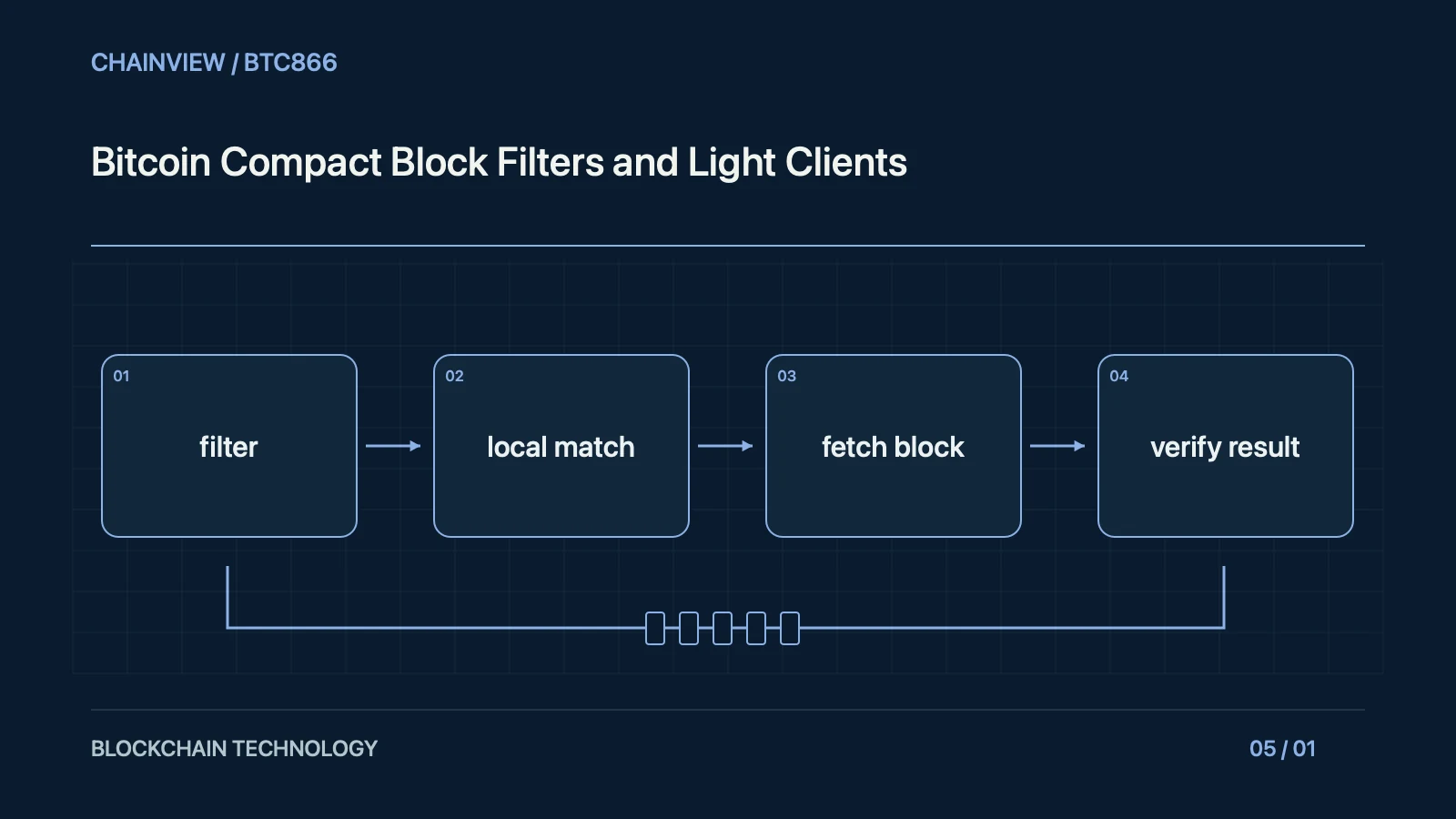
The implementation checklist for this mechanism should separate filter, local match, fetch block and verify result. For each item, distinguish the specification, software behaviour and the observation actually obtained. Start with a narrow read-only example that has no valuable assets at risk, preserving versions and block references. Missing evidence limits the conclusion instead of proving the entire protocol failed. When clients disagree, compare configuration and data coverage before choosing a result. Explain enough of the boundary that a reader can identify what remains trusted. Technical terminology, open code and a successful small demonstration are useful evidence, but none independently certifies a production system.