Original topic illustration: ChainView BTC866 original topic diagram · ChainView BTC866 Editorial · CC BY 4.0
Demand testable goals
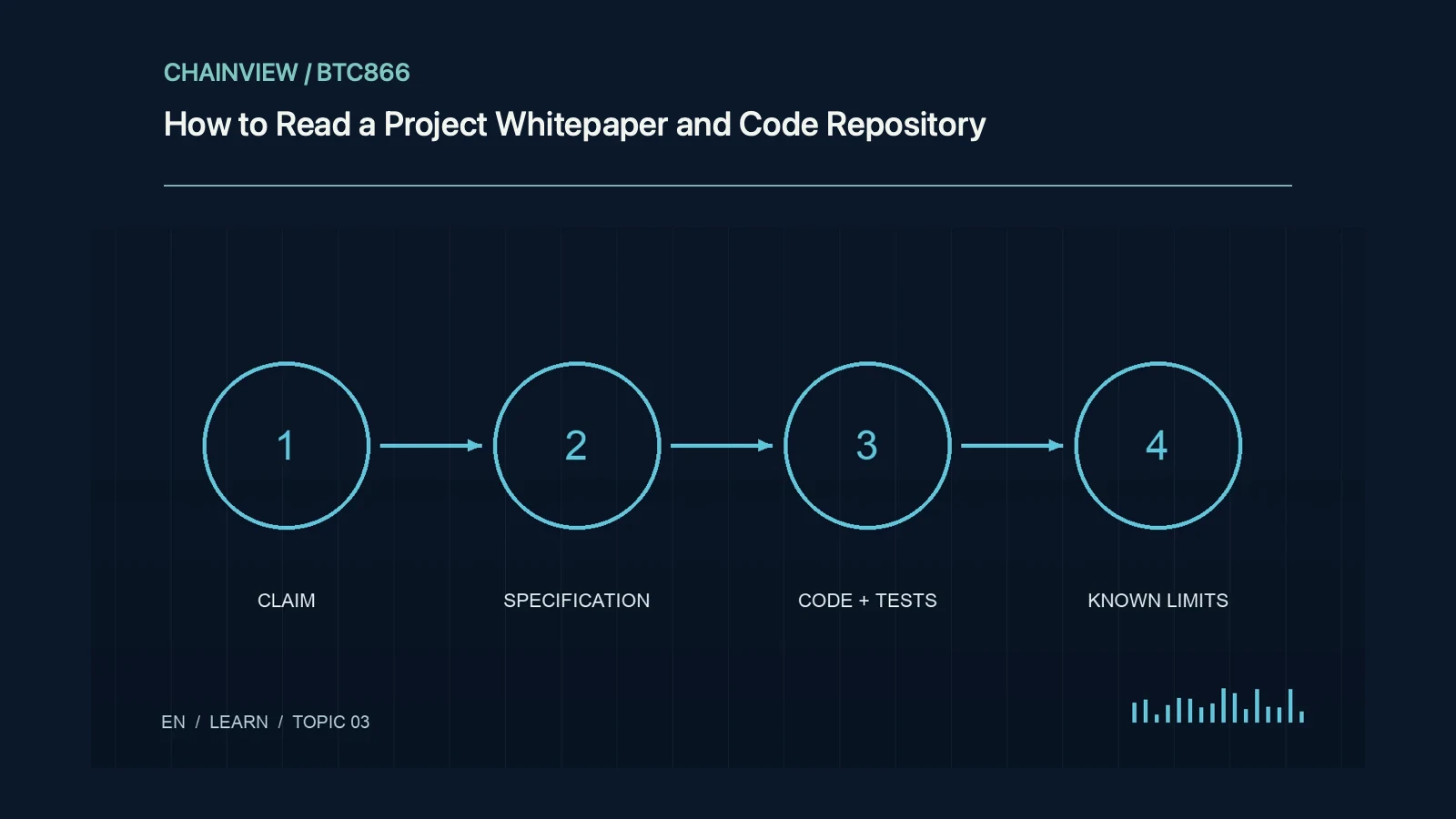
Identify the problem, intended users, and measurable goals. Performance and privacy claims need conditions and baselines. Separate implemented features, research ideas, and business plans, recording document versions. A whitepaper presents claims; implementation, tests, and operational evidence are needed before treating those claims as delivered capabilities.
Locate security assumptions
Map assumptions about honest participants, admins, hardware, oracles, and services. Identify adversary capabilities, failure modes, and recovery. A proof about one component applies within its model; it does not automatically establish the security of the entire wallet, website, governance process, or business model built around it.
Repository identity and license
Enter repositories through official channels and inspect organization identity, license, structure, and build instructions. Similar names may be forks, mirrors, or impersonations. Stars do not establish quality. Visible source is not identical to unrestricted open-source rights, and undisclosed components should be reconciled with claims about full openness.
Commits and substantive progress
Commit counts can reflect formatting, dependency bots, or imported history. Sample merged features, issues, tags, and test changes against stated goals. Activity can be maintenance, while silence does not prove no development. Describe observed evidence rather than using contribution frequency as a shortcut for competence or honesty.
Tests, audits, and known issues
Passing tests establish specified assertions for tested cases. Inspect boundaries, reproducible builds, disclosure procedures, and audit commit hashes. Record unresolved findings and scope exclusions. Do not run unfamiliar scripts on your primary device merely to inspect a project; public CI results and documentation can support an initial review.
Build a claim-evidence matrix
Map each claim to specification, code, tests, release, and unresolved limits. Label self-reports, independent checks, and operational observations. Update the matrix as releases change. Technical progress remains distinct from token rights, corporate finances, and price risk; the matrix cannot establish an investment return.
Worked review example
A claim of ten thousand transactions per second supported only by a single-machine benchmark needs hardware, workload, duration, and settlement conditions. Mark public-network evidence as absent. Later tests improve specific evidence, not every scenario. Decomposing a claim into testable conditions preserves genuine progress without expanding a narrow benchmark into a universal performance guarantee.