Original topic illustration: ChainView BTC866 original topic diagram · ChainView BTC866 Editorial · CC BY 4.0
Distinguish categories and perimeters
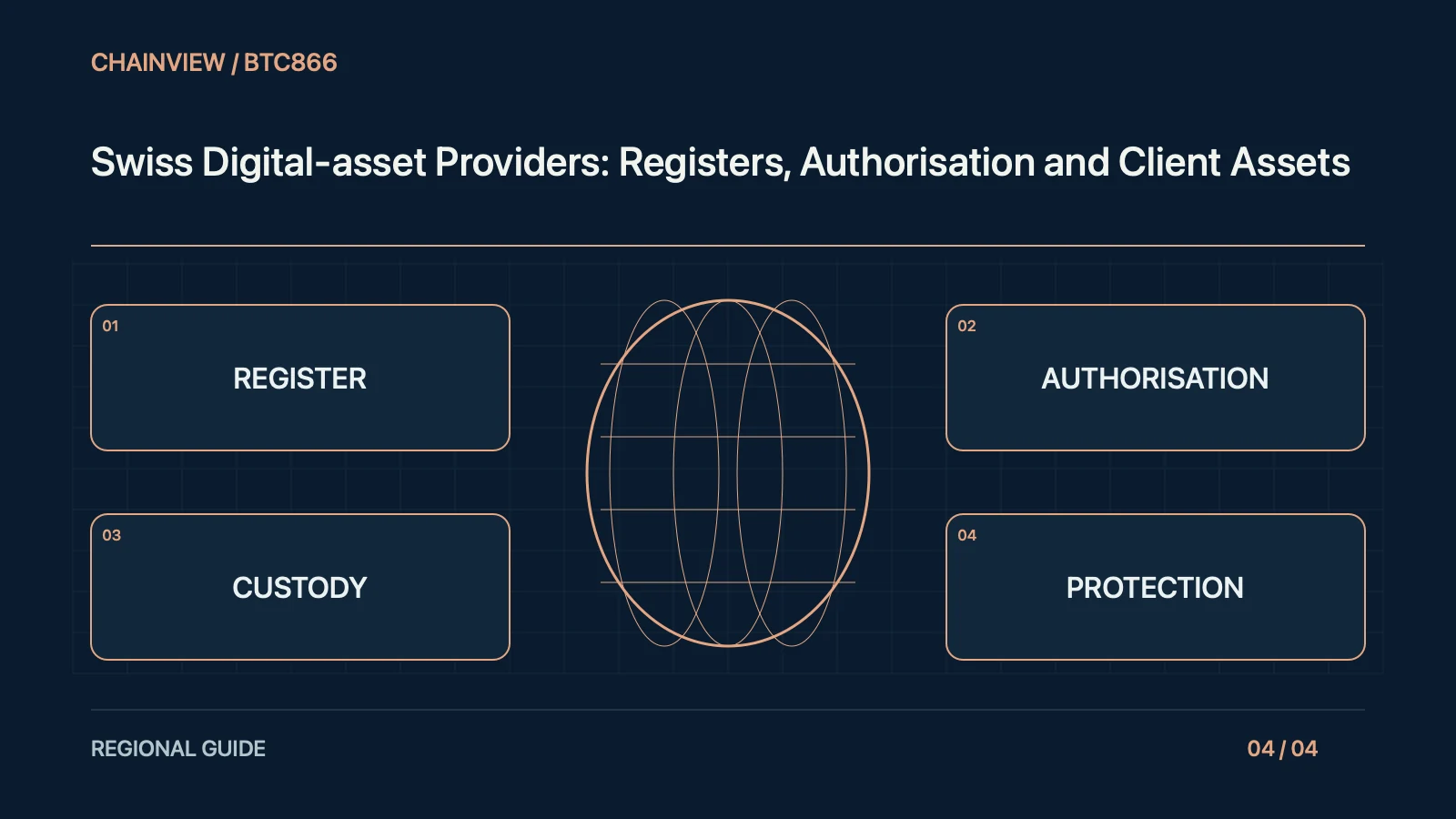
A Swiss address and an institutional name do not replace regulatory verification. FINMA authorisation categories and membership in a self-regulatory organisation cover different activities, duties, and protections. SRO membership is not a bank licence. Identify the contracting legal entity and actual service first, then consult current public records, status, and restrictions. Information about one group member should not automatically be applied to every affiliate using the same brand.
Check entity suffixes, references, and status because similar names need not identify the same company. If official records point to a different domain, verify the relationship. An imitation can borrow a legitimate company's address or licence details. Authentication requires matching the real contracting party and destination, not merely finding a familiar name somewhere in a search result.
Verify current records
Compare the register description with the contract and product, including custody, trading, banking, or another arrangement. An entity appearing in public materials does not guarantee token price, technical quality, or individual customer eligibility. If only commercial incorporation is established and the needed activity permission remains unclear, mark the evidence gap and seek clarification. A Swiss office, local telephone number, or market reputation cannot supply a missing authorisation by implication.
An authorisation category can include conditions and limits. Use the original activity wording and explain its scope. Self-regulatory responsibilities differ from prudential bank supervision, so the presence of compliance requirements does not make their protection levels equivalent. The specific arrangement matters. Avoid constructing a simple licensed-or-unlicensed binary where the evidence actually describes several distinct categories and permitted activities.
Read applicable terms
Client-asset segregation, key control, lending or reuse, and insolvency treatment require the actual agreement and applicable law. Deposit protection should not be assumed to include every token or custody claim. Identify covered assets, limits, and conditions from specific evidence. Institutional custody can still depend on administrators and third parties. Read asset-return, suspension, and fee provisions rather than treating a polished custody label as proof that all assets remain unconditionally accessible in every scenario.
Read whether custody gives the client rights to specific assets or a general claim against the institution. Commingling, lending, and reuse provisions can change risk. Even where deposit protection applies, check currency, account type, and asset coverage rather than assuming tokens are included. A product name containing savings or custody is not enough to determine the legal character of the customer's claim.
Keep personal evidence
Overseas clients must also confirm genuine residence, customer category, and product scope. A Swiss permission does not automatically authorise solicitation in every other country. Preserve the applicable language text and necessary translations, seeking qualified help for important clauses. After onboarding, review statements, withdrawal procedures, and complaints routes. An opened account does not remove the need to check whether the actual arrangement continues to match the description used during marketing and contracting.
For complaints or exit, use the agreement's official channels and confirm fees and return methods. Submit required information only through authenticated secure routes. Institutional reputation does not authenticate a sudden address-change notice or supplementary payment request. A genuine provider can be impersonated, and an unexpected instruction should be independently verified before either money or identity records are sent.
Maintain and seek qualified review
Maintain entity, authorisation category, SRO details, contract version, custody structure, and register query date together. Recheck periodically and after material notices. Label unknown matters as unconfirmed rather than using a register screenshot as permanent insurance evidence. The purpose is to distinguish identity, permission, custody, and protection as separate evidentiary layers, giving readers a way to evaluate concrete arrangements without substituting national reputation for risk assessment or promising returns.
Track regulatory-status changes separately from product notices. A maintenance outage does not necessarily imply a licence problem, while a valid authorisation does not ensure uninterrupted technology. Accurate categorisation reduces false alarms and helps readers act on relevant evidence. The maintained article should explain both observations without letting a national label or an institutional logo substitute for the details of the actual event.