Original topic illustration: ChainView BTC866 original topic diagram · ChainView BTC866 Editorial · CC BY 4.0
Market cap is a marked value
Quoted price multiplied by circulating units is not the cash invested or the cash available to every seller. A small marginal trade can change the mark applied to many units. Large liquidation can face a very different executable price.
Start by identifying the quoted pair and update time. If a dollar mark is derived through another stablecoin, explain the conversion. A stale quote multiplied by a fresh supply figure mixes timestamps. Extra decimal places do not fix an underlying comparability problem or make the total executable.
Market capitalisation multiplies a quoted price by a defined circulating supply; it does not represent the cash paid into an asset or cash available to sellers.
Read the diluted supply assumption
Fully diluted valuation may use maximum or total supply depending on the provider. Assets without a fixed cap need particular care. Record the denominator and issuance rules rather than assuming all identically named figures use the same method.
For uncapped issuance or supply governed by future decisions, fully diluted value has no unconditional single terminal quantity. Display a provider's published definition with its assumption. Inflation, vesting and administrators affect the future, so a static FDV is not the final value of every asset that can ever exist.
Fully diluted valuation uses another supply assumption, often maximum or total supply, and definitions can vary when issuance has no fixed cap.
Distinguish float from circulation
Treasury balances, restrictions, lost keys and concentrated ownership can reduce readily tradable supply. Public data may not classify them precisely. State estimates as estimates and examine depth instead of treating every circulating token as offered for sale.
Separate publicly restricted holdings from balances whose status is unknown. Do not subtract a precise estimate of lost coins as if keys were independently inspected. Holders can also hedge or borrow, so on-chain concentration does not fully describe their economic exposure or willingness to sell.
Treasury holdings, restricted balances, lost keys and concentrated ownership can make published circulating supply different from readily tradable float.
Compare a hypothetical asset
A price of two units, circulating supply of 100 and maximum supply of 500 produce values of 200 and 1,000 under those assumptions. The difference does not establish cheapness. A thin market's quote also needs a separate execution check.
Imagine buyers accept only ten units at the quoted price while the rest require a lower bid. Liquidating the whole supply would not equal the marked capitalisation. This thought experiment explains impact without submitting disruptive real orders or concluding that a particular real token necessarily lacks liquidity.
Compare source definitions, supply timestamps and market depth together; neither a small market cap nor a large FDV is a standalone valuation conclusion.
Keep timestamps and definitions
Align the price and supply dates, and flag migrations, burns or new issuance. A comparison sheet should include methodology and uncertainty. Market cap helps describe scale but cannot replace an analysis of rights, demand, cash flows or future risks.
A useful table includes quote, circulation, total supply, maximum supply, FDV definition and observation date. When sources conflict, retain both figures with their methods until reconciled. Explaining why the denominator differs is more useful than deleting an inconvenient discrepancy to produce an apparently authoritative ranking.
For a manual check, reproduce one provider's capitalisation using its own quoted price and supply timestamp. A mismatch can reveal rounding, stale marks or a different denominator. Ask which rather than selecting whichever value supports a preferred valuation narrative. Retaining the original units also makes a later redenomination understandable: a change in unit count and reciprocal price can leave aggregate marked value unchanged without creating a gain for the holder.
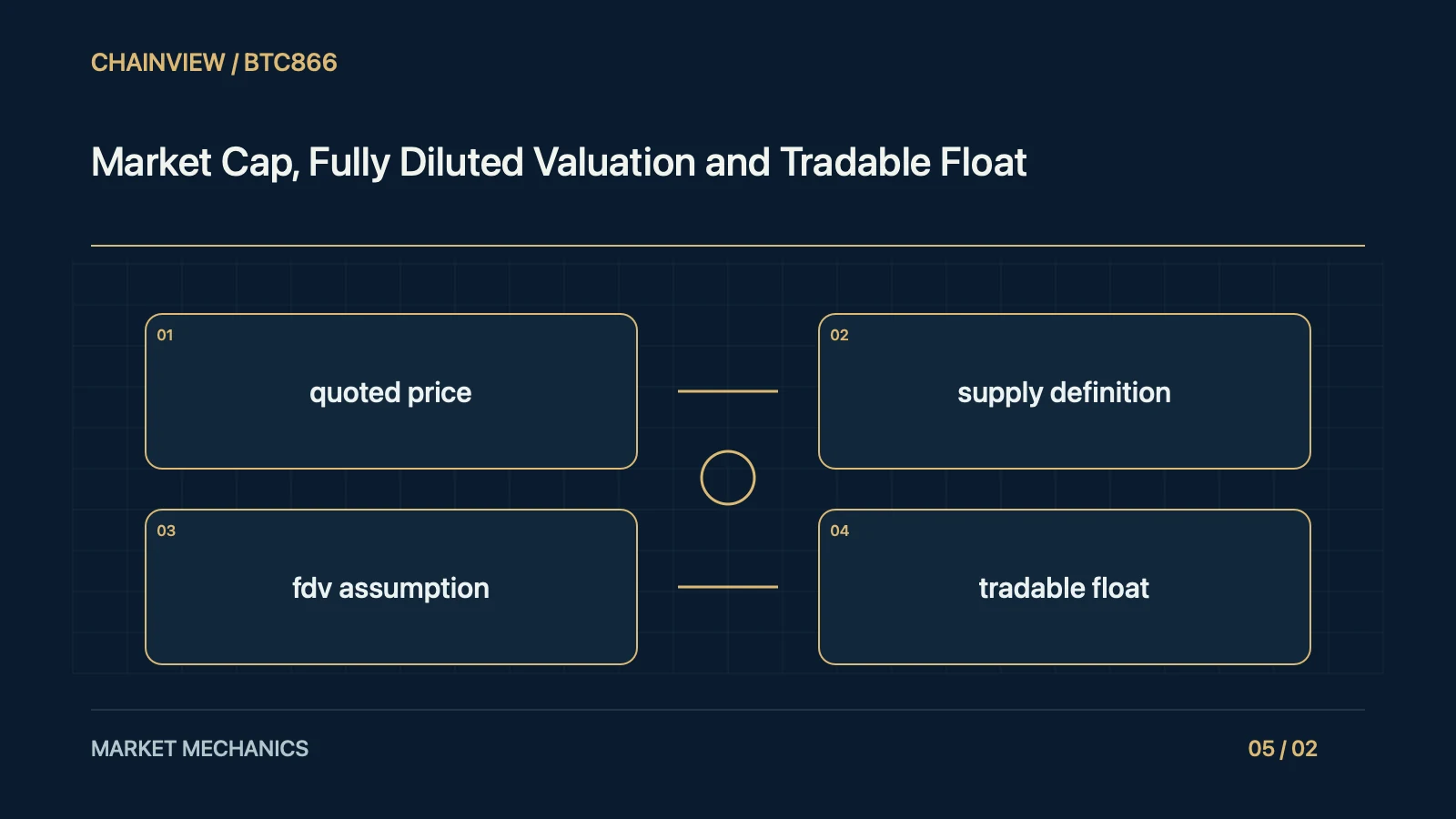
A useful worksheet for this topic has separate entries for quoted price, supply definition, fdv assumption and tradable float. Fix one set of fictional inputs, change one condition at a time and identify which conclusion moves. Retain units, observation time and source beside every number. An unknown input should remain unknown rather than becoming zero by default. The purpose is to expose methodological dependence, not select the most flattering outcome. Before using the result for a real-money decision, compare its assumptions with actual fees, available liquidity, household spending needs and the loss the user can afford. A clean calculation cannot remove those constraints.