Original topic illustration: ChainView BTC866 original topic diagram · ChainView BTC866 Editorial · CC BY 4.0
Understand the matching objective
Quadratic funding seeks to give weight to broad support rather than donation size alone. Allocation still depends on each round's formula, eligibility rules and caps. The name does not guarantee that every small recipient benefits equally.
With the same total donation, broader independent support may receive different matching, but the formula and finite pool still constrain the result. Do not advertise a universal multiplier such as every donation being matched tenfold. A simplified theoretical calculation is not the amount a real round has committed to pay.
Quadratic funding aims to give weight to broad support rather than donation size alone, with a finite matching pool allocated under round-specific rules.
Separate estimates from final awards
Direct donations, projected match and final allocation are different amounts. A finite pool, caps and review can change the display. An early estimate is not already disbursed money or a guaranteed withdrawable balance.
When demand exceeds the matching pool, allocation or caps follow round rules. Eligibility review can also exclude amounts. Final results are better evidence than an early screenshot, and actual payment still needs reconciliation with disbursement. A leaderboard estimate is not immediately available money for the recipient to spend.
Distinguish direct donations, estimated match and final matching allocation; caps, eligibility checks and post-round review can change a displayed estimate.
Consider identity manipulation
Multiple identities or coordinated reciprocal donations can distort the intended measure of support. Anti-Sybil controls introduce detection, false-positive, privacy and trust trade-offs. No identity badge should be presented as eliminating every form of abuse.
Identity checks may rely on accounts, documents or behaviour, each with error and privacy costs. Read appeals and retention rules before participating. Do not upload sensitive identification to an unknown site or borrow another person's identity merely to increase a projected matching weight in the interface.
One person using many identities or coordinated reciprocal donations can distort the intended mechanism, so anti-Sybil controls carry both trust and privacy trade-offs.
Do not imply an investment claim
A donation does not automatically create equity, distributions or future token rights. Matching support is not independent certification of project quality. Read the work, maintenance plan and conflicts rather than interpreting a leaderboard as an investment recommendation.
Delivery, conflicts and spending still require independent assessment. A donor anticipating an airdrop should understand that it is not a default right; an unpromised reward cannot be recorded as certain income. Public-goods funding objectives also need not track the market price of any associated governance token.
Read the published calculation and dispute process, document conflicts and avoid presenting matched funding as investment returns or independent proof of project quality.
Retain round-specific evidence
Keep donation records, eligibility status, rule version, appeal deadline and final payment separately. A fictional participant example can explain breadth without exposing real donor identities or creating deceptive accounts to test the mechanism.
Three independent donors and one person donating three times need not carry the same intended meaning. Diagrams should distinguish identities from transaction count. Use fictional samples, not fabricated accounts or coordinated match farming. Report suspected abuse through a formal evidence process instead of organising public harassment of donors.
Before donating, check whether support is irrevocable and whether the round has exclusions unrelated to the matching formula. A mechanism can allocate a pool transparently while still funding projects with uncertain outcomes. Read the recipient's stated purpose and maintenance plan. The matching calculation answers an allocation question, not whether the project will succeed, whether it has legal obligations to the donor or whether later tokens will have any market value.
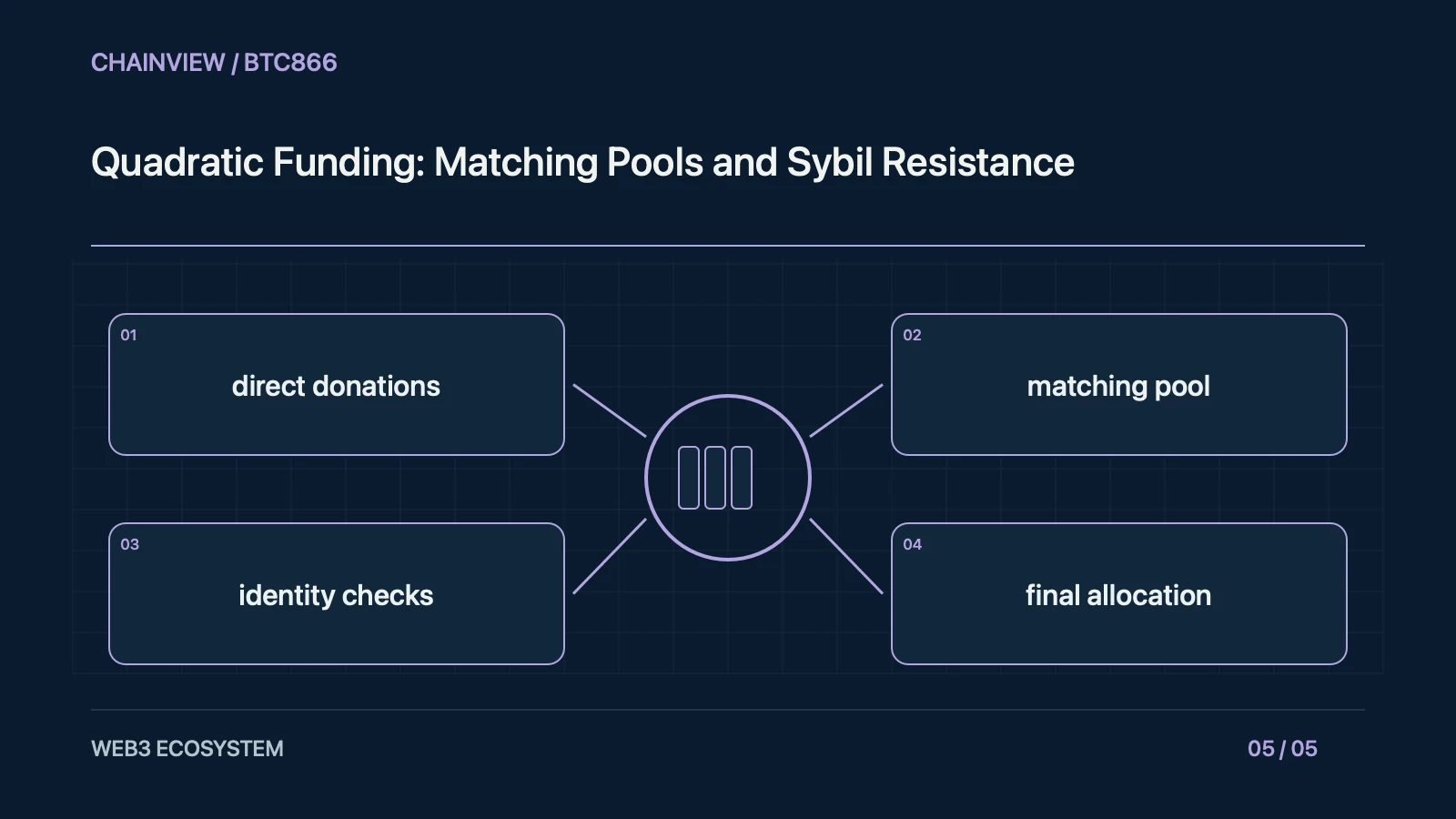
Build a rights-and-execution table around direct donations, matching pool, identity checks and final allocation. Record who can act, which condition must be satisfied, when funds become available and what happens if the step fails. Separate interface display, signed commitment and completed transaction; the same claim shown in two places must not become two assets in a ledger. Keep the rule version and exit conditions, explicitly marking unknown powers. This exercise supports an assessment of real obligations and control. A headline return, community vote or popular application can be relevant context, but does not replace the specific contractual and technical facts of the operation.