Original topic illustration: ChainView BTC866 original topic diagram · ChainView BTC866 Editorial · CC BY 4.0
Connection is not spending approval
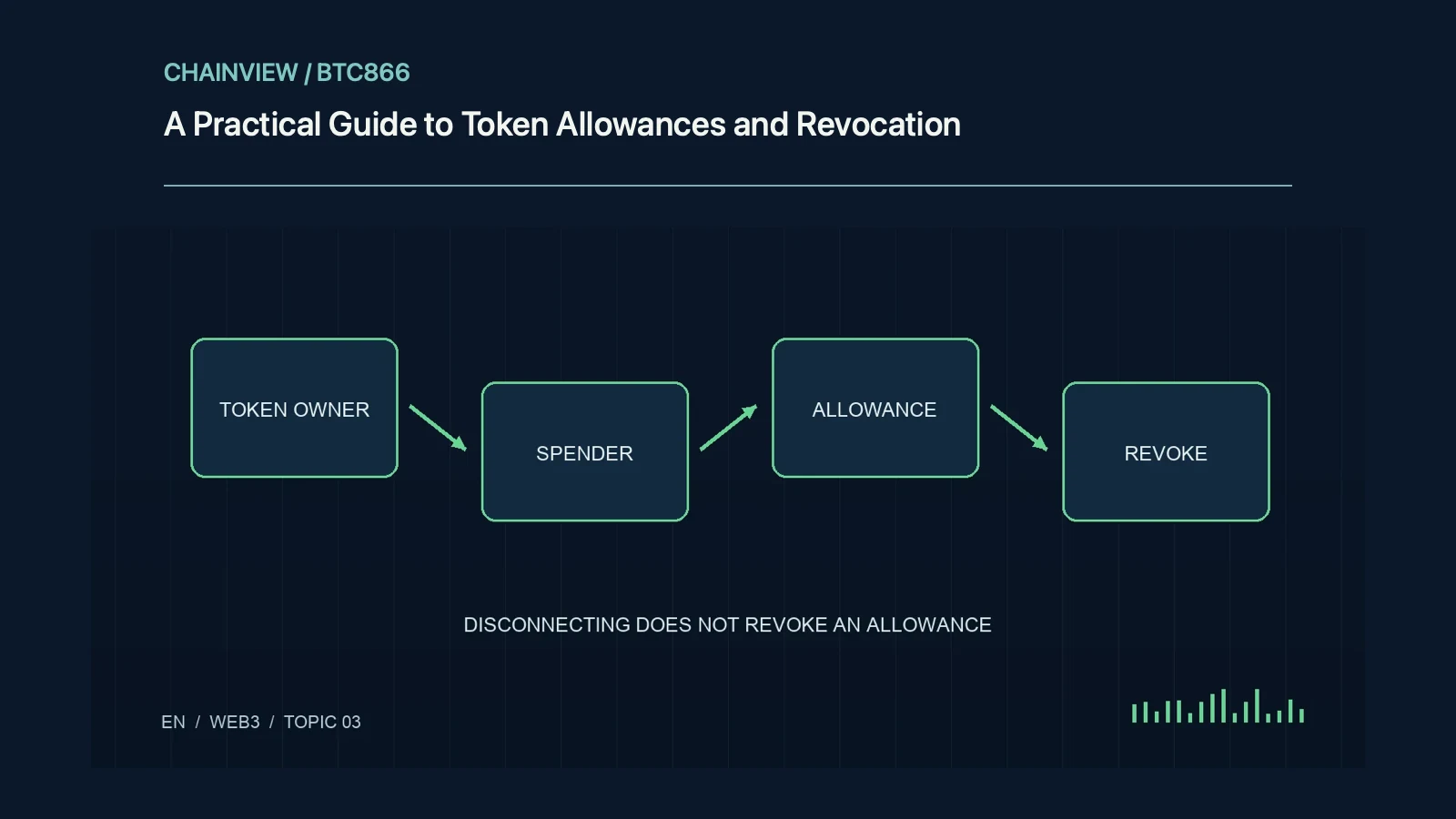
Connecting exposes an address and allows requests; an allowance grants a spender authority over tokens. Disconnecting a site does not necessarily revoke an on-chain allowance. Identify the active account, network, and requested action. Interface wording such as verification cannot change the actual function being signed or the permissions it creates.
Identify token and spender
An approval specifies token, spender, and amount. The spender may be a router, vault, or upgradeable proxy. Verify addresses through official documentation and an explorer. A counterfeit application can request authority over a genuine token, so a correct token address does not establish that the proposed spender is trustworthy.
Limited and unlimited amounts
Unlimited approval saves repeated transactions but broadens future exposure. Limited approval can reduce scope at additional gas or workflow cost. Check decimals and display units carefully. A zero current balance does not make an outstanding allowance harmless because later deposits may become available to the same authorized spender.
Off-chain permits have consequences
Permit signatures can create allowances later when another party submits them. Inspect domain, chain identifier, contract, deadline, nonce, and amount. Paying no gas now does not mean the signature is harmless. Cancellation and nonce invalidation depend on the exact implementation; a generic disconnect button is not a universal permit-revocation mechanism.
Verify a revocation
A revocation tool constructs a transaction; verify its origin and request. Setting an allowance to zero usually costs gas and needs confirmation followed by a state query. Congestion or insufficient fees can leave exposure unchanged, and preexisting signed permits may need separate treatment. Retain hashes rather than relying only on a sent notification.
Maintain an allowance inventory
Inventory allowances by account and network, including spender, token, amount, purpose, and review date. Investigate unfamiliar entries before further interaction. Separating experimentation from long-term reserves can limit exposure but does not replace key security. Revocation cannot recover completed transfers or guarantee that a previously reviewed application will remain free of vulnerabilities.
Worked review example
A zero balance does not erase unlimited approval: future deposits may still be exposed. Record token, spender, and allowance, revoke through a verified interface, and query confirmed state. Previously signed permits require a separate nonce and expiry review. One revocation transaction should not be described as invalidating every signature associated with the account.