Original topic illustration: ChainView BTC866 original topic diagram · ChainView BTC866 Editorial · CC BY 4.0
Price constraint and execution goal
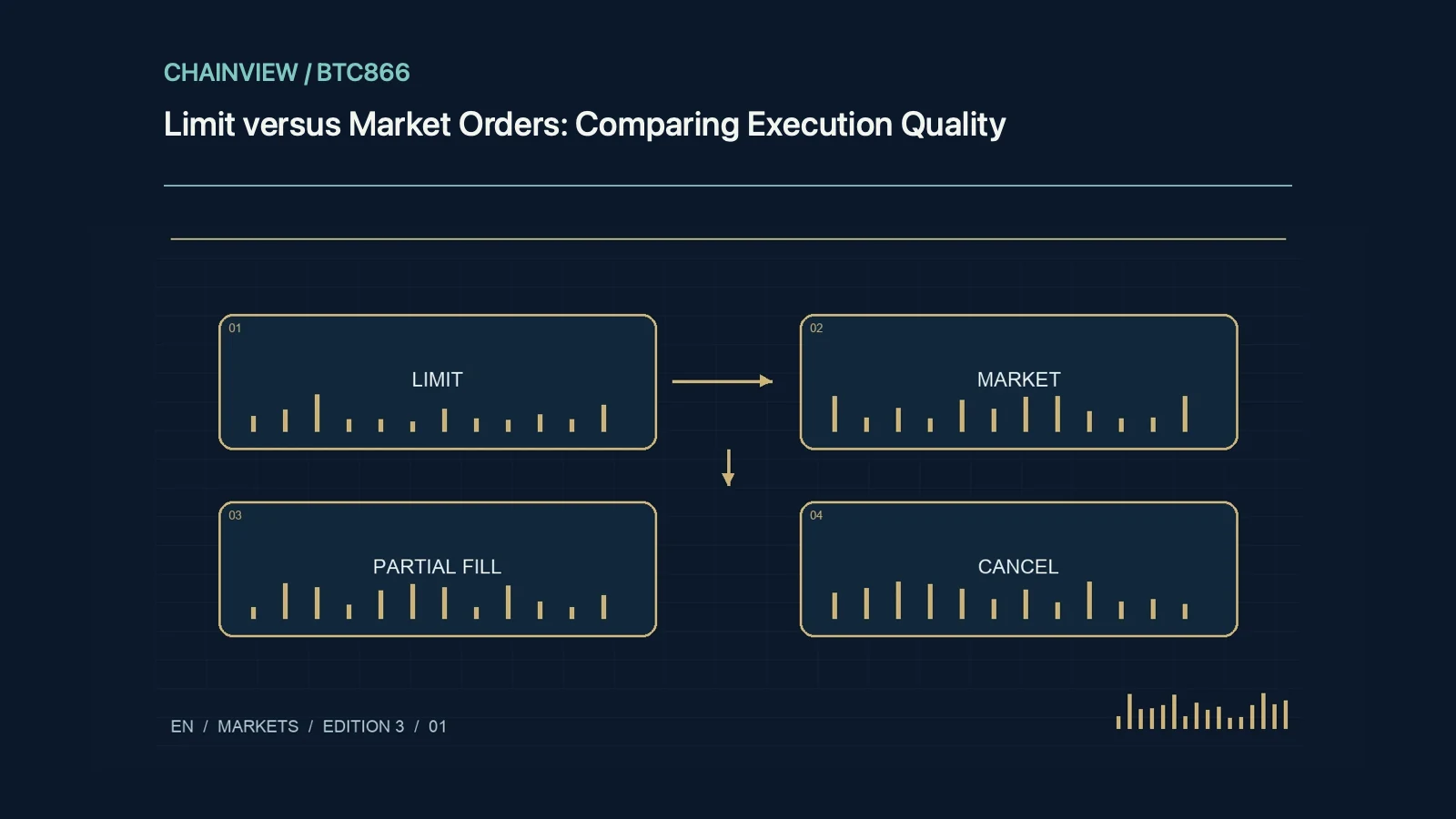
A limit order constrains the worst acceptable price; a market order seeks execution against available liquidity. Neither guarantees both price and completion. Venue-specific protection, time-in-force, and maker-only rules change outcomes. Define whether price or urgency matters most, then record size and validity. The best displayed quote may cover only a small quantity, so multiplying it by the entire order is not a reliable cost estimate.
Queue and partial fills
At one price, queue rules can determine who trades first. A touched limit may remain unfilled, and a partially filled order retains exposure through its remainder. Save each fill's time, price, size, and fee, then calculate the weighted average. Accepted means received, not filled. A cancellation request is not final cancellation; fills and cancel processing can race, requiring reconciliation against the venue's authoritative final state.
Compare complete execution costs
Assess spread, impact, explicit fees, waiting costs, and non-completion risk together. A cheaper maker fee can be outweighed by later chasing. A market order can consume several levels or be partially blocked by venue protections. Compare the same size against quotes available at the decision time. Otherwise later market movements can be misattributed to execution skill or the order type alone.
Build a simulated review log
Practice with historical books or simulation, documenting depth, volatility, estimated costs, fills, and residuals. If the best ask covers one tenth of the target, price the rest across deeper levels. For a limit, record waiting and non-fill costs. Simulated queue position is uncertain and historical feeds can omit cancellations. The exercise builds explicit intent and review discipline rather than proving one order type always wins.