Original topic illustration: ChainView BTC866 original topic diagram · ChainView BTC866 Editorial · CC BY 4.0
Address identity and real identity
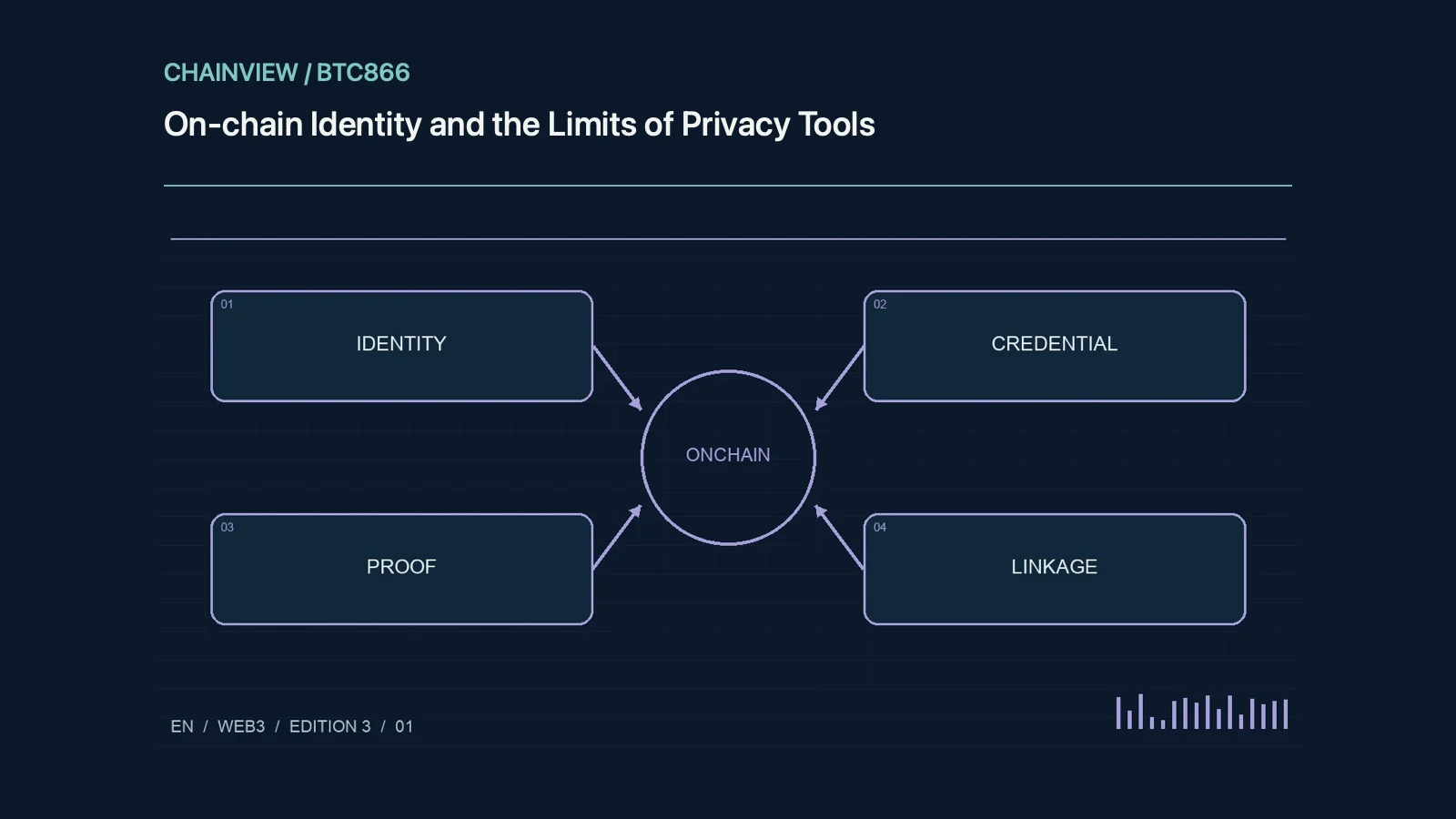
Addresses are pseudonyms, not guaranteed anonymity. Payment codes, screenshots, exchange records, and matching times or amounts can link them to people. Define which information should be hidden from which observer and what outside data that observer has. Renaming a profile or funding a new address directly from an old one may preserve linkage. A useful privacy claim specifies a threat model rather than promising to erase an already public ledger.
Credentials should disclose only needed facts
A credential can express eligibility or another attribute without repeatedly disclosing a full identity document. Issuer trust, revocation, expiry, and correction still matter; cryptographic verification does not prove every real-world statement true. Review selective disclosure and cross-service identifiers. Collect only the fields required for the purpose, while recognising that credential technology does not automatically remove applicable identity-verification duties or make every verification process legally interchangeable.
The scope of a zero-knowledge proof
A zero-knowledge proof protects a defined statement and witness under specified assumptions. Timing, network metadata, payment paths, and application logs may remain revealing. Inspect public inputs, setup assumptions, implementation, and frontend behaviour. Mathematical proof validity does not establish a clean device or absence of provider tracking. Assess on-chain and off-chain data together, identifying the information and parties that remain outside the proof's protection.
Practise minimum necessary disclosure
Inventory addresses, credential fields, signed messages, and provider records exposed by each interaction. Use non-sensitive test data. If an age check requests extensive financial records, examine purpose, retention, and policy before proceeding. Respect local rules and genuine eligibility. Privacy maintenance combines disclosure restraint, device security, and permission review; it cannot undo old transactions or provide permanent anonymity through one setting.