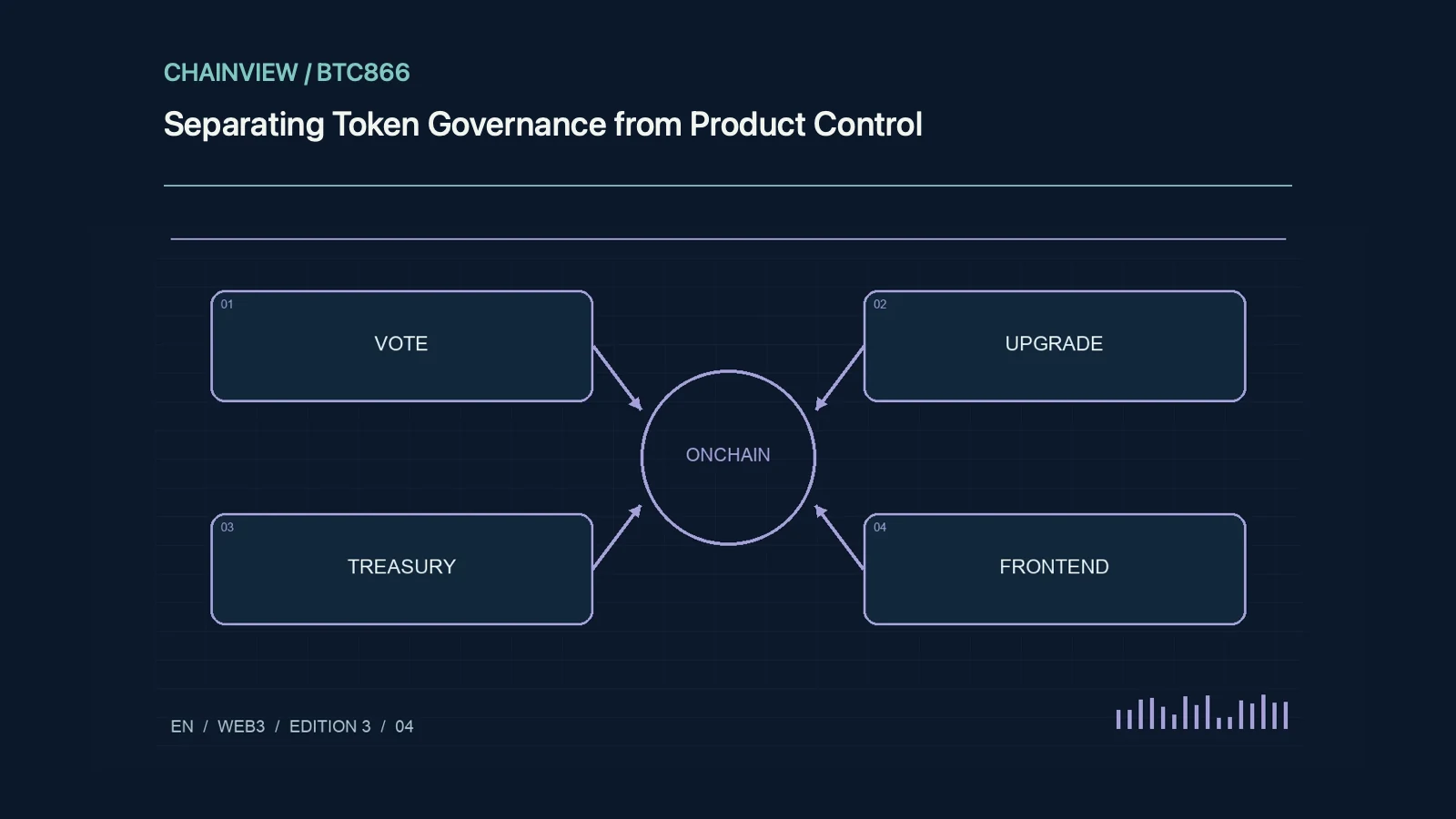
Original topic illustration: ChainView BTC866 original topic diagram · ChainView BTC866 Editorial · CC BY 4.0
Map several kinds of control
Token holders may propose or vote while upgrades, pauses, treasury transfers, domains, and legal entities remain separately controlled. Map each decision to actor, execution address, and constraints. A sentiment vote can be advisory; another action may execute on-chain without broad debate. Distributed token ownership does not by itself distribute operational control. Trace permissions through deployed contracts and organisational arrangements rather than relying on the governance label.
Thresholds and timelock scope
Proposal thresholds, quorum, approval ratio, delegation, and delays protect different stages. A timelock may cover ordinary upgrades while emergency powers bypass it. Signers can share one employer and lack independence. Record replacement, revocation, cancellation, and threshold-change powers. Historical execution helps explain practice, but absence of prior abuse is not a technical restriction on future abuse. Review both code permissions and human incentives.
Frontend and entity control
Frontends and APIs can change fees, access, or data collection without token votes. A live public contract does not guarantee a usable interface. Directors, equity, trademarks, and service terms can be independent of token governance; a vote is not automatically a share or profit right. Separate protocol, distribution, operations, and legal claims. Preserve verified documentation for legitimate access rather than relying on untrusted mirrors during an outage.
Review claims with a permission matrix
Build a matrix for proposals, upgrades, pauses, treasury, domains, data, and disputes, with controller, threshold, delay, evidence, and unknowns. If voters approve budgets but signers can independently move funds, do not describe complete community control. Cite contracts, charters, and execution transactions. Update the matrix when powers change. This makes governance benefits and limits understandable through verifiable responsibility rather than an abstract decentralisation claim.