Original topic illustration: ChainView BTC866 original topic diagram · ChainView BTC866 Editorial · CC BY 4.0
Identify the report type
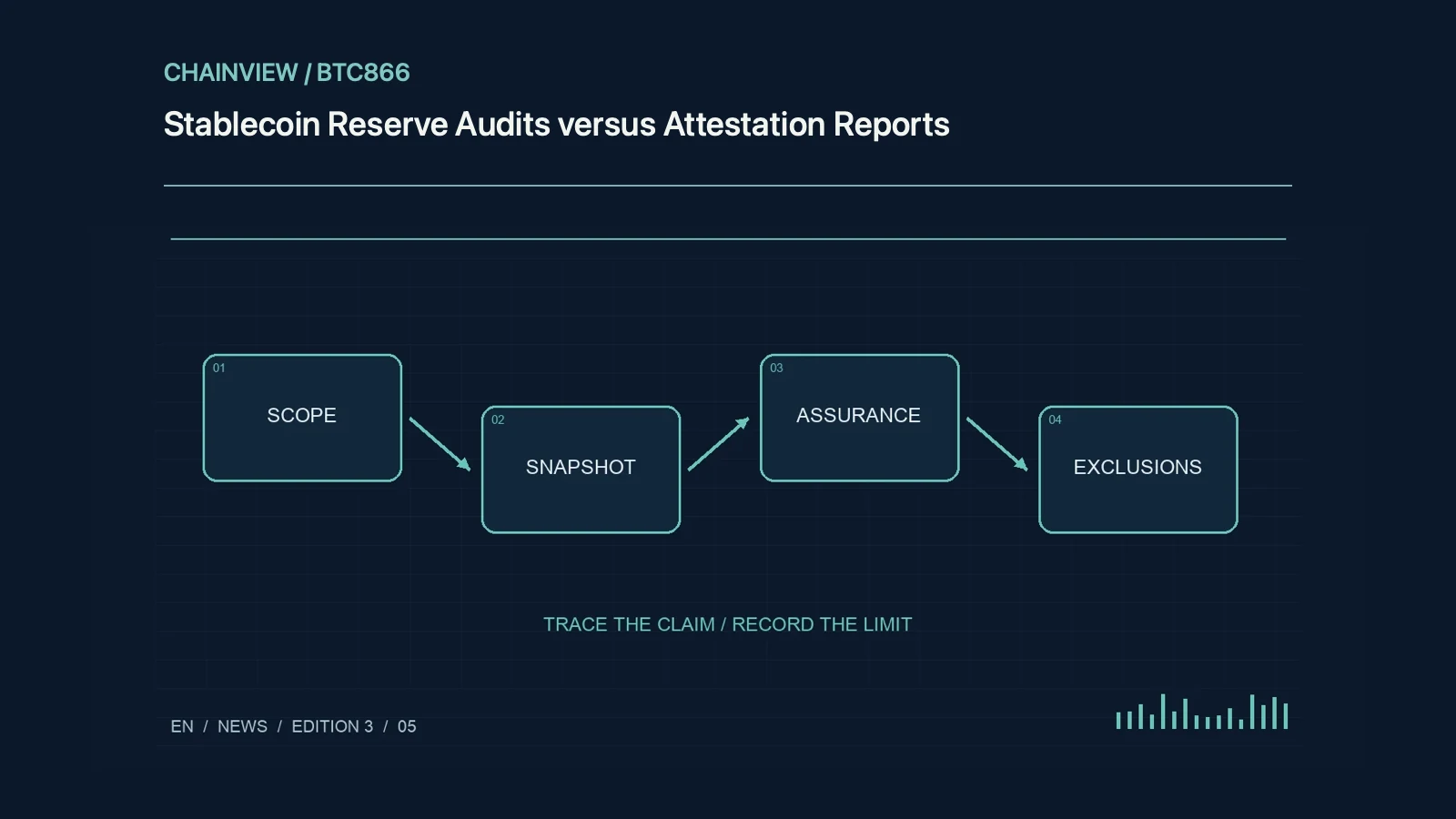
An audit, attestation, verification, and agreed-upon procedures engagement are not interchangeable. A financial-statement audit addresses specified statements under a framework; a reserve attestation may address only a point-in-time management assertion. Agreed-upon procedures can report findings without an overall assurance opinion. Read scope, standards, intended users, and exact conclusion before accepting a headline that extends beyond the engagement's actual subject matter.
Point-in-time assets and ongoing solvency
Assets exceeding tokens at one instant do not establish continuous backing or full solvency. Check ownership, custody, encumbrances, other liabilities, valuation, and redemption obligations. Temporary borrowing can alter a snapshot. Cash, government securities, and related-party receivables have different liquidity characteristics. Visible on-chain balances are useful evidence about those addresses, but cannot substitute for a complete balance sheet or proof that liabilities are fully captured.
Assurance level and limitations
Inspect assurance level, sampling, materiality, and management responsibility. Reasonable and limited assurance are different. An engagement may rely on custodial confirmations or management records while excluding controls, future redemption, or legal enforceability. Check qualifications, emphasis, use restrictions, and subsequent events. A reputable signatory does not endorse every business promise. Clearly identify questions the report never attempted to answer.
Create a cross-period comparison
Compare report date, measurement date, asset categories, liability definition, assurance, signatory, and exclusions. If a later report adds previously excluded assets, a higher total alone does not demonstrate improved safety. Separately review redemption eligibility, minimums, timing, and charges. Reporting should show evidence strength and gaps, preserving later corrections instead of treating the existence of any reserve report as proof of zero risk.